
\(n\) people can sit round a table in \((n - 1)!\) ways, not \(n!\). Moving everyone one seat round gives the same seating, because everyone keeps the same neighbours on the same sides.
Factorial
\(n! = n \times (n - 1) \times \dots \times 1\): the number of ways to put \(n\) people in a row.
\(4! = 24\), \(3! = 6\).
Circular arrangement
An order round a circle, where only the positions of the people relative to each other matter, not which chair.
No first seat, no last seat.
Why we divide by \(n\)
In a row, 4 people sit in \(4! = 24\) ways. Round a table, move everyone one seat clockwise: the picture changes, but A still has B on one side and D on the other, and so on for everyone. It is the same seating. Doing it four times brings everyone back:
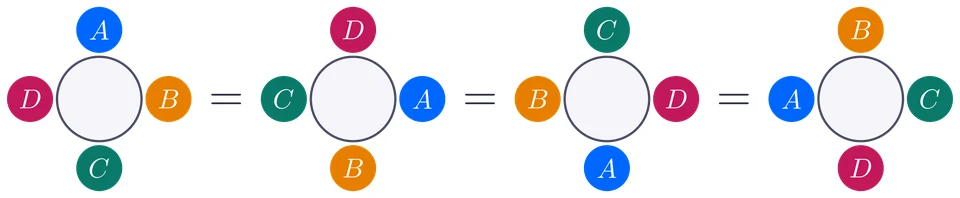
So each round-table seating appears 4 times among the 24 row orders:
\[ \text{seatings} = \frac{4!}{4} = 3! = 6, \qquad \text{in general } \frac{n!}{n} = (n - 1)!. \]
Or fix one person
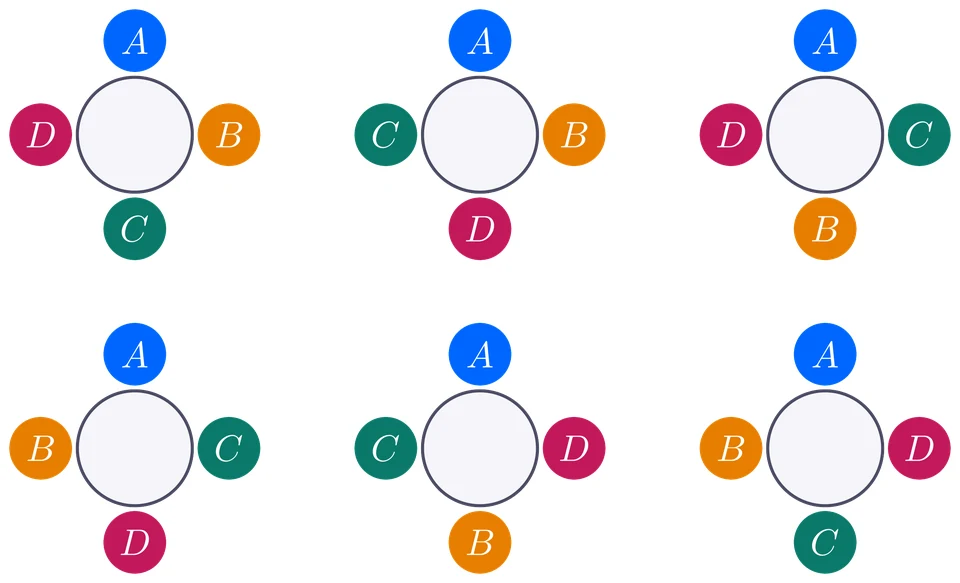
A second way to see it: since turning changes nothing, let A take any seat and count from there. The other three fill the three seats left, in order clockwise from A: \(3! = 6\) ways. Here are all six, A at the top.
Each is different from the others: in each, someone has a different neighbour, or a neighbour on the other side.
Careful
Clockwise and anticlockwise orders are different seatings: in ABCD (clockwise) B sits on one side of A, in ADCB on the other. But for a necklace or a garland, which can be turned over, the mirror image is the same object, so there are only \(\frac{(n - 1)!}{2}\) ways (for \(n \ge 3\)).
When the chairs are numbered
The \((n - 1)!\) rule assumes only who sits next to whom matters. If the chairs are numbered (or a seat is marked, like the head of the table), moving everyone one seat round does change the seating: each person is now in a different chair. Then all \(n!\) orders are different. Read the question for this.
Solved example
In how many ways can 6 people sit round a table? In how many of them do two friends, P and Q, sit together?
All seatings. \((6 - 1)! = 5! = 120\).
P and Q together. Tie them into one block: 5 units round the table, \((5 - 1)! = 24\) ways, and inside the block P, Q can swap: \(24 \times 2 = 48\).
120; 48
Key formulas
\[ \begin{aligned}n \text{ people in a row: } & n! & n \text{ people round a table: } & (n - 1)!\\[3pt] n \text{ beads on a necklace: } & \frac{(n - 1)!}{2} & \text{two together (round a table): } & (n - 2)! \times 2\end{aligned} \]
Practice set
Easy to hard. Try each one before you open its answer.
Quiz from the Short. In how many ways can 5 people sit round a table? (A) 120 (B) 60 (C) 24.
Show answer
(C) 24. \((5 - 1)! = 4! = 24\). Fix one person's seat; the other 4 fill the rest in \(4!\) ways. \(5! = 120\) counts each seating 5 times, once for each turn of the table.
How many different necklaces can be made from 7 different beads?
Show answer
360. \(\frac{(7 - 1)!}{2} = \frac{720}{2}\): a necklace can be turned over.
5 people sit round a table. In how many seatings are A and B together?
Show answer
12. A and B as one block: \((4 - 1)! = 6\), times 2 for their order.
In how many of those seatings are A and B not together?
Show answer
12. All seatings minus together: \(24 - 12\).
4 men and 4 women sit round a table, men and women alternating. How many seatings?
Show answer
144. Seat the men: \((4 - 1)! = 6\). The 4 gaps between them take the women in \(4! = 24\) ways: \(6 \times 24\).
8 people sit round a table. In how many seatings are two particular people not next to each other?
Show answer
3600. All: \(7! = 5040\). Together: \(6! \times 2 = 1440\). Not together: \(5040 - 1440\).