
A spring balance at rest reads the tension in its spring: the pull at one end. Pulled with 100 N at each end, it reads 100 N, not 200 N.
Tension
The pull a string, rope or spring passes along itself. In a light one at rest, it is the same all along.
Measured in newtons.
Spring balance
A spring with a scale. The stretch of the spring shows the tension in it.
Taken as light (no mass) in JEE problems.
One end on a wall
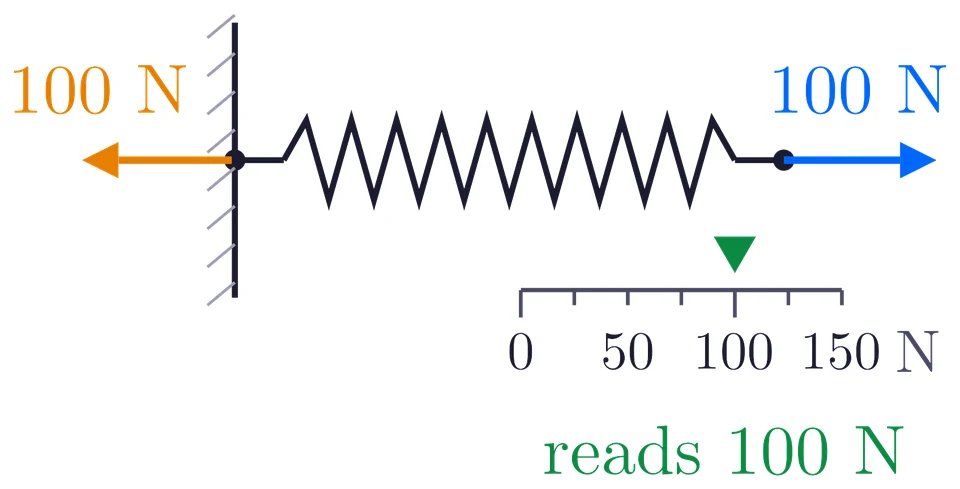
Tie the left end to a wall and pull the right end with 100 N. The balance stays at rest, so the forces on it balance: the wall must pull the left end back with 100 N. (It is also Newton's third law: the balance pulls the wall with 100 N, the wall pulls back with 100 N.)
The spring is pulled at both ends with 100 N, and the scale reads 100 N.
Why the reading is the pull at one end
Imagine cutting the spring anywhere. The piece on the right is at rest, with 100 N pulling it to the right, so the left piece must pull it with 100 N to the left. The force across every cut is 100 N: that is the tension, and the scale shows it. To read 200 N, the balance would need 200 N at each end.
A person in place of the wall
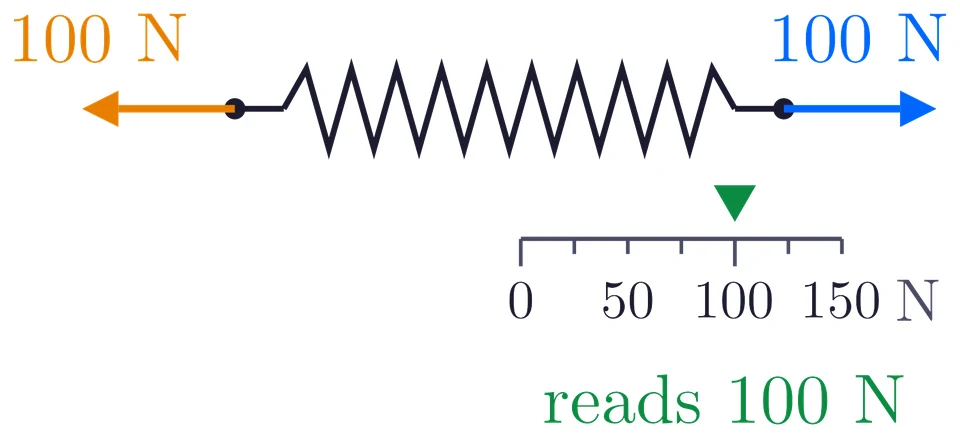
Now a person holds the left end and pulls with 100 N. The balance cannot tell a wall from a person: it feels the same two pulls, so it stretches the same and reads the same, 100 N.
This is the hook of the Short: 100 N at each end is exactly the wall case.
Careful
Two light balances hooked together in a line and pulled with 50 N at each end read 50 N each, not 25 N each and not 100 N: the same tension runs through both.
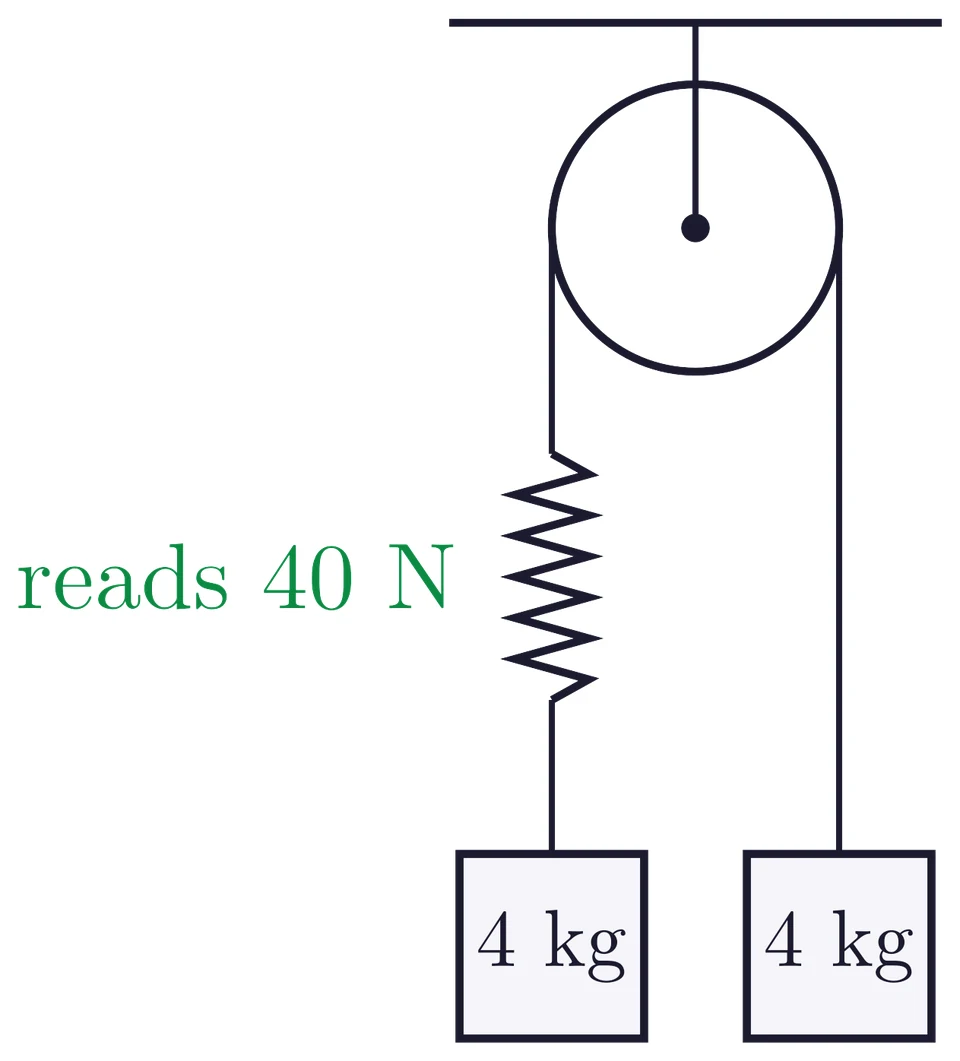
A balance in a string over a pulley, with 4 kg hanging on each side at rest, reads \(4 \times 10 = 40\) N, not 80 N. The string pulls each block up with 40 N; the balance feels 40 N at each of its ends, exactly the Short's case.
Solved example
A 5 kg block hangs from a spring balance fixed to the ceiling. What does it read? (\(g = 10\ \mathrm{m\,s^{-2}}\))
Forces on the balance. The block pulls down with \(mg = 50\) N; the ceiling pulls up with 50 N. One end's pull is 50 N.
50 N
Key formulas
\[ \begin{aligned}\text{light balance at rest: reading} &= \text{tension} = \text{pull at one end}\\[3pt] \text{Atwood machine (masses } m_1, m_2\text{): } T &= \frac{2 m_1 m_2 g}{m_1 + m_2}\end{aligned} \]
Practice set
Easy to hard. Take \(g = 10\ \mathrm{m\,s^{-2}}\); balances, strings and pulleys are light, pulleys frictionless. Try each one before you open its answer.
Quiz from the Short. Two people pull the ends of a spring balance, 50 N each way, and it is at rest. It reads: (A) 50 N (B) 100 N (C) 0 N.
Show answer
(A) 50 N. A spring balance reads the pull at one end. At rest, each end is pulled with 50 N, so the tension in the spring is 50 N: the same as one end tied to a wall and the other pulled with 50 N. 100 N adds two pulls that act on opposite ends.
A 2 kg mass hangs from a spring balance fixed to the ceiling. What does the balance read?
Show answer
20 N. \(mg = 2 \times 10\); the ceiling pulls the other end with 20 N.
Two spring balances hang one below the other, with a 3 kg mass at the bottom. What does each read?
Show answer
30 N each. The same tension, \(mg = 30\) N, runs through both light balances.
A string over a pulley carries 4 kg on each side, at rest, with a spring balance in the string. What does it read?
Show answer
40 N. Each side's string holds 4 kg at rest: tension \(40\) N. Not 80 N.
A spring balance is tied to a wall and pulled with 60 N. What does it read, and what force does the wall exert on it?
Show answer
60 N; 60 N towards the wall. At rest, the wall's pull balances yours.
Masses of 3 kg and 5 kg hang on either side of a pulley (an Atwood machine), with a balance in the string. What does it read while they move?
Show answer
37.5 N. \(T = \frac{2 \times 3 \times 5 \times 10}{3 + 5}\). Check: \(a = \frac{(5 - 3) \times 10}{8} = 2.5\ \mathrm{m\,s^{-2}}\) and \(3 \times (10 + 2.5) = 37.5\).