
At the top of a vertical throw the ball stops for an instant: \(v = 0\). Its acceleration is still \(g\), downward, as it is all the way up and down. Zero velocity does not mean zero acceleration.
Velocity
How fast, and which way, the ball is moving now.
Up is positive here.
Acceleration
How fast the velocity is changing: by how much each second.
Here \(-10\ \mathrm{m\,s^{-2}}\): the velocity drops by 10 m/s every second.
One throw, second by second
Throw a ball straight up at 20 m/s (\(g = 10\ \mathrm{m\,s^{-2}}\), no air resistance) and read its velocity every second:
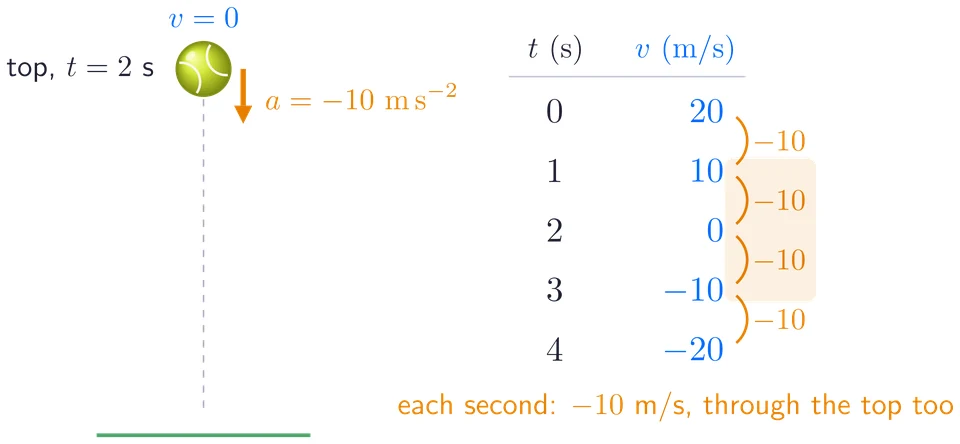
The velocity goes \(20, 10, 0, -10, -20\) m/s. From each second to the next it changes by the same step, \(-10\) m/s. The two steps through the top (from 1 s to 2 s and from 2 s to 3 s) are the same as the others: at 2 s the velocity passes zero without stopping to change. If the acceleration were zero at the top, the velocity would stay zero there and the ball would hang in the air. It falls, so its velocity is still changing. The acceleration is that step per second, \(-10\ \mathrm{m\,s^{-2}}\), at every instant.
The equations (up positive)
\[ {v} = u - gt, \qquad y = ut - \tfrac{1}{2}gt^2, \qquad t_{\text{top}} = \frac{u}{g}, \qquad H = \frac{u^2}{2g}. \]
At 20 m/s: the top comes at 2 s, at a height of 20 m.
The graph says it at once
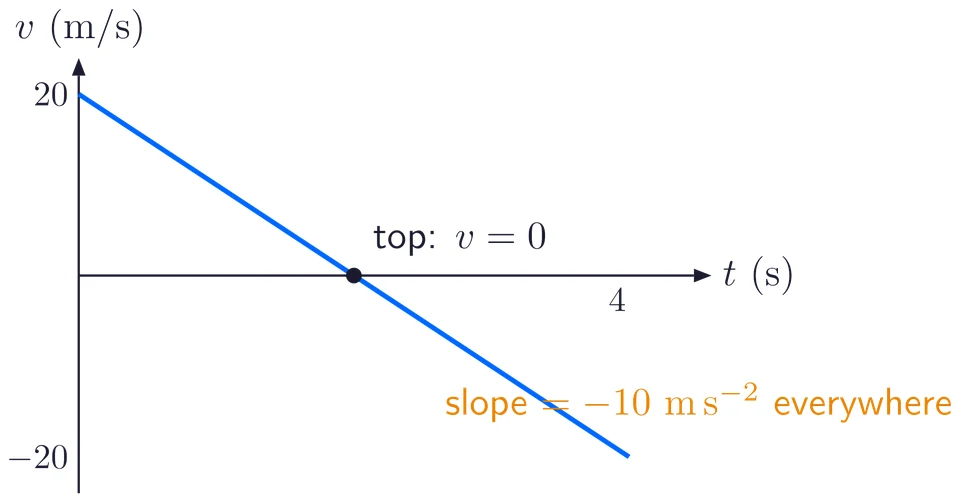
On a velocity-time graph the motion is one straight line. It crosses zero at the top, but its slope, the acceleration, is \(-10\ \mathrm{m\,s^{-2}}\) at every point, the top included.
Why \(a\) cannot be zero at the top
If \(a\) were zero there, the velocity would stop changing. It is zero at that instant, so it would stay zero, and the ball would hang in the air for ever. It falls back because gravity is still pulling: \(a = g\) downward.
Careful
"At the highest point the net force is zero" is false: the force on the ball is \(mg\) downward the whole time. The same trap appears wherever something stops to turn back: a pendulum at the end of its swing, or a block on a spring at its farthest point, has \(v = 0\) but \(a \ne 0\).
Solved example
A ball is thrown straight up at 30 m/s. Find the time to the top, the greatest height, and the velocity and acceleration at the top. Take \(g = 10\ \mathrm{m\,s^{-2}}\).
Time. \(t = \frac{u}{g} = \frac{30}{10} = 3\) s. Height. \(H = \frac{u^2}{2g} = \frac{900}{20} = 45\) m.
At the top. \(v = 0\), and \(a = 10\ \mathrm{m\,s^{-2}}\) downward.
3 s, 45 m; \(v = 0\), \(a = g\) downward
Key formulas
\[ \begin{aligned}v &= u - gt & y &= ut - \tfrac{1}{2}gt^2 & v^2 &= u^2 - 2gy\\[3pt] t_{\text{top}} &= \frac{u}{g} & H &= \frac{u^2}{2g} & a &= -g\ \text{at every instant}\end{aligned} \]
Practice set
Easy to hard. Take \(g = 10\ \mathrm{m\,s^{-2}}\) and no air resistance. Try each one before you open its answer.
Quiz from the Short. At the top of the throw, the net force on the ball (mass \(m\)) is:
(A) \(0\) (B) \(mg\), downward (C) \(mg\), upward.Show answer
(B) \(mg\), downward. At the top \(v = 0\), but \(a = g\) downward, as at every instant of the flight. So the net force is \(F = ma = mg\), downward. It is not zero: if it were, the ball would stay at the top.
A ball is thrown up at 15 m/s. Find the time to the top and the greatest height.
Show answer
1.5 s, 11.25 m. \(t = \frac{15}{10}\), \(H = \frac{225}{20}\).
One second after the top, what are the ball's velocity and acceleration?
Show answer
10 m/s downward; \(10\ \mathrm{m\,s^{-2}}\) downward. The velocity has changed by \(-10\) m/s from zero; the acceleration never changes.
A ball is thrown up at 20 m/s. Where is it at \(t = 3\) s, and how fast is it moving?
Show answer
15 m up, moving 10 m/s downward. \(y = 20 \times 3 - 5 \times 9 = 15\) m; \(v = 20 - 30 = -10\) m/s.
A swinging pendulum stops for an instant at its highest point. Is its acceleration there zero?
Show answer
No, it is not zero. At the highest point \(v = 0\), but gravity still pulls the bob back along its path: the acceleration is \(g \sin \theta_0\) along the arc, where \(\theta_0\) is the angle from the vertical. That is why it swings back.
A ball is thrown up at 25 m/s. How long is it in the air before it returns to the hand?
Show answer
5 s. Up for \(\frac{u}{g} = 2.5\) s, and the same time down.