
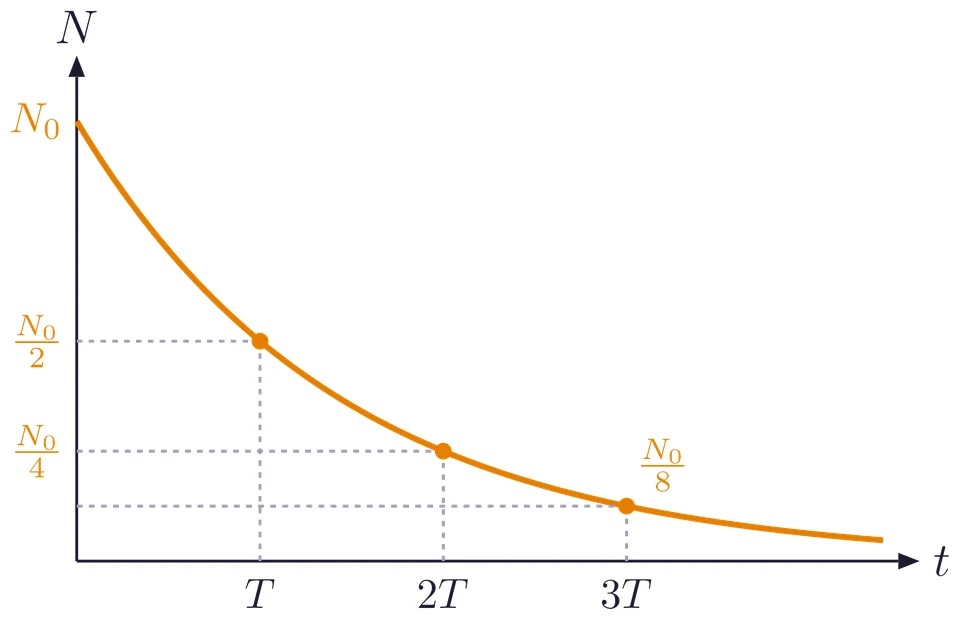
Each half-life halves what is left, not what you started with. After two half-lives a quarter remains, after three an eighth: \(N = \dfrac{N_0}{2^n}\) after \(n\) half-lives.
Half-life \(T_{1/2}\)
The time in which half of the nuclei present decay. It is the same whatever amount you start with.
For a sample, a reaction, a drug in the blood.
Decay constant \(\lambda\)
The chance per unit time that one nucleus decays. Larger \(\lambda\), faster decay.
\(T_{1/2} = \dfrac{\ln 2}{\lambda} \approx \dfrac{0.693}{\lambda}\).
Halving what is left
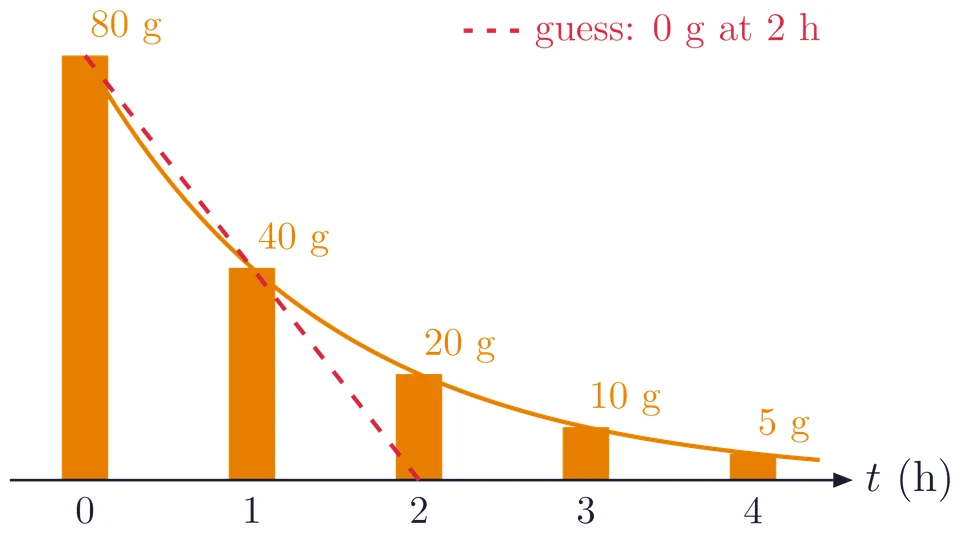
Take 80 g of a radioactive substance with a half-life of 1 hour. In the first hour half of it decays: 40 g left. In the next hour half of what is left decays, that is 20 g, not another 40 g: 20 g left, not zero. Then 10 g, 5 g, and so on. The amount that decays in each hour gets smaller, because there is less left to decay.
The red line is the common guess: 40 g in each hour, so nothing left at 2 hours. It agrees with the truth at 1 hour and fails after that. Decay is random for each nucleus, but 80 g holds more than \(10^{23}\) nuclei, so the halving holds very closely.
The law
\[ N = N_0\,e^{-\lambda t} = N_0 \left(\frac{1}{2}\right)^{n}, \qquad n = \frac{t}{T_{1/2}} \text{ (the number of half-lives)}. \]
The decay curve
Plot \(N\) against \(t\). Every step of one half-life cuts the height in half, so the curve falls fast at first and then more and more slowly. The law never gives zero: each half-life leaves half of what was there.
The same law runs a first-order reaction in chemistry: the concentration halves every \(t_{1/2} = \frac{0.693}{k}\), whatever it started at.
Careful
"Half decays in 1 hour, so all of it is gone in 2 hours" treats the second half as decaying at the same rate as the first. But in the second hour only half of what is left decays: \(\frac{N_0}{2} \to \frac{N_0}{4}\). After 2 hours a quarter is still there.
Solved example
A sample of 80 g has a half-life of 5 days. How much is left after 15 days?
Count half-lives. \(n = \frac{15}{5} = 3\).
Halve three times. \(80 \to 40 \to 20 \to 10\), that is \(80 \times \left(\frac{1}{2}\right)^3\).
10 g
Key formulas
\[ \begin{aligned}N &= N_0\left(\tfrac{1}{2}\right)^{n} = \frac{N_0}{2^n} & n &= \frac{t}{T_{1/2}}\\[3pt] N &= N_0\,e^{-\lambda t} & T_{1/2} &= \frac{\ln 2}{\lambda} \approx \frac{0.693}{\lambda}\\[3pt] \text{fraction decayed} &= 1 - \frac{1}{2^n} & \text{first-order reaction: } t_{1/2} &= \frac{0.693}{k}\end{aligned} \]
Practice set
Easy to hard. Try each one before you open its answer.
Quiz from the Short. A sample has a half-life of 2 days. After 6 days, the fraction left is: (A) \(\dfrac{1}{6}\) (B) \(\dfrac{1}{8}\) (C) \(0\).
Show answer
(B) \(\dfrac{1}{8}\). 6 days are 3 half-lives: \(\dfrac{1}{2} \times \dfrac{1}{2} \times \dfrac{1}{2} = \dfrac{1}{8}\). Each half-life halves what is left, so after 6 days \(\dfrac{1}{8}\) is still there, not \(0\).
A sample has a half-life of 2 hours. How long until only \(\frac{1}{8}\) of it is left?
Show answer
6 hours. \(\frac{1}{8} = \left(\frac{1}{2}\right)^3\): three half-lives of 2 hours.
What fraction of a sample has decayed after 3 half-lives?
Show answer
\(\frac{7}{8}\). Left: \(\frac{1}{8}\). Decayed: \(1 - \frac{1}{8}\).
A first-order reaction has \(k = 0.0693\ \mathrm{min^{-1}}\). Find its half-life.
Show answer
10 min. \(t_{1/2} = \frac{0.693}{0.0693}\).
What fraction of a sample is left after 2.5 half-lives?
Show answer
about 0.177. \(\left(\frac{1}{2}\right)^{2.5} = \frac{1}{4\sqrt{2}}\). A half-life count need not be a whole number.
Samples A (\(T_{1/2} = 1\) h) and B (\(T_{1/2} = 2\) h) start with the same number of nuclei. Find \(\frac{N_A}{N_B}\) after 4 hours.
Show answer
\(\frac{1}{4}\). A: 4 half-lives, \(\frac{1}{16}\). B: 2 half-lives, \(\frac{1}{4}\). Ratio \(\frac{1}{16} \div \frac{1}{4}\).