
Thrown at the same speed from level ground (no air resistance), the angles \(\theta\) and \(90^\circ - \theta\) land at the same distance. The range depends on \(\sin 2\theta\), and \(\sin 2\theta = \sin(180^\circ - 2\theta)\).
Range
The horizontal distance a projectile covers before it comes back to the height it was thrown from.
Written \(R\).
Complementary angles
Two angles that add up to \(90^\circ\), like \(30^\circ\) and \(60^\circ\), or \(15^\circ\) and \(75^\circ\).
\(\theta\) and \(90^\circ - \theta\).
Where the range formula comes from
Launch at speed \(u\), angle \(\theta\). Sideways the speed \(u\cos\theta\) never changes; upwards it starts at \(u\sin\theta\) and gravity slows it.
Time, height, range
\[ T = \frac{2u\sin\theta}{g}, \qquad H = \frac{u^2\sin^2\theta}{2g}, \]
\[ \begin{aligned}R &= u\cos\theta \times T\\ &= \frac{2u^2\sin\theta\cos\theta}{g} = \frac{u^2\sin 2\theta}{g}.\end{aligned} \]
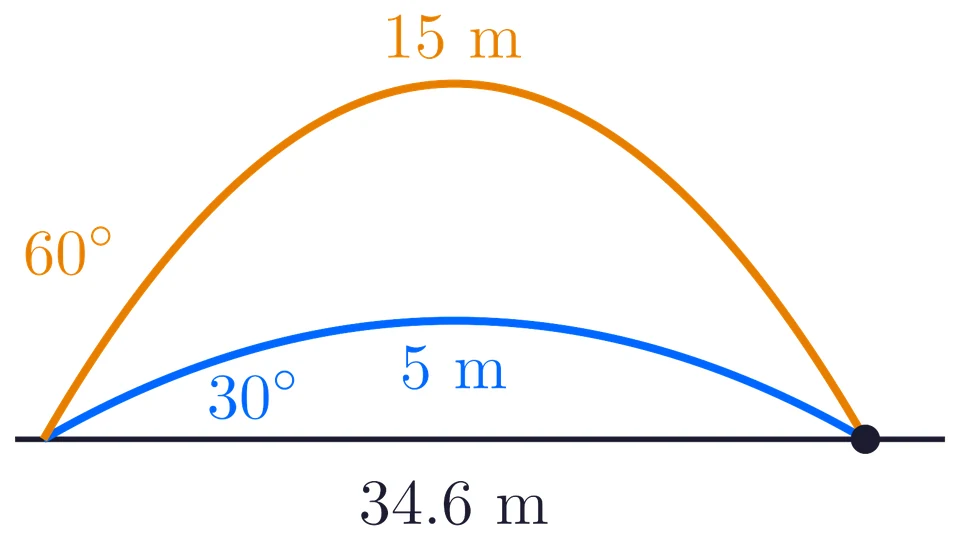
With \(u = 20\) m/s and \(g = 10\ \mathrm{m\,s^{-2}}\): \({30^\circ}\) gives \(R = 40\sin 60^\circ = 20\sqrt{3} \approx 34.6\) m, and so does \({60^\circ}\).
Why the pair lands together
For the angle \(90^\circ - \theta\),
\[ \sin 2(90^\circ - \theta) = \sin(180^\circ - 2\theta) = \sin 2\theta, \]
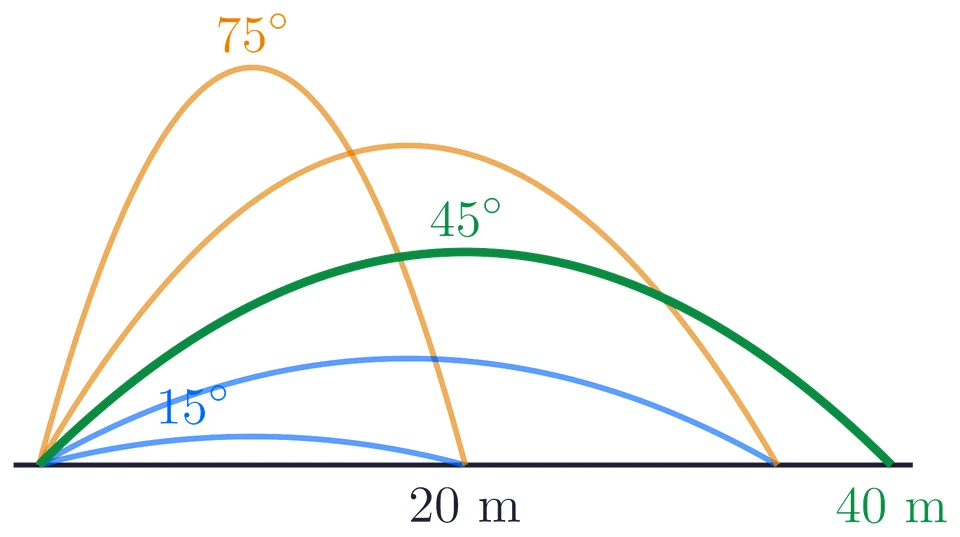
so \(R\) is the same. The largest range is at \(\theta = 45^\circ\), where \(\sin 2\theta = 1\): \(R_{\max} = \frac{u^2}{g} = 40\) m at 20 m/s. Every other range is reached by two angles, one on each side of \(45^\circ\): below, \({15^\circ}\) and \({75^\circ}\) land together at 20 m.
Careful
Same range does not mean the same flight. The higher angle climbs higher and stays up longer: at 20 m/s, \({30^\circ}\) rises to 5 m in 2 s of flight, \({60^\circ}\) to 15 m in \(2\sqrt{3} \approx 3.46\) s. And the rule needs level ground and no air: thrown from a cliff, or with drag, the two ranges differ.
Solved example
At 20 m/s, a ball thrown at \(20^\circ\) lands 25.7 m away. At what other angle does a ball thrown at the same speed land at the same point?
Pair it. The complementary angle: \(90^\circ - 20^\circ = 70^\circ\).
Check. \(R = 40\sin 40^\circ \approx 25.7\) m, and \(40\sin 140^\circ = 40\sin 40^\circ\).
\(70^\circ\)
Key formulas
\[ \begin{aligned}T &= \frac{2u\sin\theta}{g} & H &= \frac{u^2\sin^2\theta}{2g} & R &= \frac{u^2\sin 2\theta}{g}\\[3pt] R(\theta) &= R(90^\circ - \theta) & R_{\max} &= \frac{u^2}{g}\ (\theta = 45^\circ) & T_1 T_2 &= \frac{2R}{g}\ \text{(a pair)}\end{aligned} \]
Practice set
Easy to hard. Take \(g = 10\ \mathrm{m\,s^{-2}}\), level ground, no air resistance. Try each one before you open its answer.
Quiz from the Short. At the same speed, on level ground with no air, which angle gives the same range as \(20^\circ\)? (A) \(40^\circ\) (B) \(80^\circ\) (C) \(70^\circ\).
Show answer
(C) \(70^\circ\). \(R = \dfrac{u^2 \sin 2\theta}{g}\), and \(\sin 140^\circ = \sin 40^\circ\), so \(70^\circ\) and \(20^\circ\) give the same range: the two angles add to \(90^\circ\). Doubling the angle to \(40^\circ\) gives \(\sin 80^\circ\), a longer range.
A ball is thrown at 10 m/s at \(30^\circ\). Find its range.
Show answer
\(5\sqrt{3} \approx 8.66\) m. \(R = \frac{10^2 \sin 60^\circ}{10} = 10 \times \frac{\sqrt{3}}{2}\).
Find the greatest range for a launch speed of 30 m/s, and the angle that gives it.
Show answer
90 m, at \(45^\circ\). \(R_{\max} = \frac{u^2}{g} = \frac{900}{10}\).
A ball thrown at 20 m/s lands 20 m away. Find the two possible angles.
Show answer
\(15^\circ\) or \(75^\circ\). \(20 = \frac{400\sin 2\theta}{10}\) gives \(\sin 2\theta = \frac{1}{2}\), so \(2\theta = 30^\circ\) or \(150^\circ\).
Two balls are thrown at the same speed at \(30^\circ\) and \(60^\circ\). Find the ratio of their greatest heights.
Show answer
\(1 : 3\). \(H \propto \sin^2\theta\): \(\frac{\sin^2 30^\circ}{\sin^2 60^\circ} = \frac{1}{4} \div \frac{3}{4} = \frac{1}{3}\). (5 m and 15 m at 20 m/s.)
For a pair of angles that give the same range \(R\), show that the product of the two times of flight is \(\frac{2R}{g}\). Check it for 20 m/s at \(30^\circ\) and \(60^\circ\).
Show answer
\(T_1 T_2 = \frac{2R}{g}\). \(T_1 T_2 = \frac{2u\sin\theta}{g} \cdot \frac{2u\cos\theta}{g} = \frac{2}{g} \cdot \frac{u^2\sin 2\theta}{g}\). Check: \(2 \times 2\sqrt{3} = 4\sqrt{3} \approx 6.93\), and \(\frac{2 \times 20\sqrt{3}}{10}\) is the same.