
To find the probability of at least one, find the probability of none and subtract it from 1: \(P(\text{at least one}) = 1 - P(\text{none})\). Adding the probabilities of the separate events counts the results they share more than once.
Complement
The opposite event: every result that is not in \(A\). Written \(A'\) or \(\bar{A}\).
\(P(A) + P(A') = 1\).
Independent rolls
Rolls that do not affect each other, like the separate dice here.
Probability that all of them happen: multiply.
Two dice: why adding goes wrong
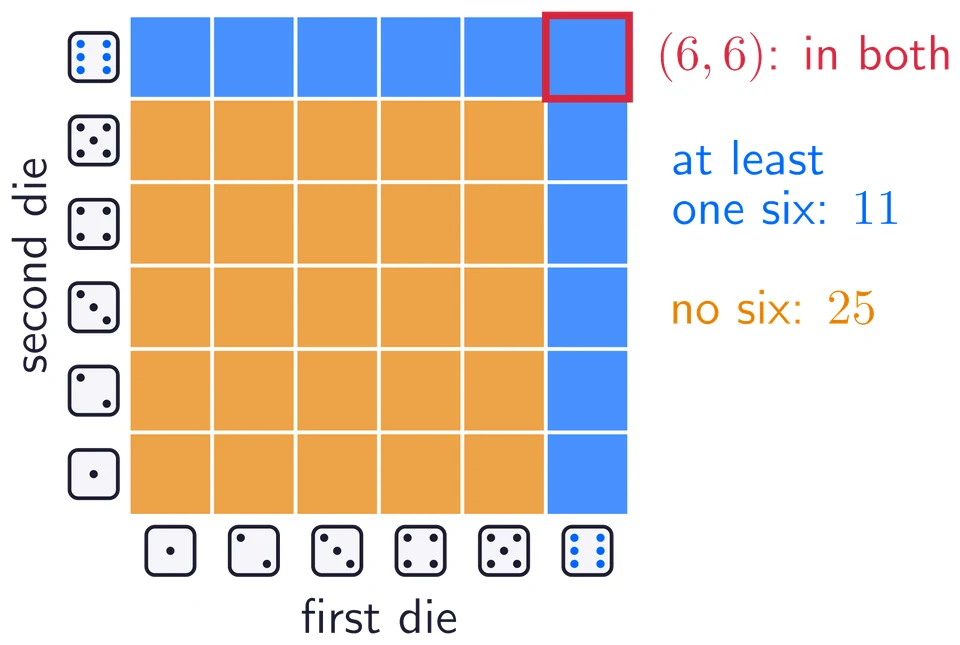
Two fair dice have 36 equally likely results, one square each in the grid. A six on the first die is the right column: 6 squares, so \({\frac{1}{6}}\). A six on the second die is the top row: 6 squares, again \({\frac{1}{6}}\).
Adding gives \(\frac{1}{6} + \frac{1}{6} = \frac{12}{36}\), which counts 12 squares. But the square \((6, 6)\) is in the column and in the row, so it is counted twice. Only 11 squares have a six:
\[ P(\text{at least one six}) = \frac{1}{6} + \frac{1}{6} - \frac{1}{36} = \frac{11}{36}. \]
Count the opposite
"At least one six" fails only when neither die shows a six. Then the first die is 1 to 5 and the second die is 1 to 5: the \(5 \times 5\) block, 25 squares. Every other square has a six.
No six on two dice
\[ P(\text{no six}) = {\frac{25}{36}} = {\left(\tfrac{5}{6}\right)^2}, \qquad P(\text{at least one six}) = 1 - \frac{25}{36} = \frac{11}{36}. \]
The subtraction needs no care about overlaps: the opposite event is one simple block.
Three dice: the cube
With a third die the 216 results are the small cubes of a \(6 \times 6 \times 6\) cube (left). No six on any die is the \(5 \times 5 \times 5\) corner cube, 125 results (right), so \(P(\text{no six}) = {\left(\frac{5}{6}\right)^3}\). The rest have at least one six:
\[ 216 - 125 = 91, \qquad P(\text{at least one six}) = 1 - \left(\tfrac{5}{6}\right)^3 = \frac{91}{216}. \]
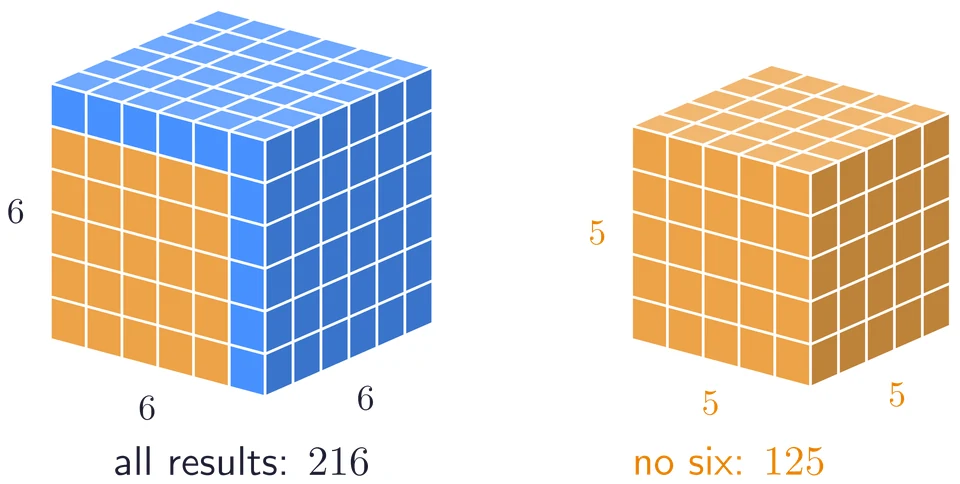
Counted directly, those 91 results split three ways: first die 6 (36); first die not 6 and second die 6 (30); first two not 6 and third die 6 (25). The opposite is one product. For \(n\) rolls, \(P(\text{at least one six}) = 1 - \left(\frac{5}{6}\right)^n\); for 4 rolls it is \(1 - \frac{625}{1296} = \frac{671}{1296} \approx 0.52\). Adding would give \(\frac{n}{6}\), a sure six at six rolls: false, because all six rolls can miss.
Careful
"At least one six" is not "exactly one six". Exactly one six in 4 rolls means one roll is a six and three miss, and the six can be any of the 4 rolls:
\[ 4 \times \tfrac{1}{6} \times \left(\tfrac{5}{6}\right)^3 = \tfrac{500}{1296} = \tfrac{125}{324} \approx 0.39. \]
Solved example
A coin is tossed 3 times. Find the probability of at least one head.
The opposite. No head means three tails: \(\left(\frac{1}{2}\right)^3 = \frac{1}{8}\).
Subtract. \(1 - \frac{1}{8} = \frac{7}{8}\).
\(\frac{7}{8}\)
(adding would give \(\frac{3}{2}\), more than 1)
Key formulas
\[ \begin{aligned}P(\text{at least one}) &= 1 - P(\text{none})\\[3pt] \text{independent events: } P(\text{all of them}) &= \text{the product of their probabilities}\\[3pt] \text{probability } p \text{ each, } n \text{ tries: } P(\text{at least one}) &= 1 - (1 - p)^n\\[3pt] P(\text{exactly one}) &= n\,p\,(1 - p)^{n - 1}\end{aligned} \]
Practice set
Easy to hard. Try each one before you open its answer.
Quiz from the Short. Two coins are tossed. The probability of at least one head is: (A) \(1\) (B) \(\dfrac{3}{4}\) (C) \(\dfrac{1}{4}\).
Show answer
(B) \(\dfrac{3}{4}\). \(P(\text{no head}) = \dfrac{1}{2} \times \dfrac{1}{2} = \dfrac{1}{4}\), so \(P(\text{at least one head}) = 1 - \dfrac{1}{4} = \dfrac{3}{4}\). Check by listing HH, HT, TH, TT: three of the four have a head. (A) adds \(\dfrac{1}{2} + \dfrac{1}{2}\) and counts HH twice; (C) is the probability of no head.
Two dice are rolled. Find the probability that at least one of them shows a 1 or a 2.
Show answer
\(\frac{5}{9}\). One die shows neither 1 nor 2 with probability \(\frac{4}{6}\); both dice: \(\left(\frac{4}{6}\right)^2 = \frac{16}{36}\). So \(1 - \frac{16}{36} = \frac{20}{36} = \frac{5}{9}\) (20 of the 36 squares).
A die is rolled 4 times. Find the probability of exactly one six.
Show answer
\(\frac{125}{324}\). \(4 \times \frac{1}{6} \times \left(\frac{5}{6}\right)^3 = \frac{500}{1296} = \frac{125}{324}\) (500 of the 1296 results have exactly one six).
What is the least number of rolls of a die for which the probability of at least one six is more than \(\frac{1}{2}\)?
Show answer
4 rolls. 3 rolls: \(1 - \frac{125}{216} = \frac{91}{216}\), less than \(\frac{1}{2}\). 4 rolls: \(\frac{671}{1296}\), more than \(\frac{1}{2}\).
A shooter hits a target with probability \(0.3\) on each shot. Find the probability of at least one hit in 3 shots.
Show answer
\(0.657\). No hit in 3 shots: \(0.7^3 = 0.343\). \(1 - 0.343 = 0.657\).
For the same shooter, find the least number of shots that makes the probability of at least one hit at least \(0.9\).
Show answer
7 shots. Need \(0.7^n \le 0.1\). \(0.7^6 \approx 0.118\) is too big; \(0.7^7 \approx 0.082\) is enough.