
Static friction is as large as it needs to be to stop sliding, and no larger. It matches the push, up to its limit \(\mu_s N\). It is not always \(\mu_s N\).
Static friction
The friction on a body that is not sliding. It takes whatever value keeps the body at rest.
Its largest value is \(\mu_s N\).
Normal force \(N\)
The push of the surface on the body, at right angles to the surface.
On a level floor with no other vertical force, \(N = mg\).
The block in the Short
A 10 kg block rests on a floor with \(\mu_s = 0.5\); take \(g = 10\ \mathrm{m\,s^{-2}}\).
The limit
\(N = mg = 100\) N, so the most static friction can give is
\[ \mu_s N = 0.5 \times 100 = {50\ \mathrm{N}}. \]
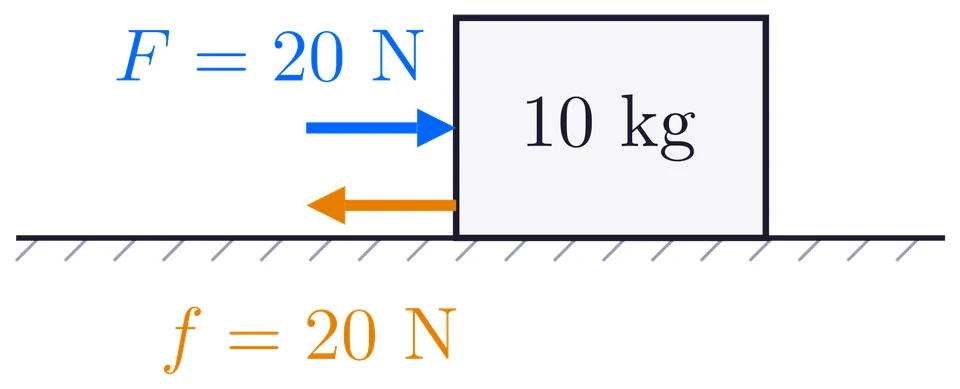
Push with \(F = 20\) N. The block does not move, so the forces on it balance:
\[ {f} = {F} = 20\ \mathrm{N}. \]
Not 50 N: friction only matches what is trying to move the block.
Why friction cannot be 50 N here
If friction were 50 N against a 20 N push, the net force would be 30 N backwards, and the block would start sliding towards the person pushing it. Static friction opposes sliding between the two surfaces; it can never start the block sliding the other way. So at rest it takes exactly the value that balances the push.
The whole story in one graph
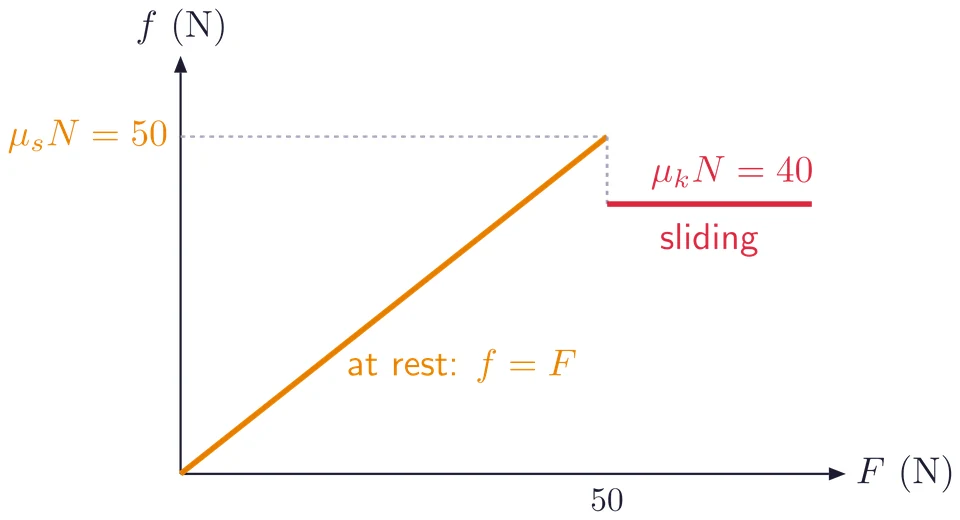
As the push grows from zero, friction grows with it, equal to it, until it reaches \(\mu_s N\). Push past that and the block slides; friction then becomes kinetic, \(\mu_k N\), which is usually a little smaller (here \(\mu_k = 0.4\), so 40 N).
Careful
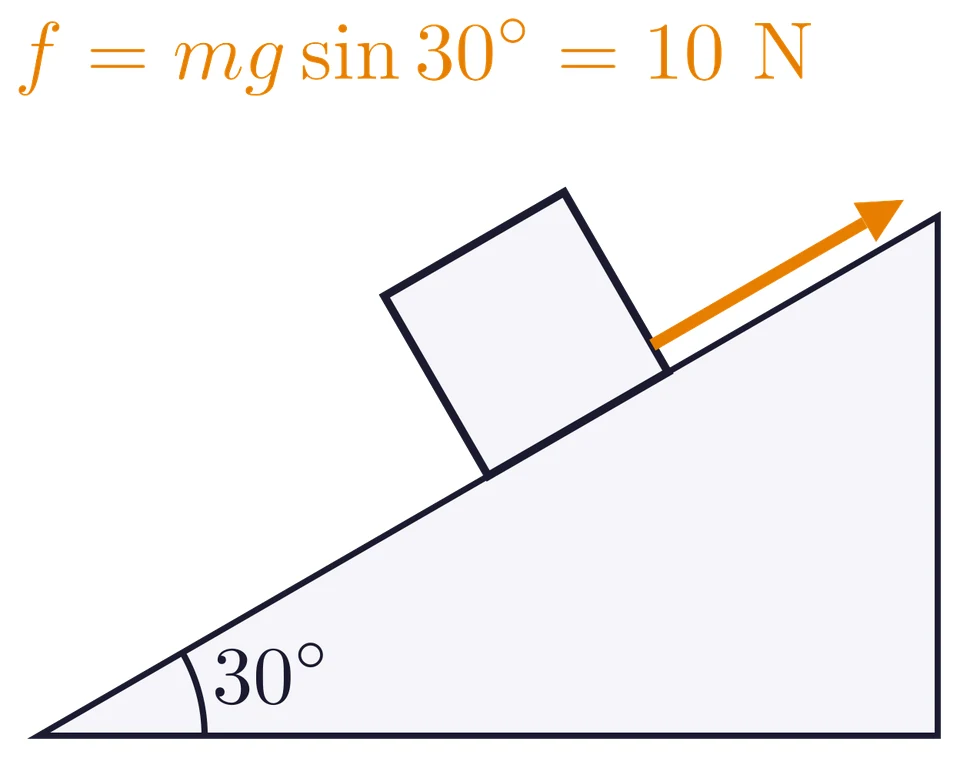
On an incline the same trap appears. A 2 kg block rests on a \(30^\circ\) slope with \(\mu_s = 0.7\). Friction is not \(\mu_s mg\cos 30^\circ \approx 12.12\) N. It only has to hold the block against the pull down the slope:
\[ f = mg\sin 30^\circ = 2 \times 10 \times \tfrac{1}{2} = 10\ \mathrm{N}. \]
\(12.12\) N is only the limit; the block stays because \(10 < 12.12\).
Solved example
The same 10 kg block (\(\mu_s = 0.5\), \(\mu_k = 0.4\)) is pushed with 35 N, then with 60 N. Find the friction each time.
35 N. The limit is 50 N and \(35 < 50\), so the block stays at rest: \(f = 35\) N.
60 N. \(60 > 50\), so the block slides: \(f = \mu_k N = 0.4 \times 100 = 40\) N.
35 N, then 40 N
Key formulas
\[ \begin{aligned}\text{at rest: } f &= \text{the force trying to slide the body}, & f &\le \mu_s N\\[3pt] \text{sliding: } f &= \mu_k N & \text{level floor: } N &= mg\end{aligned} \]
Practice set
Easy to hard. Take \(g = 10\ \mathrm{m\,s^{-2}}\). Try each one before you open its answer.
Quiz from the Short. A box on a level floor starts sliding when it is pushed horizontally with 50 N. It is pushed with 20 N. The friction on it is: (A) 20 N (B) 50 N (C) 0 N.
Show answer
(A) 20 N. The largest static friction is 50 N, and 20 N is less, so the box stays at rest. At rest the forces balance: friction matches the push, 20 N. 50 N is only the limit.
A 5 kg block rests on a level floor with \(\mu_s = 0.4\) and \(\mu_k = 0.3\). It is pushed horizontally with 25 N. Find the friction.
Show answer
15 N (kinetic). \(N = 50\) N, so the limit is \(\mu_s N = 0.4 \times 50 = 20\) N. \(25 > 20\), so the block slides: \(f = \mu_k N = 0.3 \times 50 = 15\) N.
Find the least horizontal force that starts a 20 kg box moving if \(\mu_s = 0.25\).
Show answer
50 N. It starts when the push just exceeds \(\mu_s N = 0.25 \times 200 = 50\) N.
A 2 kg block rests on a \(30^\circ\) incline with \(\mu_s = 0.7\). Find the friction on it.
Show answer
10 N, up the slope. \(f = mg\sin 30^\circ = 10\) N. The limit \(\mu_s mg\cos 30^\circ = 7\sqrt{3} \approx 12.12\) N is larger, so the block stays at rest.
A 1 kg book is pressed against a wall by a horizontal force of 50 N, and \(\mu_s = 0.5\). Find the friction on the book.
Show answer
10 N, upwards. \(N = 50\) N, so the limit is 25 N. Friction only holds the weight: \(f = mg = 10\) N.
A 4 kg block on a floor (\(\mu_s = 0.5\), \(\mu_k = 0.4\)) is pulled horizontally with a force that rises slowly from zero. Find the friction when the pull is 10 N, 20 N and 30 N.
Show answer
10 N, 20 N, 16 N. Limit \(0.5 \times 40 = 20\) N. At 10 N and 20 N the block is at rest, so \(f\) equals the pull. Past 20 N it slides: \(f = 0.4 \times 40 = 16\) N.