
In a DC circuit, an uncharged capacitor acts like a plain wire just after switch-on, and like an open circuit after a long time.
Capacitor
Two plates with a gap. Charge \(q\) gathers on them, and the voltage across it is \(V_C = \dfrac{q}{C}\).
No charge crosses the gap.
Time constant
\(RC\), the time scale of charging. After one \(RC\) the current has fallen to \(e^{-1} \approx 37\%\) of its start.
Units: ohm \(\times\) farad \(=\) second.
Just after switch-on: like a wire
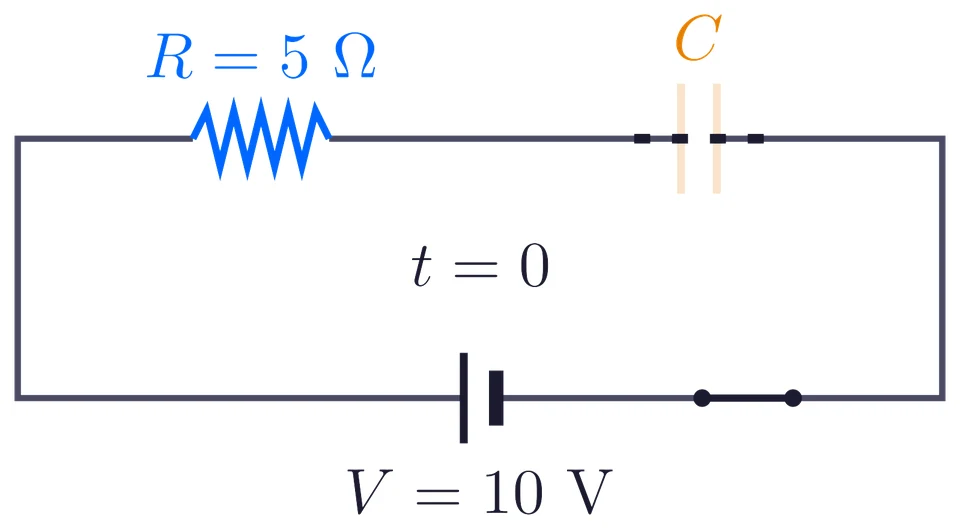
A capacitor \(C\), a resistor \(R = 5\ \Omega\) and a 10 V battery in one loop. The capacitor starts uncharged: \(q = 0\), so \({V_C} = \dfrac{q}{C} = 0\). Just after the switch closes, the capacitor still has no voltage across it, the same as a plain wire (dashed in the figure). All 10 V is across \(R\):
\[ {I} = \frac{V}{R} = \frac{10}{5} = {2\ \mathrm{A}}. \]
As it charges, the current falls
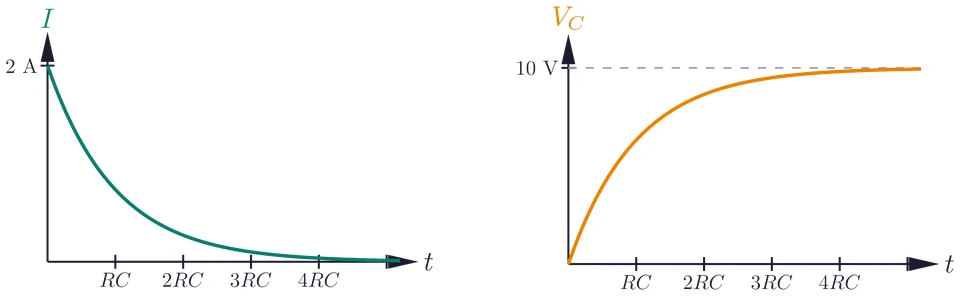
Charge builds up on the plates, \({V_C}\) rises, and less voltage is left across \(R\), so the current falls. For an uncharged capacitor charging through \(R\) from a battery \(V\):
\[ {I} = \frac{V}{R}\,e^{-t/RC}, \qquad {V_C} = V\left(1 - e^{-t/RC}\right). \]
| \(t\) | \(0\) | \(RC\) | \(2RC\) | \(3RC\) |
|---|---|---|---|---|
| \(I\) (A) | \(2\) | \(0.74\) | \(0.27\) | \(0.10\) |
| \(V_C\) (V) | \(0\) | \(6.32\) | \(8.65\) | \(9.50\) |
After a long time: like an open circuit
The current keeps falling towards \(0\), and \({V_C}\) rises towards the battery's 10 V. With (almost) no current, the capacitor acts like a gap in the circuit: an open circuit. In the DC steady state, no current flows through a capacitor.
Careful
Never exactly zero. At any finite time \(e^{-t/RC} > 0\), so the current is never exactly 0 and \(V_C\) never exactly 10 V; they tend to those values. After \(5RC\) the current is under 1% of its start (\(e^{-5} \approx 0.0067\)), which is why "a long time" means a few \(RC\).
Only an uncharged capacitor acts like a wire at switch-on. One that already holds a voltage keeps it at the first instant: it acts like a battery of that voltage, not a wire.
Solved example
A 12 V battery, a 4 \(\Omega\) resistor and an uncharged capacitor are joined in one loop with a switch. Find the current and \(V_C\) just after the switch closes, and what they tend to after a long time.
Just after: \(V_C = 0\), so \(I = \dfrac{12}{4} = 3\) A. Long after: \(I \to 0\) and \(V_C \to 12\) V.
3 A and 0 V; then 0 A and 12 V
Key formulas
\[ \begin{aligned}I &= \frac{V}{R}\,e^{-t/RC} & V_C &= V\left(1 - e^{-t/RC}\right) & \tau &= RC\\[4pt] t = 0\text{: } I &= \frac{V}{R},\ V_C = 0 & t \gg RC\text{: } I &\to 0,\ V_C \to V\end{aligned} \]
Practice set
Easy to hard. Every capacitor starts uncharged, and every battery is ideal. Try each one before you open its answer.
Quiz from the Short. In the Short's circuit (10 V battery, \(R = 5\ \Omega\), uncharged \(C\)), long after switch-on, the voltage across \(R\) is about: (A) 0 V (B) 5 V (C) 10 V.
Show answer
(A) about 0 V. Long after switch-on the current tends to 0, so \(V_R = IR = 10\,e^{-t/RC}\) V tends to 0. At every moment \(V_R + V_C = 10\) V, and now \(V_C\) is close to 10 V. 10 V is \(V_R\) just after switch-on, the trap; 5 V holds only at \(t = RC \ln 2 \approx 0.69\,RC\).
A 20 V battery, a 10 \(\Omega\) resistor and a capacitor are joined in one loop. Find the current just after the switch closes.
Show answer
2 A. \(V_C = 0\) at first, so \(I = \dfrac{20}{10}\).
In the circuit of Q2, find the current at \(t = RC\).
Show answer
about 0.74 A. \(I = 2\,e^{-1} \approx 0.736\) A, about 37% of the start.
Find the time constant for \(R = 2\ \mathrm{k\Omega}\) and \(C = 5\ \mu\mathrm{F}\).
Show answer
0.01 s (10 ms). \(RC = 2000 \times 5 \times 10^{-6}\) s.
A capacitor charges through \(R\) from a battery \(V\). At what time is \(V_C = \dfrac{V}{2}\)?
Show answer
\(t = RC \ln 2 \approx 0.69\,RC\). \(V\left(1 - e^{-t/RC}\right) = \dfrac{V}{2}\) gives \(e^{-t/RC} = \dfrac{1}{2}\).
A 12 V battery is joined in series with \(R_1 = 4\ \Omega\) and then a pair in parallel: a resistor \(R_2 = 4\ \Omega\) and a capacitor \(C\). Find the battery current just after switch-on and after a long time, and the final \(V_C\).
Show answer
3 A; then 1.5 A; \(V_C = 6\) V. Just after, \(C\) acts like a wire and shorts \(R_2\): \(I = \dfrac{12}{4}\). Long after, no current through \(C\): \(I = \dfrac{12}{4 + 4}\), and \(V_C\) equals the voltage across \(R_2\), \(1.5 \times 4\).