
In a Wheatstone bridge, the galvanometer reads zero when \(\dfrac{{P}}{{Q}} = \dfrac{{R}}{{S}}\). The bridge is then balanced, and the middle arm carries no current.
Wheatstone bridge
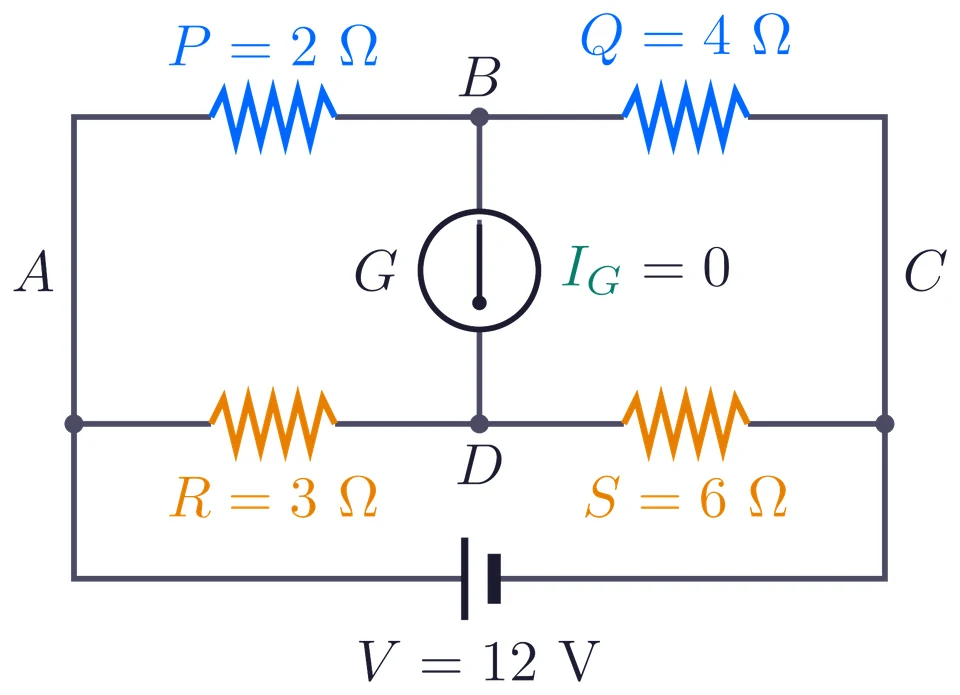
Two arms joined at the same two points A and C: \(P\) then \(Q\) in one, \(R\) then \(S\) in the other. A galvanometer \(G\) joins B (between \(P\) and \(Q\)) to D (between \(R\) and \(S\)).
A battery across A and C drives it.
Balanced
No current through \(G\): B and D are at the same potential.
Then \(\dfrac{P}{Q} = \dfrac{R}{S}\).
Why the current through G is zero
Suppose no current flows through \(G\). Then \({P}\) and \({Q}\) carry one current, and B splits the battery's voltage as a voltage divider does. So do \({R}\) and \({S}\) at D. Measured from C:
\[ V_B = V\,\frac{{Q}}{{P} + {Q}}, \qquad V_D = V\,\frac{{S}}{{R} + {S}}. \]
For the Short's bridge with \(V = 12\) V: \(V_B = 12 \times \frac{4}{6} = 8\) V and \(V_D = 12 \times \frac{6}{9} = 8\) V.
The balance condition
B and D are at the same potential when
\[ \frac{{Q}}{{P} + {Q}} = \frac{{S}}{{R} + {S}} \iff {Q}({R} + {S}) = {S}({P} + {Q}) \iff {Q}{R} = {P}{S} \iff \frac{{P}}{{Q}} = \frac{{R}}{{S}}. \]
With no potential difference across \(G\), no current flows through it, so the guess of no current holds.
Neither \(V\) nor the resistance of \(G\) appears in the condition: a bridge that is balanced stays balanced for any battery and any galvanometer. Off balance, current flows through \(G\) from the higher of B and D to the lower: in the Short, from B to D below \(S = 6\ \Omega\) and from D to B above it.
Careful
Pair the arms as they are wired. \(P\) and \(Q\) are in series in one arm, \(R\) and \(S\) in the other, and \(P\) and \(R\) meet at the same end (A). Then \(\dfrac{P}{Q} = \dfrac{R}{S}\). Writing \(\dfrac{P}{Q} = \dfrac{S}{R}\) is the usual slip: in the quiz it gives \(3\ \Omega\) in place of \(12\ \Omega\).
Using it: the middle resistor drops out
At balance the middle arm carries no current, so whatever sits there can be removed, or replaced by a plain wire, without changing any other current. This is the quick way through many equivalent-resistance questions.
Solved example
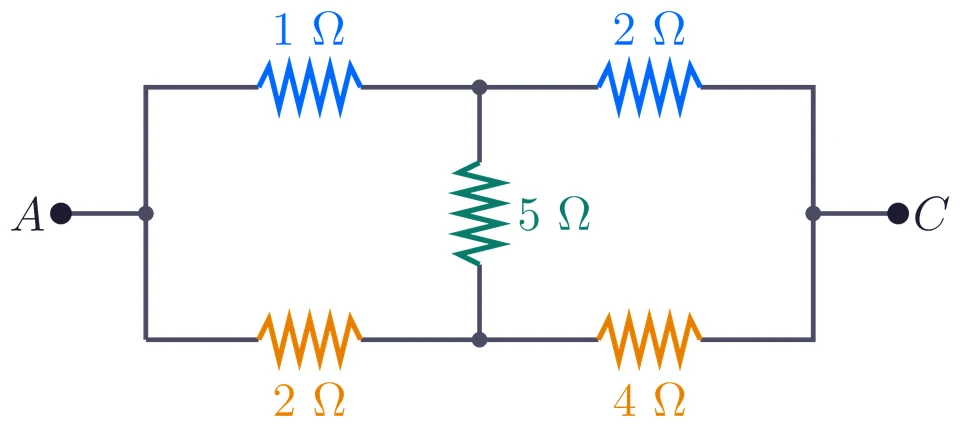
Find the resistance between A and C.
Check the ratios: \(\dfrac{{1}}{{2}} = \dfrac{{2}}{{4}}\), so the bridge is balanced and the \(5\ \Omega\) carries no current. Remove it. The two arms are then in parallel:
\[ R_{AC} = \frac{(1 + 2)(2 + 4)}{(1 + 2) + (2 + 4)} = \frac{18}{9}. \]
\(2\ \Omega\)
The metre bridge
A metre bridge is a Wheatstone bridge in which a uniform wire 100 cm long forms two of the arms. With a resistance \(X\) in the left gap and \(R\) in the right gap, balance at \(l\) cm from the left end gives
\[ \frac{X}{R} = \frac{l}{100 - l}, \]
since the resistances of the two parts of the wire are in the ratio of their lengths.
Key formulas
\[ \begin{aligned}\text{balance: } \frac{P}{Q} &= \frac{R}{S} & V_B &= V\,\frac{Q}{P + Q}, \quad V_D = V\,\frac{S}{R + S}\\[4pt] \text{metre bridge: } \frac{X}{R} &= \frac{l}{100 - l} & \text{at balance: } I_G &= 0 \text{ for any } V \text{ and any } G\end{aligned} \]
Practice set
Easy to hard. Try each one before you open its answer.
Quiz from the Short. In a Wheatstone bridge, \(P = 4\ \Omega\), \(Q = 8\ \Omega\), \(R = 6\ \Omega\). The galvanometer reads zero when \(S\) is: (A) \(12\ \Omega\) (B) \(3\ \Omega\) (C) \(6\ \Omega\).
Show answer
(A) \(12\ \Omega\). Balance needs \(\dfrac{P}{Q} = \dfrac{R}{S}\): \(\dfrac{4}{8} = \dfrac{6}{S}\), so \(S = \dfrac{6 \times 8}{4} = 12\ \Omega\). \(3\ \Omega\) comes from the ratio upside down, and \(6\ \Omega\) from taking \(S = R\).
In a Wheatstone bridge, \(P = 10\ \Omega\), \(Q = 20\ \Omega\), \(R = 15\ \Omega\). Find \(S\) for balance.
Show answer
\(30\ \Omega\). \(S = \dfrac{RQ}{P} = \dfrac{15 \times 20}{10} = 30\ \Omega\).
Five equal resistors, each \(r\), form a Wheatstone bridge (one of them across the middle). Find the resistance between A and C.
Show answer
\(r\). \(\dfrac{r}{r} = \dfrac{r}{r}\): balanced, so the middle resistor carries nothing. Two arms of \(2r\) in parallel give \(r\).
In the Short's bridge (\(P = 2\ \Omega\), \(Q = 4\ \Omega\), \(R = 3\ \Omega\), \(S = 6\ \Omega\)) a 12 V battery is joined across A and C. Find the potentials of B and D above C.
Show answer
8 V and 8 V. \(V_B = 12 \times \dfrac{4}{2 + 4} = 8\) V and \(V_D = 12 \times \dfrac{6}{3 + 6} = 8\) V: equal, as balance needs.
In a metre bridge, an unknown resistance \(X\) is in the left gap and \(10\ \Omega\) in the right gap. The balance point is 40 cm from the left end. Find \(X\).
Show answer
\(\dfrac{20}{3}\ \Omega \approx 6.67\ \Omega\). \(\dfrac{X}{10} = \dfrac{40}{60}\), so \(X = \dfrac{20}{3}\ \Omega\).
In the Short's bridge, \(S\) is raised to \(9\ \Omega\). Which way does the current flow through \(G\): from B to D, or from D to B? Does the answer depend on the resistance of \(G\)?
Show answer
From D to B; no. With \(G\) removed, \(V_B = 12 \times \dfrac{4}{6} = 8\) V and \(V_D = 12 \times \dfrac{9}{12} = 9\) V. D is higher, so the current flows from D to B, whatever the resistance of \(G\) (that changes only its size).