
Average speed is the total distance divided by the total time. It is not the mean of the speeds: the speed you hold for longer counts for more.
Average speed
Total distance covered, divided by the total time taken.
Never negative. Units: km/h or m/s.
Average velocity
Total displacement (from start to finish, with direction), divided by the total time.
Zero for a trip that ends where it began.
The trip in the Short
A car drives from A to B, 120 km, at 40 km/h, and comes back at 60 km/h.
There: 3 hours
\(t_1 = \dfrac{120\ \mathrm{km}}{40\ \mathrm{km/h}} = {3\ \mathrm{h}}\)
Back: 2 hours
\(t_2 = \dfrac{120\ \mathrm{km}}{60\ \mathrm{km/h}} = {2\ \mathrm{h}}\)
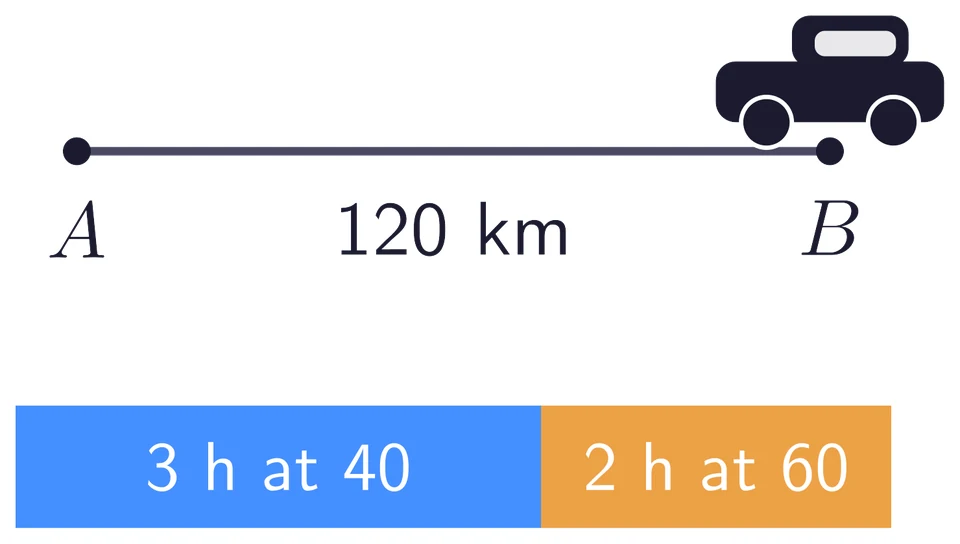
Average speed of the whole trip
\[ v_{\text{avg}} = \frac{\text{total distance}}{\text{total time}} = \frac{120 + 120}{{3} + {2}}\ \mathrm{km/h} = \frac{240}{5}\ \mathrm{km/h} = {\mathbf{48\ km/h}} \]
Careful
For the same round trip the average velocity is \(0\): the car ends where it started, so the displacement is zero. Average speed 48 km/h, average velocity 0. JEE questions ask for one or the other; read which.
Why 48 and not 50
Draw speed against time. The area under each step is the distance on that leg: \({40 \times 3} = 120\) and \({60 \times 2} = 120\). The dashed line at 48 for 5 hours covers the same 240 km.
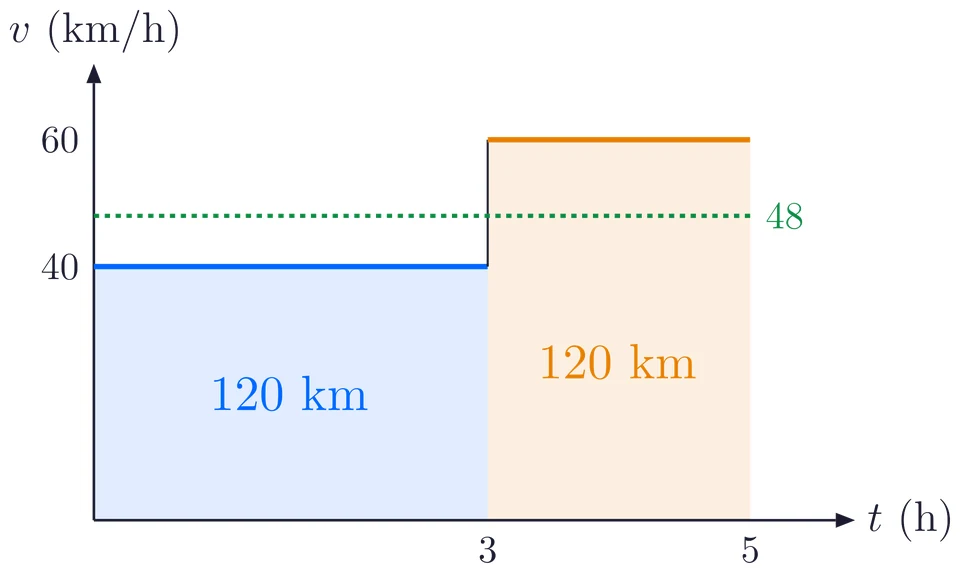
The car spends 3 of the 5 hours at 40 and only 2 at 60, so the average leans towards 40. Each speed counts as many times as the hours it was held:
\[ v_{\text{avg}} = \frac{{40 \times 3} + {60 \times 2}}{5} = \frac{240}{5} = 48. \]
Equal distances
Two legs of the same length at \(v_1\) and \(v_2\):
\[ v_{\text{avg}} = \frac{2 v_1 v_2}{v_1 + v_2} \]
Here \(\frac{2 \times 40 \times 60}{100} = 48\).
Equal times
Two legs of the same duration at \(v_1\) and \(v_2\):
\[ v_{\text{avg}} = \frac{v_1 + v_2}{2} \]
Only then is the plain mean right.
Solved example
A bus covers the first half of a journey at 30 km/h and the second half at 60 km/h. Find its average speed.
Equal distances, so use the formula for equal distances, or take a length: say each half is 60 km. Then the times are \(\frac{60}{30} = 2\) h and \(\frac{60}{60} = 1\) h, and \(v_{\text{avg}} = \frac{120}{3} = 40\) km/h.
40 km/h
(not 45)
Key formulas
\[ \begin{aligned}v_{\text{avg}} &= \frac{\text{total distance}}{\text{total time}} & \text{average velocity} &= \frac{\text{total displacement}}{\text{total time}}\\[4pt] \text{equal distances: } v_{\text{avg}} &= \frac{2 v_1 v_2}{v_1 + v_2} & \text{equal times: } v_{\text{avg}} &= \frac{v_1 + v_2}{2}\end{aligned} \]
Practice set
Easy to hard. Try each one before you open its answer.
Quiz from the Short. A car goes up a hill at 20 km/h and comes back down the same road at 30 km/h. Its average speed is: (A) 25 km/h (B) 26 km/h (C) 24 km/h.
Show answer
(C) 24 km/h. Call the road \(d\). Time \(= \dfrac{d}{20} + \dfrac{d}{30} = \dfrac{d}{12}\), so the average speed is \(2d \div \dfrac{d}{12} = 24\) km/h. 25 km/h is the mean of the two speeds: the slow climb lasts longer, so it counts for more.
A car goes 60 km at 30 km/h and then 60 km more at 60 km/h. Find its average speed.
Show answer
40 km/h. Times 2 h and 1 h: \(\frac{120}{3} = 40\). Equal distances, so also \(\frac{2 \times 30 \times 60}{90} = 40\).
A car drives for 1 hour at 40 km/h and then for 1 hour at 60 km/h. Find its average speed.
Show answer
50 km/h. Equal times, so here the plain mean is right: \(\frac{40 + 60}{2} = 50\), or \(\frac{100\ \mathrm{km}}{2\ \mathrm{h}}\).
For the round trip of the Short (A to B at 40 km/h, back at 60 km/h), find the average velocity.
Show answer
0. The car returns to A, so the displacement is zero. (Its average speed is still 48 km/h.)
A cyclist covers one third of a distance at 20 km/h and the rest at 60 km/h. Find the average speed.
Show answer
36 km/h. Take the distance as 3 km. 1 km at 20 km/h takes \(\frac{1}{20}\) h; 2 km at 60 km/h take \(\frac{1}{30}\) h. Total \(\frac{1}{20} + \frac{1}{30} = \frac{1}{12}\) h, so \(v_{\text{avg}} = 3 \times 12 = 36\).
A particle covers half of a distance at speed \(v_0\). For the other half, it moves at \(v_1\) for half the time and at \(v_2\) for the other half of the time. Find its average speed.
Show answer
\(\dfrac{2v_0(v_1 + v_2)}{2v_0 + v_1 + v_2}\). The second half is equal times, so it is covered at \(u = \frac{v_1 + v_2}{2}\). The two halves are equal distances: \(v_{\text{avg}} = \frac{2 v_0 u}{v_0 + u}\). Put in \(u\) and multiply top and bottom by 2.