
Two bulbs rated for the same voltage, joined in series: the lower wattage bulb glows brighter. It has the larger resistance, and in series the same current flows through both, so it takes more power.
Rating
"220 V, 100 W" means: joined across 220 V, the bulb takes 100 W.
Only at its rated voltage does it take its rated power.
Resistance of a bulb
From the rating, \(R = \dfrac{V^2}{P}\). JEE takes it as fixed, whatever the voltage.
A real filament's resistance changes as it heats up.
From the rating to the resistance
Both bulbs are rated for 220 V. At its rated voltage a bulb takes its rated power, \(P = \dfrac{V^2}{R}\), so its resistance is \(R = \dfrac{V^2}{P}\):
\[ {R_1} = \frac{220^2}{{100}} = {484\ \Omega}, \qquad {R_2} = \frac{220^2}{{60}} = \frac{2420}{3} \approx {807\ \Omega}. \]
The 60 W bulb has the larger resistance: at the same rated voltage, a lower wattage always means a larger resistance.
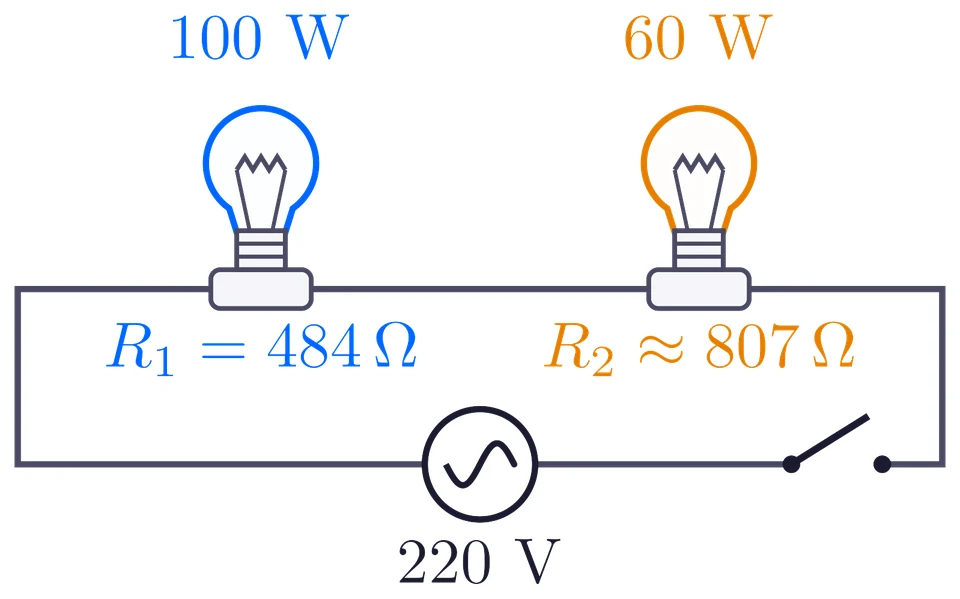
Joined in series
In series there is one path, so the same current \(I\) flows through both bulbs. The power in each is \(P = I^2 R\), so the larger resistance takes more power.
Brightness follows power, so the 60 W bulb glows brighter: in the figure each glow is in proportion to its power.
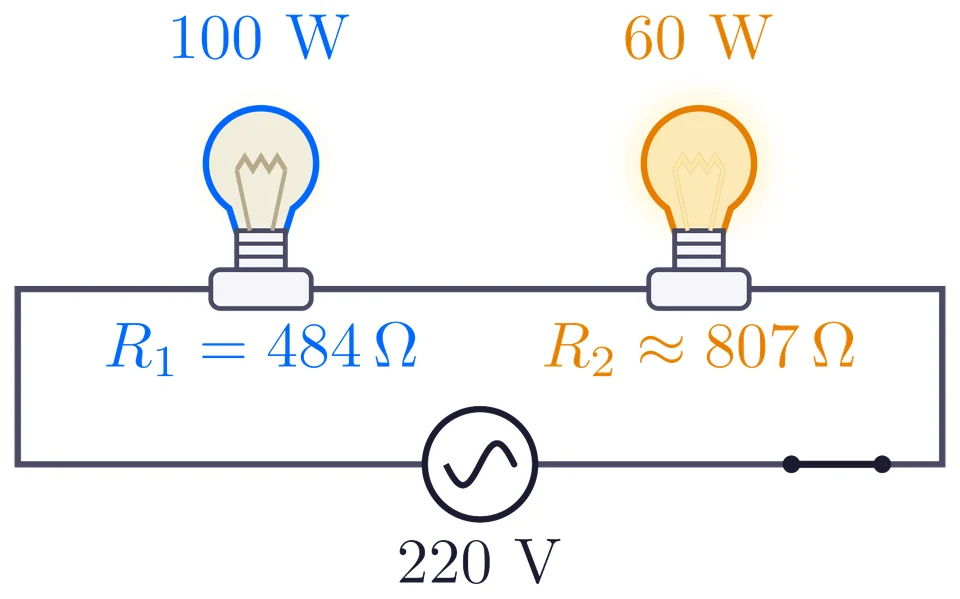
\[ {P_1} = I^2 {R_1} \approx {14.06\ \mathrm{W}}, \qquad {P_2} = I^2 {R_2} \approx {23.44\ \mathrm{W}}. \]
Where the numbers come from
\(I = \dfrac{220}{484 + \frac{2420}{3}} = \dfrac{15}{88}\ \mathrm{A} \approx 0.170\ \mathrm{A}\), the same in both. Then \(P_1 = \left(\dfrac{15}{88}\right)^2 \times 484 = \dfrac{225}{16} = 14.0625\ \mathrm{W}\) and \(P_2 = \dfrac{375}{16} = 23.4375\ \mathrm{W}\). Neither bulb gets its rating: together they take only 37.5 W. In series the powers are in the ratio of the resistances, \(\dfrac{P_2}{P_1} = \dfrac{R_2}{R_1} = \dfrac{100}{60}\).
Careful
"The 100 W bulb is always brighter" is the trap. The rating tells you the power only at the rated voltage. In series neither bulb has 220 V across it: the voltage splits in the ratio of the resistances (\(82.5\) V and \(137.5\) V here), and each power must be worked out from the current. Work out the resistances first, then decide.
Solved example
Two identical 100 W, 220 V bulbs are joined in series across 220 V. Find the power in each.
Resistance of each: \(\dfrac{220^2}{100} = 484\ \Omega\); together \(968\ \Omega\). Total power \(= \dfrac{220^2}{968} = 50\ \mathrm{W}\), shared equally (same current, same \(R\)).
25 W each
(a quarter of the rating: each has half the voltage)
Key formulas
\[ \begin{aligned}\text{from the rating: } R &= \frac{V_{\text{rated}}^2}{P_{\text{rated}}} & \text{any voltage } V\text{: } P &= \frac{V^2}{R}\\[4pt] \text{series (same } I\text{): } P &= I^2 R \;\propto\; R & \text{series: } \frac{P_2}{P_1} &= \frac{R_2}{R_1}\end{aligned} \]
Practice set
Easy to hard. Bulbs are rated for 220 V unless stated, and their resistance is taken as fixed. Try each one before you open its answer.
Quiz from the Short. The same two bulbs (100 W and 60 W), now in parallel across 220 V. Which bulb glows brighter? (A) the 100 W bulb (B) the 60 W bulb (C) both the same.
Show answer
(A) the 100 W bulb. In parallel each bulb is joined straight across 220 V, its rated voltage, so each takes its rated power: \(\dfrac{220^2}{484} = 100\) W and \(\dfrac{3 \times 220^2}{2420} = 60\) W. The 100 W bulb is brighter: the series answer turns round. In parallel the voltage is the same, so \(P = \dfrac{V^2}{R}\) and the smaller resistance takes more power.
Find the resistance of a 40 W bulb.
Show answer
1210 \(\Omega\). \(R = \dfrac{220^2}{40} = \dfrac{48400}{40}\).
A 100 W bulb and a 25 W bulb are joined in series across 220 V. Which one glows brighter, and how much power does it take?
Show answer
The 25 W bulb; 16 W. \(R = 484\ \Omega\) and \(1936\ \Omega\), so \(I = \dfrac{220}{2420} = \dfrac{1}{11}\) A. Then \(P = I^2 R\) gives \(4\) W and \(16\) W: the 25 W bulb is brighter.
A 60 W bulb is run on 110 V. How much power does it take?
Show answer
15 W. \(R = \dfrac{220^2}{60}\), so \(P = \dfrac{110^2}{R} = 60 \times \left(\dfrac{110}{220}\right)^2 = \dfrac{60}{4}\). Half the voltage gives a quarter of the power.
A 100 W bulb is joined in series with a 484 \(\Omega\) resistor across 220 V. Find the power in the bulb.
Show answer
25 W. The bulb is \(484\ \Omega\), the same as the resistor, so each has 110 V: \(P = \dfrac{110^2}{484} = 25\) W. Or \(I = \dfrac{220}{968}\) A and \(P = I^2 \times 484\).
For the Short's pair (100 W and 60 W in series across 220 V), find the current and the voltage across each bulb.
Show answer
\(I = \dfrac{15}{88}\ \mathrm{A} \approx 0.170\) A; 82.5 V and 137.5 V. \(I = \dfrac{220}{484 + \frac{2420}{3}} = \dfrac{15}{88}\) A. \(V_1 = I R_1 = 82.5\) V, \(V_2 = I R_2 = 137.5\) V; they add to 220 V.