
Two words: modulus as a distance, and the circle
\(|z|\) is the length of the arrow from \(0\) to \(z\): the distance of \(z\) from the origin. In the same way, \(|z - a|\) is the distance between the points \(z\) and \(a\).
\(|z - a| = r\) is every point at distance \(r\) from \(a\): the circle with centre \(a\) and radius \(r\). Read the centre with its sign: \(|z + 3 - 4i| = |z - (-3 + 4i)|\), so the centre is \(-3 + 4i\).
How far can \(z\) be from the origin?
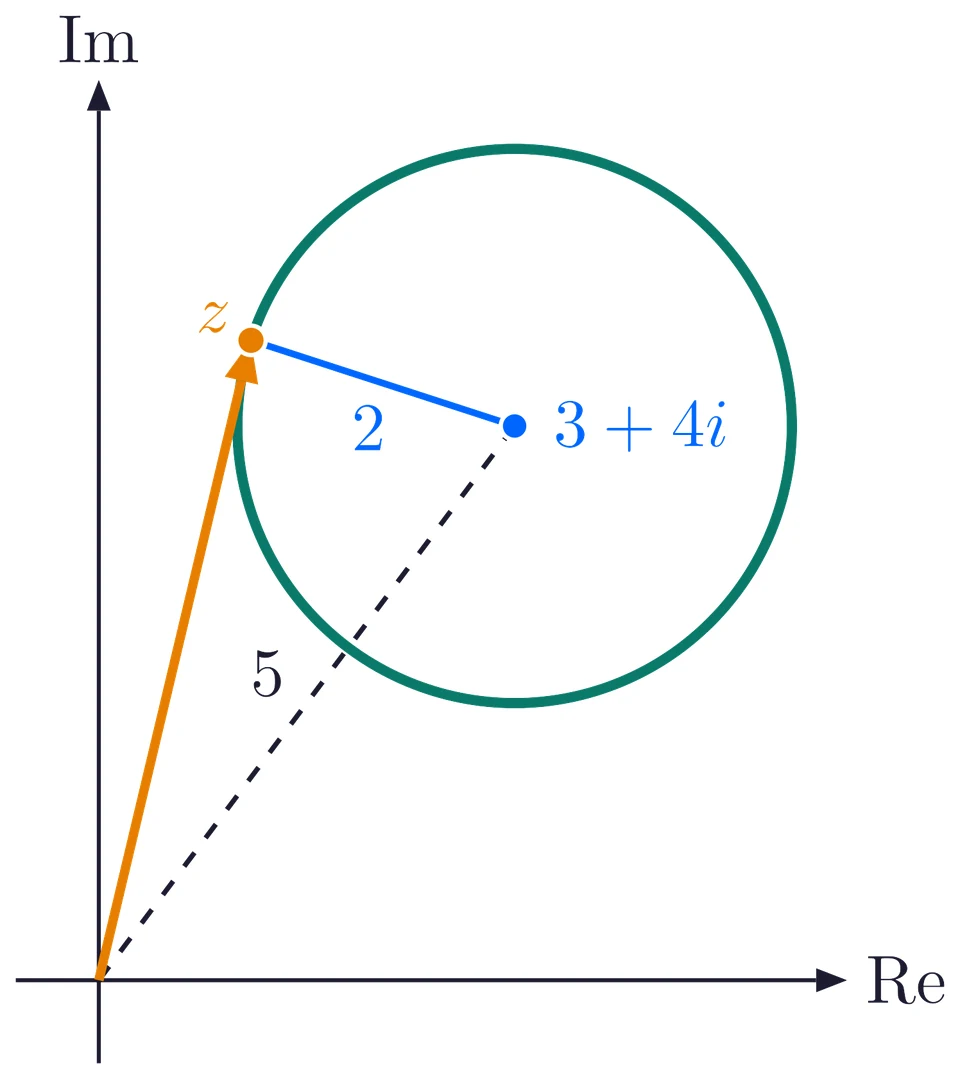
Take the circle \(|z - (3 + 4i)| = 2\): centre \(a = 3 + 4i\) and radius \(2\). As \(z\) goes round it, its distance \(|z|\) from the origin keeps changing.
The origin, the centre and \(z\) make a triangle. Its sides are \(|a| = |3 + 4i| = 5\), the radius \(2\), and \(|z|\).
A triangle gives the answer
In a triangle, one side is less than the sum of the other two and more than their difference:
\[ 5 - 2 \le |z| \le 5 + 2, \quad\text{so}\quad 3 \le |z| \le 7 . \]
The nearest and the farthest points
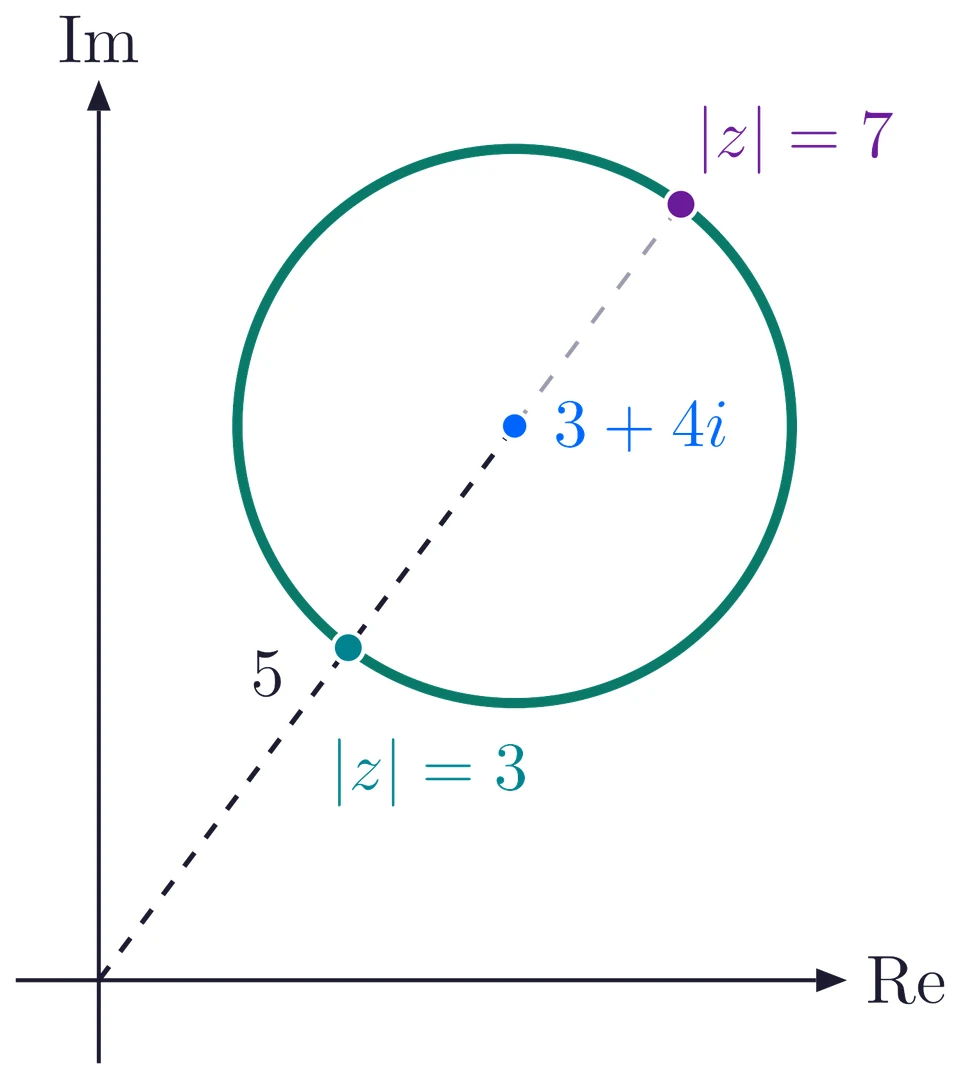
The two ends of this range are reached when the triangle is flat, that is when \(z\) lies on the line through \(0\) and the centre.
On the far side of the centre, \(|z|\) is greatest: \(|z| = 7\) at \(4.2 + 5.6i\). On the near side it is least: \(|z| = 3\) at \(1.8 + 2.4i\). Both points are the centre moved by the radius along that line:
\[ (3 + 4i)\left(1 \pm \tfrac{2}{5}\right) = 4.2 + 5.6i \ \text{ and } \ 1.8 + 2.4i . \]
The rule, when the origin is outside or on the circle (\(|a| \ge r\))
\[ |a| - r \;\le\; |z| \;\le\; |a| + r \]
The least value is at \(a\left(1 - \dfrac{r}{|a|}\right)\), the greatest at \(a\left(1 + \dfrac{r}{|a|}\right)\). When the circle passes through the origin (\(|a| = r\)), the least value is \(0\), at the origin itself.
Careful: the origin inside the circle
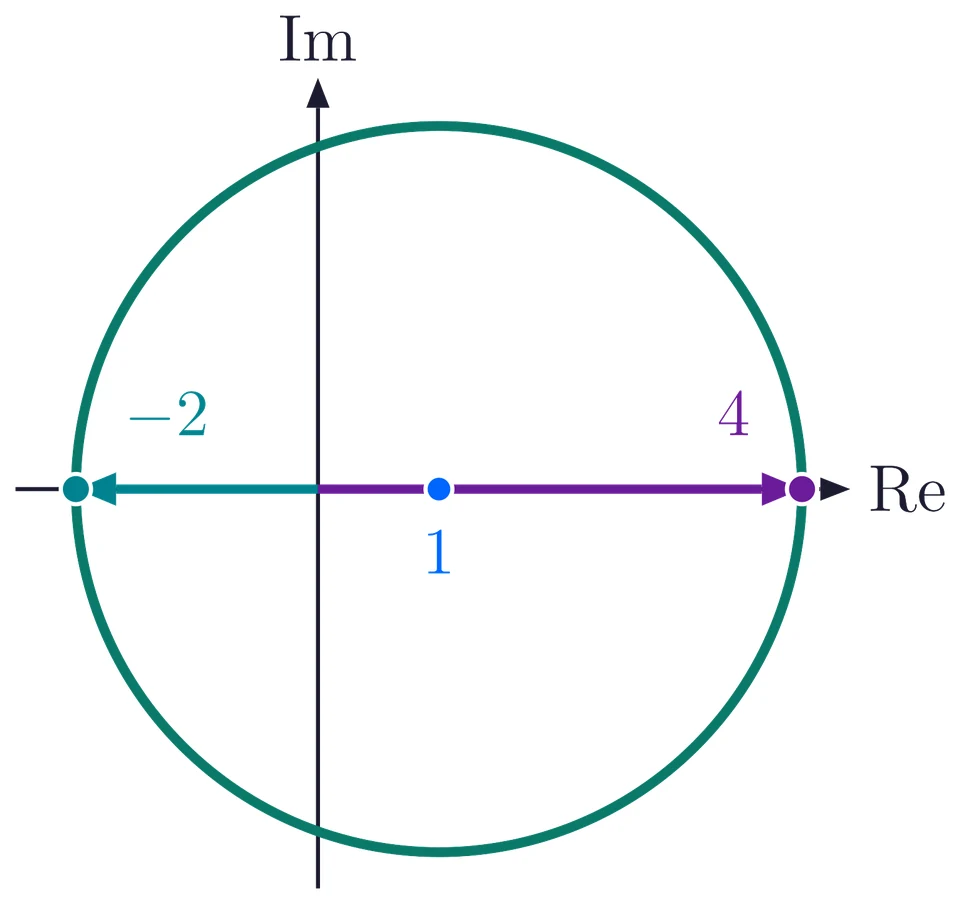
For \(|z - 1| = 3\) the rule gives \(|a| - r = 1 - 3 = -2\), and a distance cannot be negative.
Here \(|a| = 1\) is less than \(r = 3\), so the origin is inside the circle. The nearest point is still on the line through \(0\) and the centre, but on the other side of the origin: \(-2\), at distance \(3 - 1 = 2\). The farthest is \(4\), at distance \(3 + 1 = 4\).
Check first whether \(|a| < r\). Then the least value is \(r - |a|\).
Both cases at once
\[ \text{least } |z| = \big||a| - r\big| , \qquad \text{greatest } |z| = |a| + r . \]
If the centre is the origin (\(a = 0\)), every point of the circle has \(|z| = r\).
The triangle inequality
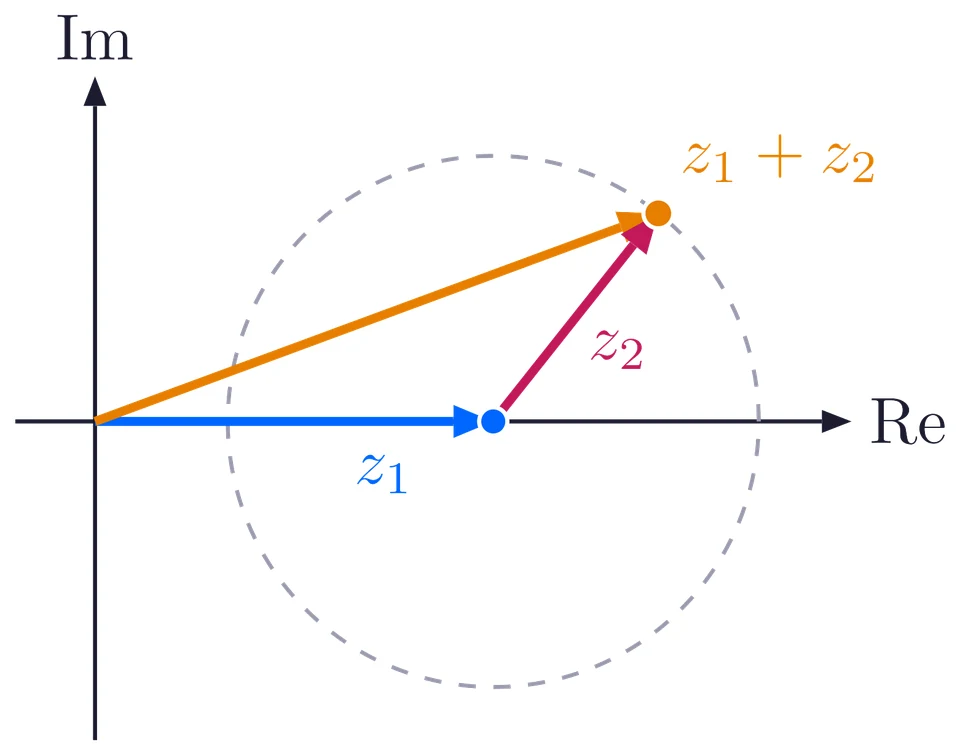
Put \(z_2\) at the tip of \(z_1\). Then \(z_1 + z_2\) is the third side of a triangle, so for any \(z_1\) and \(z_2\):
The triangle inequality
\[ \big||z_1| - |z_2|\big| \le |z_1 + z_2| \le |z_1| + |z_2| \]
The same holds with \(z_1 - z_2\) in the middle.
The right side is reached when \(z_1\) and \(z_2\) point the same way, the left side when they point opposite ways. With \(z_1 = 3\) and \(|z_2| = 2\), \(|z_1 + z_2|\) runs from \(1\) to \(5\), and the tip of \(z_1 + z_2\) runs on the circle \(|w - 3| = 2\): the first picture again.
From the video
If \(\left|z - \dfrac{4}{z}\right| = 2\), find the greatest value of \(|z|\).
Triangle inequality. \(|z| - \left|\dfrac{4}{z}\right| \le \left|z - \dfrac{4}{z}\right| = 2\).
Solve. With \(r = |z| > 0\), \(\left|\dfrac{4}{z}\right| = \dfrac{4}{r}\), so \(r - \dfrac{4}{r} \le 2\), that is \(r^2 - 2r - 4 \le 0\). The roots are \(1 \pm \sqrt{5}\), so \(r \le 1 + \sqrt{5}\).
Is it reached? At \(z = 1 + \sqrt{5}\), \(\dfrac{4}{z} = \sqrt{5} - 1\), so \(z - \dfrac{4}{z} = 2\). Yes.
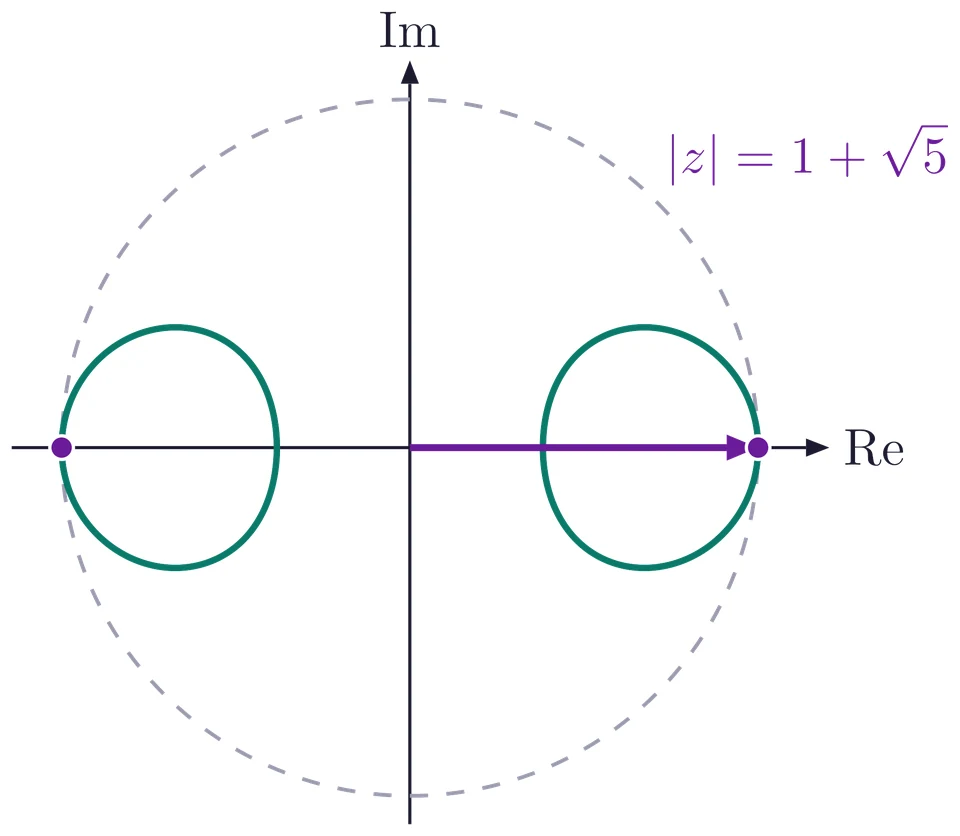
The picture: \(z\) moves on two closed curves, and the dashed circle \(|z| = 1 + \sqrt{5}\) touches them at \(\pm(1 + \sqrt{5})\).
The greatest value of \(|z|\) is \(1 + \sqrt{5}\).
Any such question in three steps
- Write the circle as \(|z - a| = r\) and read the centre \(a\), with its sign.
- Compare \(|a|\) with \(r\): is the origin outside, on, or inside the circle?
- The least value is \(\big||a| - r\big|\) and the greatest \(|a| + r\), both on the line through \(0\) and \(a\). For distances from a point \(w\), use \(|a - w|\) in place of \(|a|\).
Measuring from a point other than the origin
Distance from a point \(w\)
\(|z - w|\) is the distance of \(z\) from the point \(w\). It is the same picture, measured from \(w\) instead of \(0\). On the circle \(|z - a| = r\):
\[ \big||a - w| - r\big| \;\le\; |z - w| \;\le\; |a - w| + r . \]
For the disc \(|z - a| \le r\) the greatest value is the same, and the least value is \(0\) when \(w\) is in the disc.
A second example
If \(|z + 4| \le 3\), find the greatest and the least value of \(|z + 1|\).
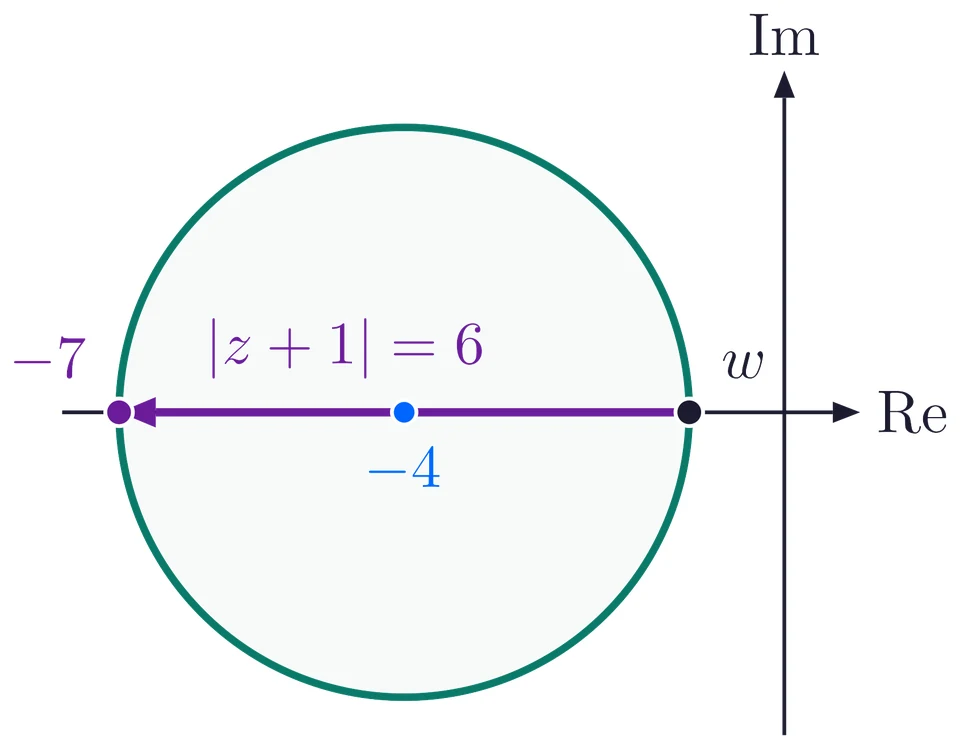
Read the picture. \(|z + 4| \le 3\) is the disc with centre \(-4\) and radius \(3\). \(|z + 1| = |z - (-1)|\) is the distance of \(z\) from the point \(w = -1\).
Greatest. \(|a - w| = |-4 + 1| = 3\), so the greatest value is \(3 + 3 = 6\), at \(z = -7\).
Least. \(|a - w| = 3 = r\): the point \(w = -1\) is on the circle, so it is in the disc. The least value is \(0\), at \(z = -1\).
The greatest value is \(6\) and the least is \(0\).
Key formulas
- Distance from \(0\): \(|z|\). Circle: \(|z - a| = r\), centre \(a\), radius \(r\).
- Origin outside or on the circle: \(|a| - r \le |z| \le |a| + r\).
- Origin inside the circle: \(r - |a| \le |z| \le r + |a|\).
- Least \(\big||a| - r\big|\), greatest \(|a| + r\), at the points \(a\left(1 \pm \dfrac{r}{|a|}\right)\) (for \(a \ne 0\)).
- Triangle inequality: \(\big||z_1| - |z_2|\big| \le |z_1 \pm z_2| \le |z_1| + |z_2|\).
- From a point \(w\): \(\big||a - w| - r\big| \le |z - w| \le |a - w| + r\).
Practice set
Easy to hard. Sketch each question first: mark the centre, decide whether the origin is outside, on or inside the circle, then calculate. Try each one before you open its answer.
\(|z + 3 - 4i| = 1\). Find the greatest and the least value of \(|z|\).
Show answer
Greatest \(6\), least \(4\). The centre is \(-3 + 4i\), so \(|a| = 5\) and \(r = 1\): \(5 + 1\) and \(5 - 1\), at \(-3.6 + 4.8i\) and \(-2.4 + 3.2i\).
\(|z - 2i| = 5\). Find the greatest and the least value of \(|z|\).
Show answer
Greatest \(7\), least \(3\). \(|2i| = 2\) is less than \(5\): the origin is inside. Least \(5 - 2 = 3\) at \(-3i\), greatest \(5 + 2 = 7\) at \(7i\).
\(|z - (1 + i)| = \sqrt{2}\). Find the greatest and the least value of \(|z|\).
Show answer
Greatest \(2\sqrt{2}\), least \(0\). \(|1 + i| = \sqrt{2}\) is the radius: the circle passes through the origin. Least \(0\) at \(0\), greatest \(2\sqrt{2}\) at \(2 + 2i\).
\(|z - 4 - 5i| = 2\). Find the greatest and the least value of \(|z - (1 + i)|\).
Show answer
Greatest \(7\), least \(3\). Measure from \(w = 1 + i\): \(|(4 + 5i) - (1 + i)| = |3 + 4i| = 5\), so \(5 \pm 2\), at \(5.2 + 6.6i\) and \(2.8 + 3.4i\).
\(|z - 3 - 4i| \le 2\). Find the greatest and the least value of \(|z|\).
Show answer
Greatest \(7\), least \(3\). The disc's nearest and farthest points are on its circle, so the answer is the same as for \(|z - 3 - 4i| = 2\).
\(|z_1| = 5\) and \(|z_2| = 2\). Find all the values that \(|z_1 + z_2|\) can take.
Show answer
\(3 \le |z_1 + z_2| \le 7\). \(5 - 2 \le |z_1 + z_2| \le 5 + 2\). As \(z_2\) turns, the tip of \(z_1 + z_2\) runs on a circle of radius \(2\) about \(z_1\), so every value from \(3\) to \(7\) is taken.
If \(\left|z - \dfrac{4}{z}\right| = 2\), find the least value of \(|z|\).
Show answer
Least \(\sqrt{5} - 1\). \(\left|\dfrac{4}{z}\right| - |z| \le 2\) gives \(r^2 + 2r - 4 \ge 0\), so \(r \ge \sqrt{5} - 1\). At \(z = \sqrt{5} - 1\), \(\dfrac{4}{z} = \sqrt{5} + 1\) and \(z - \dfrac{4}{z} = -2\).
A student says that the least value of \(|z|\) on \(|z - 2| = 5\) is \(2 - 5 = -3\). Find the mistake, and the correct least value.
Show answer
Least \(3\), not \(-3\). \(|a| = 2\) is less than \(r = 5\): the origin is inside, so \(|a| - r\) is negative. Least \(5 - 2 = 3\) at \(-3\), greatest \(7\) at \(7\).