
Two words: chord and arc, major and minor
A chord is a straight line that joins two points of a circle. It cuts the circle into two arcs, one on each side of the chord.
The major arc is more than half the circle, and the minor arc is less than half. When the chord is a diameter, both arcs are semicircles.
Two ideas first
The argument of a quotient is a turn
\[ \arg\frac{w_1}{w_2} = \arg w_1 - \arg w_2 \quad \text{(up to a multiple of } 2\pi\text{)} \]
It is the turn from the arrow \(w_2\) to the arrow \(w_1\). Anticlockwise is positive, clockwise is negative.
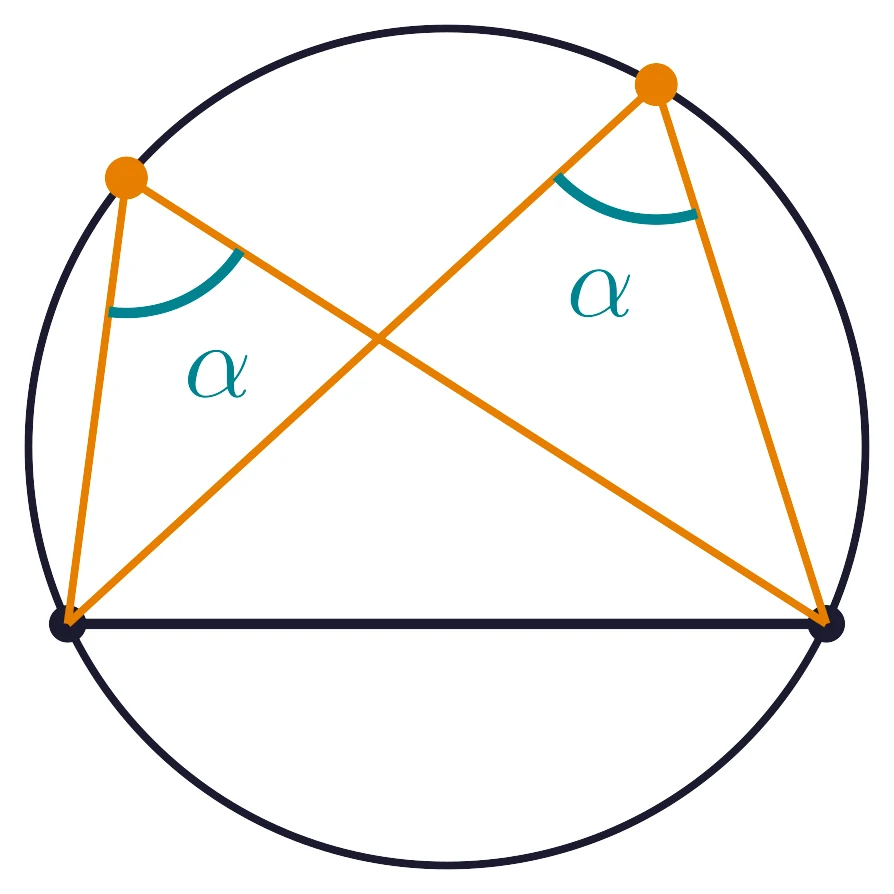
Angles in the same segment (school geometry)
Every point of one arc sees the chord at the same angle \(\alpha\). When the chord is a diameter, this angle is a right angle: the angle in a semicircle.
\(\arg\dfrac{z - a}{z - b}\) is the angle at \(z\)
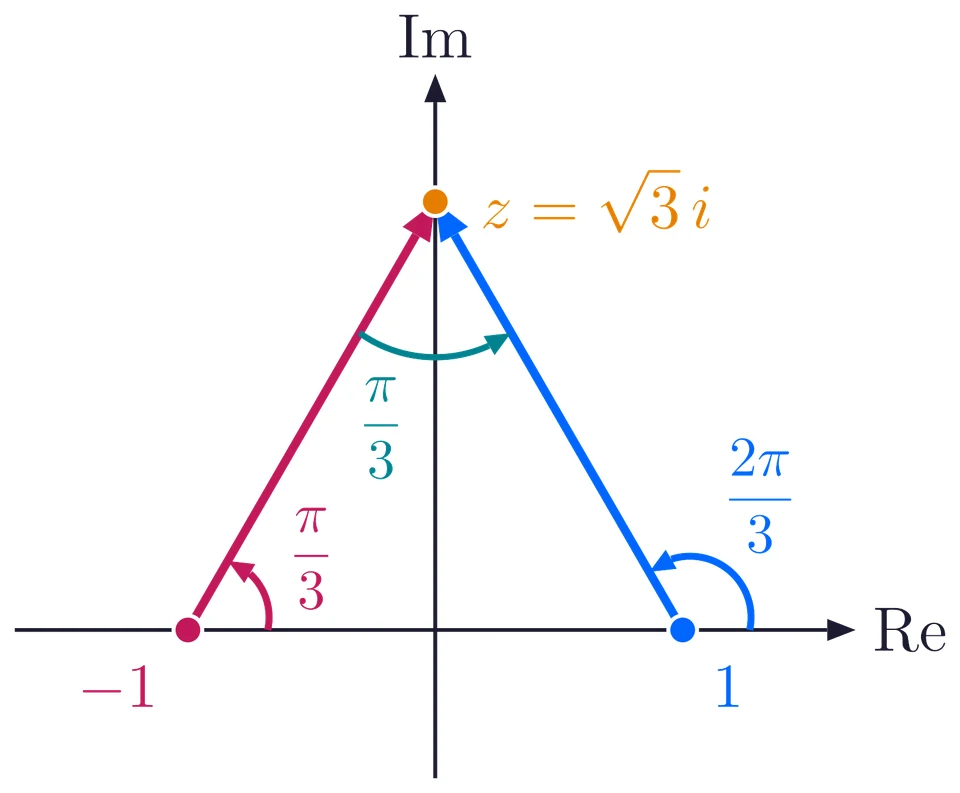
Take \(a = 1\), \(b = -1\) and the point \(z = \sqrt{3}\,i\). The arrow from \(1\) to \(z\) is \(z - 1\), and it makes an angle of \(\dfrac{2\pi}{3}\) with the real axis. The arrow from \(-1\) to \(z\) is \(z + 1\), at an angle of \(\dfrac{\pi}{3}\). So
\[ \arg\frac{z - 1}{z + 1} = \frac{2\pi}{3} - \frac{\pi}{3} = \frac{\pi}{3} , \]
and this is exactly the angle at \(z\), turned from the line to \(-1\) to the line to \(1\). Check: the triangle on \(-1\), \(1\) and \(\sqrt{3}\,i\) has all three sides \(2\), so every angle is \(\dfrac{\pi}{3}\).
Why it is the angle at \(z\), for any \(a\) and \(b\)
Extend both arrows past \(z\). The turn from the arrow \(z - b\) to the arrow \(z - a\) is the angle between these two extensions. That angle and the angle at \(z\) are vertically opposite, and vertically opposite angles are equal. Nothing here used \(1\) and \(-1\), so for any two points, \(\arg\dfrac{z - a}{z - b}\) is the angle at \(z\), turned from the line to \(b\) to the line to \(a\).
Fix the angle: an arc
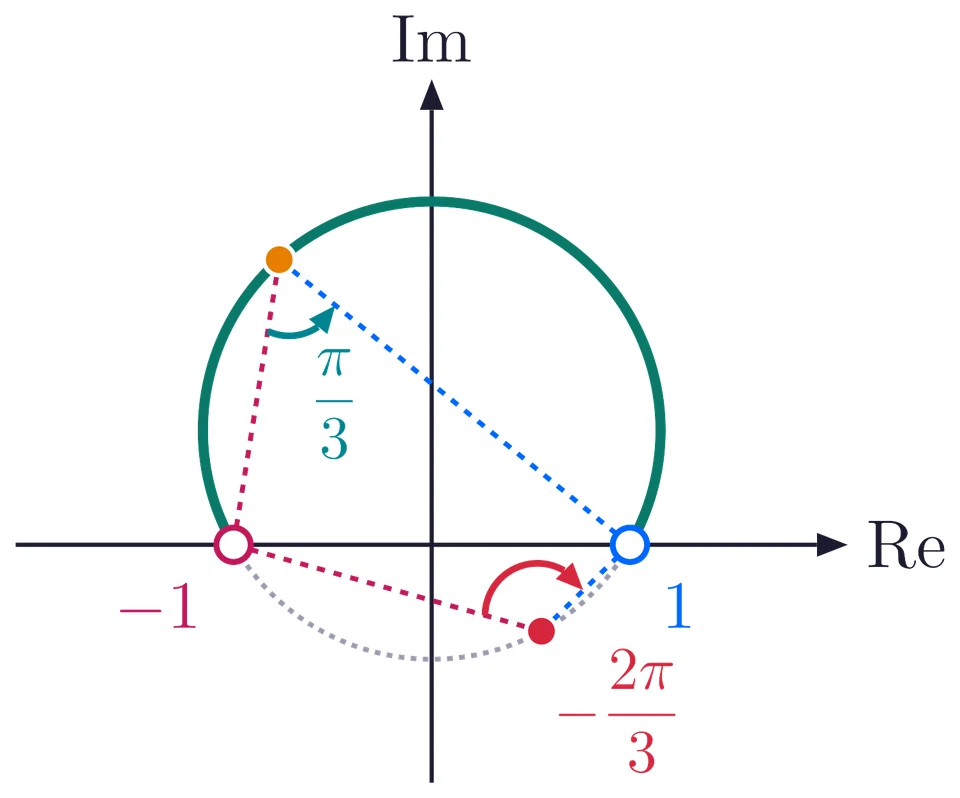
Now fix the angle: \(\arg\dfrac{z - 1}{z + 1} = \dfrac{\pi}{3}\). Let \(z\) move but keep the angle at \(z\) equal to \(\dfrac{\pi}{3}\). Every point of one arc sees the chord from \(-1\) to \(1\) at the same angle, so \(z\) moves on an arc from \(-1\) to \(1\): here the major arc above the real axis of the circle with centre \(\dfrac{i}{\sqrt{3}}\) and radius \(\dfrac{2}{\sqrt{3}}\).
On the rest of the circle (dashed), the turn from the line to \(-1\) to the line to \(1\) is clockwise. The angle there is \(-\dfrac{2\pi}{3}\), not \(\dfrac{\pi}{3}\), so the rest of the circle is not the locus.
The ends are always left out
At \(z = a\) the top \(z - a\) is \(0\), and \(0\) has no argument. At \(z = b\) the bottom \(z - b\) is \(0\), and we cannot divide by \(0\). Draw \(a\) and \(b\) as hollow circles.
A right angle: a semicircle. And which side?
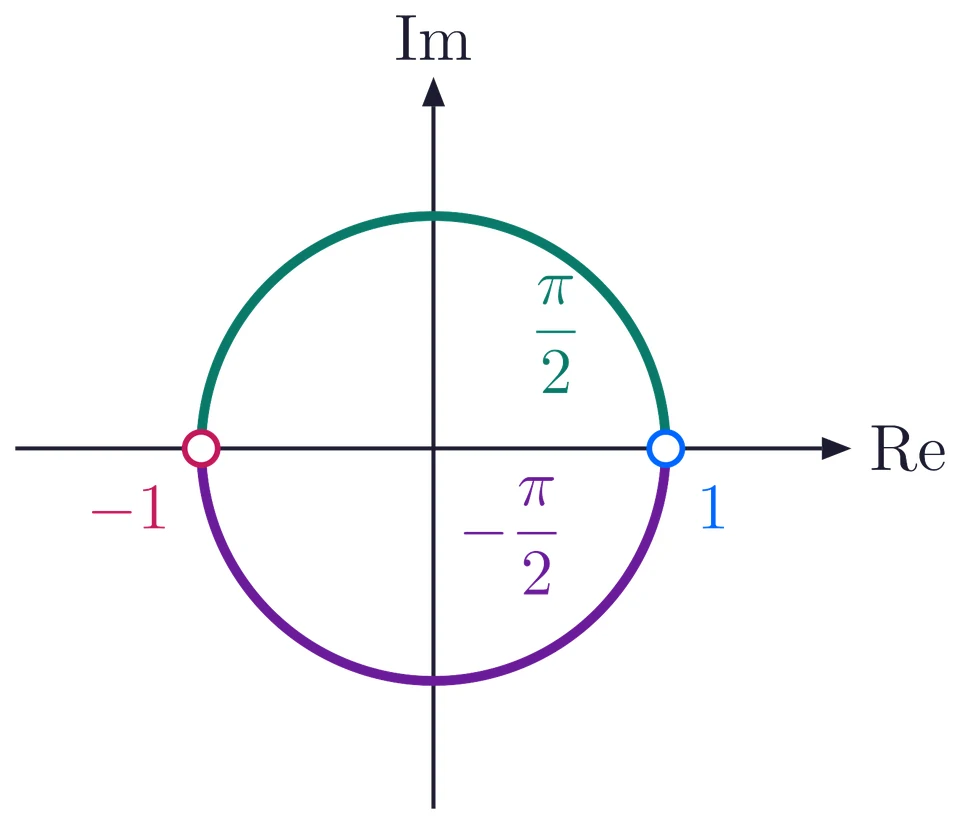
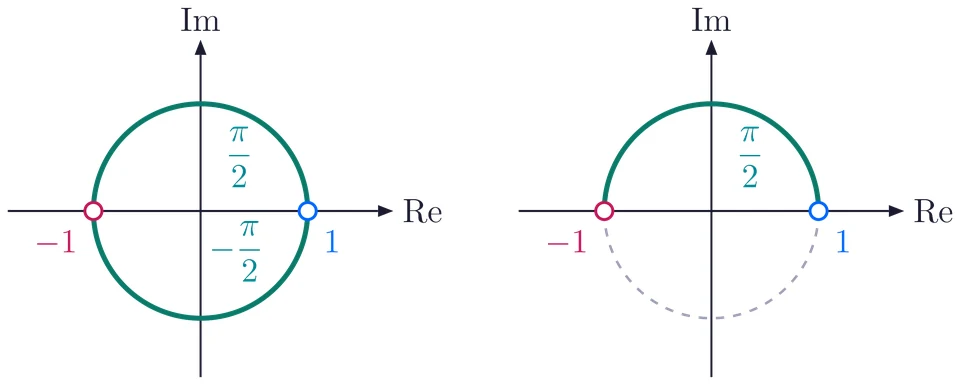
\(\arg\dfrac{z - 1}{z + 1} = \dfrac{\pi}{2}\) means a right angle at \(z\). The angle in a semicircle is a right angle, so \(z\) moves on the upper half of \(|z| = 1\), without \(\pm 1\). Check \(z = i\): \(\dfrac{i - 1}{i + 1} = i\), and \(\arg i = \dfrac{\pi}{2}\).
With \(-\dfrac{\pi}{2}\), \(z\) runs along the lower half. Check \(z = -i\): \(\dfrac{-i - 1}{-i + 1} = -i\), and \(\arg(-i) = -\dfrac{\pi}{2}\). Above the real axis the turn at \(z\) is anticlockwise, so the angle is positive. Below it, the turn is clockwise, so the angle is negative.
Which side of the chord is the arc on?
Walk along the chord from \(b\) to \(a\). A positive angle puts the arc on your left, a negative angle on your right. With \(b = -1\) and \(a = 1\) the walk goes to the right, and its left is above the real axis. Turning the whole picture does not change the angle at \(z\), so the rule holds for a chord in any direction.
Major or minor arc, centre and radius
For an angle \(\theta\) with \(0 < \theta < \pi\): an acute angle gives a major arc, a right angle gives a semicircle, and an obtuse angle gives a minor arc.
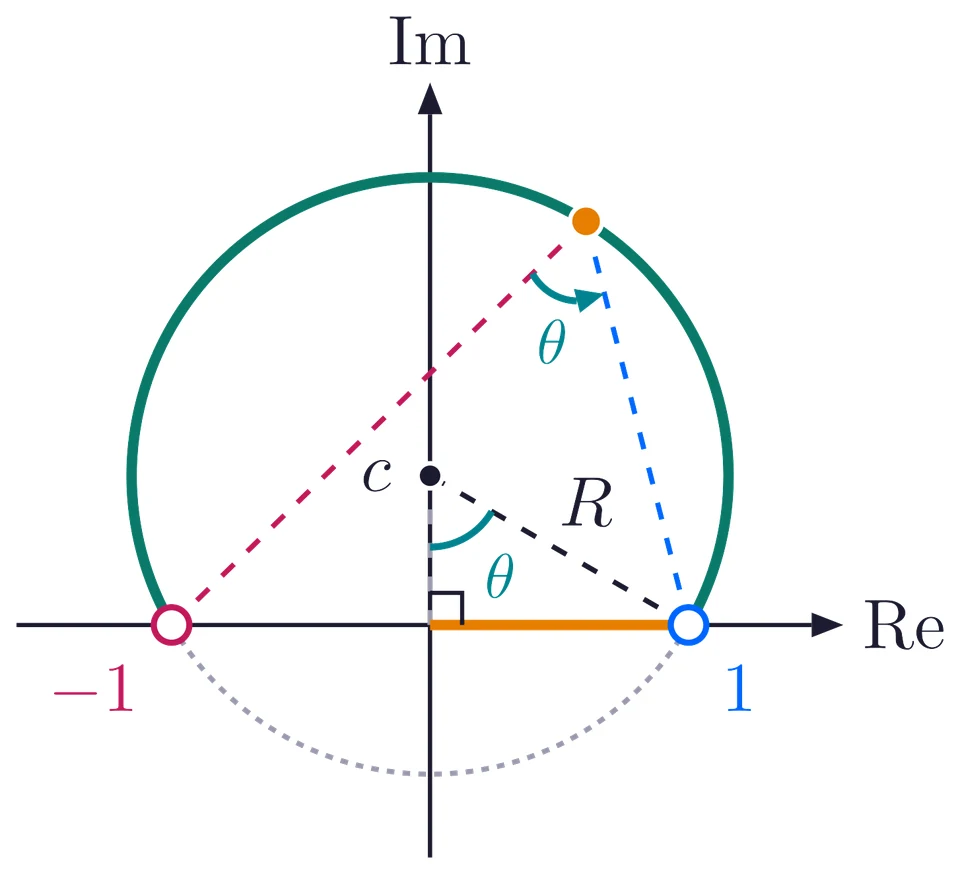
Join the centre \(c\) to the point \(1\): this is the radius \(R\). The line from \(c\) to the midpoint of the chord meets the chord at a right angle. The angle at the centre is twice the angle at \(z\), so over half the chord it is \(\theta\), and half the chord is \(R\sin\theta\). Here half the chord is \(1\), so for \(\theta = \dfrac{\pi}{3}\):
\[ R = \frac{2}{2\sin\frac{\pi}{3}} = \frac{2}{\sqrt{3}} . \]
Centre and radius
\[ R = \frac{|a - b|}{2\sin\theta} \qquad (0 < \theta < \pi;\ \text{for a negative angle, use } |\theta|) \]
The centre is on the perpendicular bisector of \(a\) and \(b\), at a distance \(\sqrt{R^2 - \left(\tfrac{1}{2}|a - b|\right)^2}\) from the midpoint of the chord. For an acute angle the centre is on the same side as the arc, for an obtuse angle on the other side, and for a right angle it is the midpoint.
Any two points
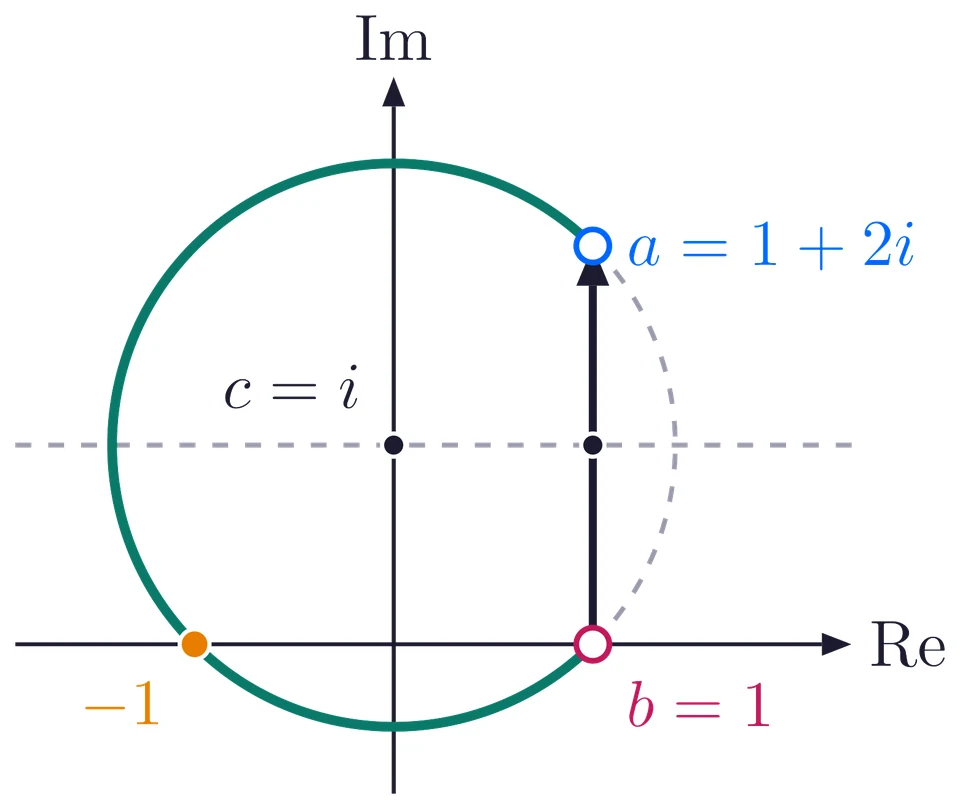
Find the locus of \(z\) if \(\arg\dfrac{z - (1 + 2i)}{z - 1} = \dfrac{\pi}{4}\).
Radius. \(a = 1 + 2i\) and \(b = 1\). The chord is \(|a - b| = 2\), so \(R = \dfrac{2}{2\sin\frac{\pi}{4}} = \sqrt{2}\).
Side. Walk from \(b = 1\) up to \(a = 1 + 2i\). The angle is positive, so the arc is on the left of the chord.
Centre. On the perpendicular bisector, at a distance \(\sqrt{R^2 - 1^2} = 1\) from the midpoint \(1 + i\). The angle is acute, so the centre is on the arc's side, to the left: \(c = (1 + i) - 1 = i\).
Check. At \(z = -1\): \(\dfrac{-2 - 2i}{-2} = 1 + i\), and its argument is \(\dfrac{\pi}{4}\).
The major arc of \(|z - i| = \sqrt{2}\) on the left of the chord, without \(1\) and \(1 + 2i\).
Careful: purely imaginary is not the same as \(\arg = \dfrac{\pi}{2}\)
If \(\dfrac{z - 1}{z + 1}\) is purely imaginary (a non-zero number on the imaginary axis), its argument is \(\dfrac{\pi}{2}\) or \(-\dfrac{\pi}{2}\). Both halves count, so the locus is the whole circle \(|z| = 1\), without \(\pm 1\).
But \(\arg\dfrac{z - 1}{z + 1} = \dfrac{\pi}{2}\) gives only the upper half. Many students draw the whole circle here. A fixed argument gives one arc, never the whole circle.
Solved example
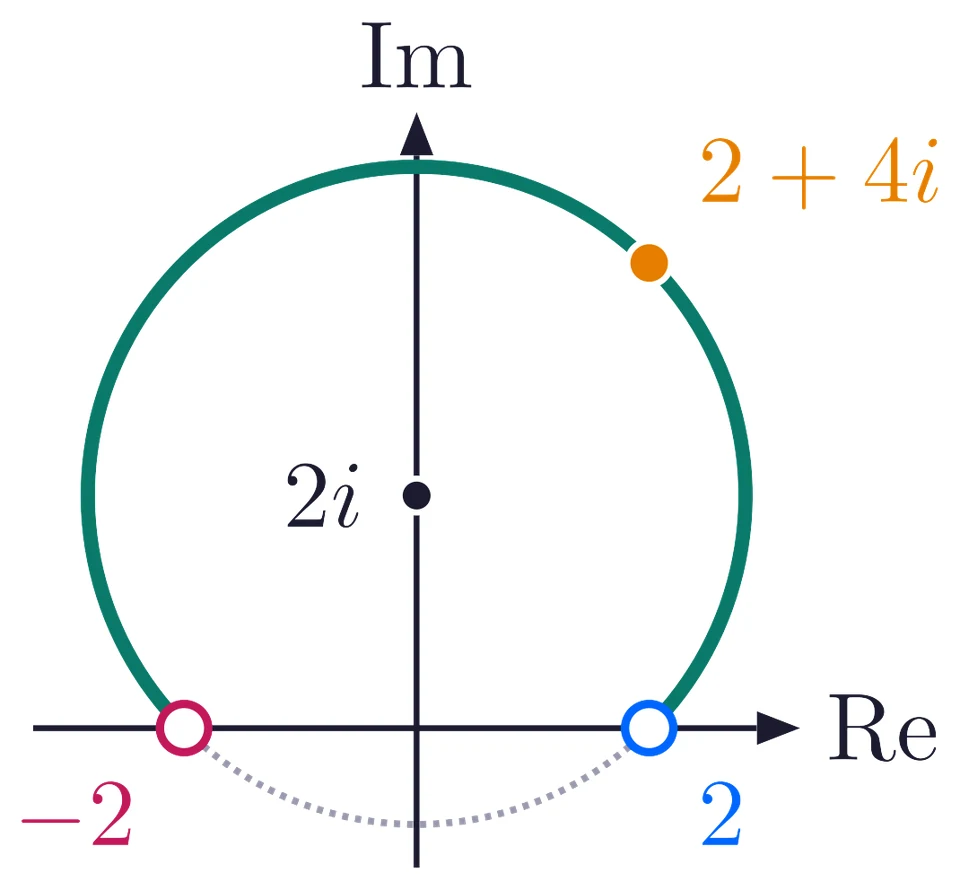
Find the locus of \(z\) if \(\arg\dfrac{z - 2}{z + 2} = \dfrac{\pi}{4}\).
Radius. The two points are \(2\) and \(-2\), so the chord is \(|a - b| = 4\) and \(R = \dfrac{4}{2\sin\frac{\pi}{4}} = 2\sqrt{2}\).
Centre. On the imaginary axis, at a distance \(\sqrt{R^2 - 2^2} = 2\) from the middle of the chord. The angle is positive, so the arc is above the real axis. It is acute, so the arc is a major arc and the centre is above too: \(2i\).
Check. \(\dfrac{(2 + 4i) - 2}{(2 + 4i) + 2} = \dfrac{4i}{4 + 4i} = \dfrac{1 + i}{2}\), and its argument is \(\dfrac{\pi}{4}\).
The major arc above the real axis of the circle with centre \(2i\) and radius \(2\sqrt{2}\), without \(\pm 2\).
Any arc question in five steps
- Read \(a\) from the top, \(z - a\), and \(b\) from the bottom, \(z - b\). Join them: this is the chord.
- The sign picks the side: walk from \(b\) to \(a\); a positive angle is on the left.
- The size picks the arc: acute gives a major arc, right a semicircle, obtuse a minor arc.
- \(R = \dfrac{|a - b|}{2\sin\theta}\), with the centre on the perpendicular bisector.
- Draw \(a\) and \(b\) hollow, and check one point of the arc.
Practice set
Easy to hard. Sketch each question first: mark \(a\) and \(b\), then decide the side and the kind of arc before you calculate. Try each one before you open its answer.
Find the locus of \(z\) if \(\arg\dfrac{z - 1}{z + 1} = -\dfrac{\pi}{2}\).
Show answer
The lower half of \(|z| = 1\), without \(\pm 1\). A right angle at \(z\), turned clockwise, so below the real axis. Check \(-i\): \(\dfrac{-i - 1}{-i + 1} = -i\), argument \(-\dfrac{\pi}{2}\).
Find the locus of \(z\) if \(\arg\dfrac{z - i}{z + i} = \dfrac{\pi}{2}\).
Show answer
The left half of \(|z| = 1\), without \(\pm i\). A right angle at \(z\): the circle on the diameter from \(-i\) to \(i\). Walk from \(-i\) up to \(i\): the left is the side of \(-1\). Check \(-1\): \(\dfrac{-1 - i}{-1 + i} = i\).
Find the centre and the radius of the locus \(\arg\dfrac{z - 2}{z + 2} = \dfrac{\pi}{3}\). Is the arc major or minor?
Show answer
Centre \(\dfrac{2}{\sqrt{3}}\,i\), radius \(\dfrac{4}{\sqrt{3}}\), a major arc above the real axis. \(R = \dfrac{4}{2\sin\frac{\pi}{3}} = \dfrac{4}{\sqrt{3}}\). The centre is \(\sqrt{\dfrac{16}{3} - 4} = \dfrac{2}{\sqrt{3}}\) from \(0\); the angle is acute, so the centre is on the arc's side.
Do the same for \(\arg\dfrac{z - 2}{z + 2} = \dfrac{2\pi}{3}\).
Show answer
Centre \(-\dfrac{2}{\sqrt{3}}\,i\), radius \(\dfrac{4}{\sqrt{3}}\), a minor arc above the real axis. \(\sin\dfrac{2\pi}{3} = \sin\dfrac{\pi}{3}\), so \(R\) is the same. The angle is obtuse, so the centre is on the other side of the chord, below.
Find the locus of \(z\) if \(\arg\dfrac{z - 1}{z + 1} = \dfrac{\pi}{4}\).
Show answer
The major arc of \(|z - i| = \sqrt{2}\) above the real axis, without \(\pm 1\). \(R = \dfrac{2}{2\sin\frac{\pi}{4}} = \sqrt{2}\); the centre is \(\sqrt{2 - 1} = 1\) above \(0\). Check \(1 + 2i\): \(\dfrac{2i}{2 + 2i} = \dfrac{1 + i}{2}\), argument \(\dfrac{\pi}{4}\).
Find the locus of \(z\) if \(\dfrac{z - 1}{z + 1}\) is purely imaginary.
Show answer
The whole circle \(|z| = 1\), without \(\pm 1\). The argument is \(\dfrac{\pi}{2}\) on the upper half and \(-\dfrac{\pi}{2}\) on the lower half, and both count. At \(\pm 1\) the fraction is \(0\) or does not exist.
Find the locus of \(z\) if \(\arg\dfrac{z - 1}{z + 1} = \pi\).
Show answer
The segment from \(-1\) to \(1\), without its ends. Argument \(\pi\): the fraction is a negative real number, so \(z - 1\) and \(z + 1\) point opposite ways and \(z\) lies between \(-1\) and \(1\). At \(z = 0\) the fraction is \(-1\).
A student gives the centre of the locus \(\arg\dfrac{z - 2}{z + 2} = \dfrac{\pi}{4}\) as \(-2i\). Find the mistake and the correct centre.
Show answer
The centre is \(2i\). On the circle about \(-2i\) the argument is \(\dfrac{3\pi}{4}\) above the real axis and \(-\dfrac{\pi}{4}\) below it, never \(\dfrac{\pi}{4}\). For an acute angle the centre is on the arc's side.