
Two words: distance and locus
\(z - a\) is the arrow from the point \(a\) to the point \(z\), and \(|z - a|\) is its length. So \(|z - a|\) is the distance between \(z\) and \(a\).
A locus is the set of all the points that obey a rule. Let a point keep obeying the rule as it moves: the path it traces is the locus.
\(|z - a|\) is a distance
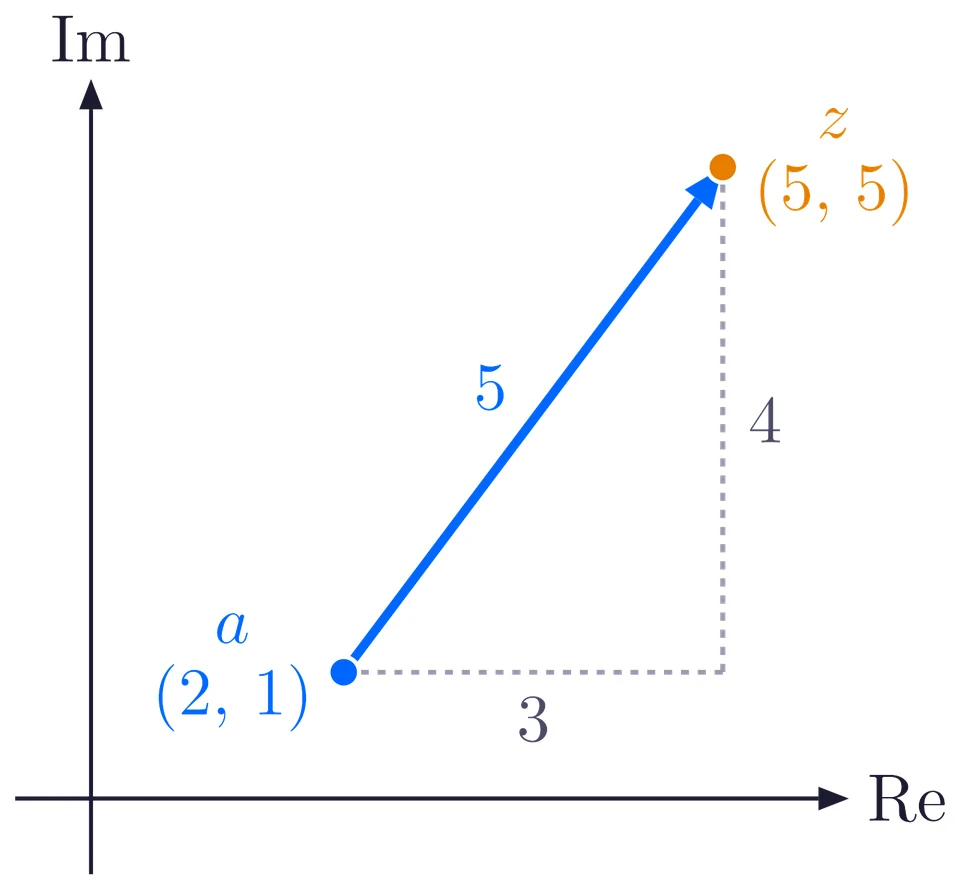
Take \(a = 2 + i\), the point \((2, 1)\), and \(z = 5 + 5i\), the point \((5, 5)\). Then
\[ z - a = 3 + 4i, \qquad |z - a| = \sqrt{3^2 + 4^2} = 5 . \]
The arrow from \(a\) to \(z\) goes \(3\) across and \(4\) up, so the two points are \(5\) apart. In general, with \(z = x + iy\) and \(a = p + iq\), \(|z - a| = \sqrt{(x - p)^2 + (y - q)^2}\): the distance formula.
Read the point: write \(z\) minus a number
\(|z + 1| = |z - (-1)|\) is the distance from \(-1\), and \(|z + 1 - i| = |z - (-1 + i)|\) is the distance from \(-1 + i\). A number in front of \(z\) comes out first: \(|2z + 2| = 2\,|z + 1|\).
One fixed distance: a circle
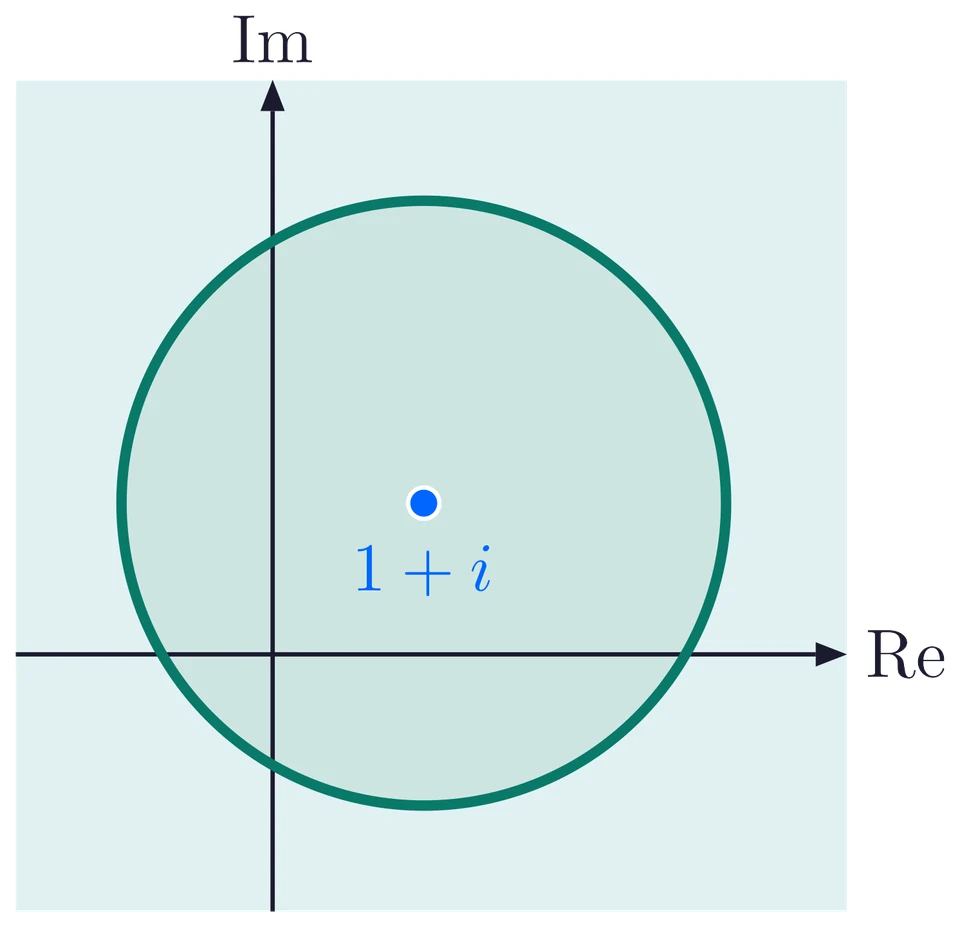
\(|z - (1 + i)| = 2\) says that \(z\) is always \(2\) away from \(1 + i\). Let the point move and keep that distance: it traces the circle with centre \(1 + i\) and radius \(2\).
Inside the circle the distance is less than \(2\): \(|z - (1 + i)| < 2\). Outside it is more than \(2\): \(|z - (1 + i)| > 2\). The origin is inside, since \(|0 - (1 + i)| = \sqrt{2}\), which is less than \(2\).
One fixed distance
\(|z - a| = r\) (\(r > 0\)) is the circle with centre \(a\) and radius \(r\). \(|z - a| < r\) is the inside, \(|z - a| \le r\) includes the circle, and \(|z - a| > r\) is the outside.
Two equal distances: a straight line
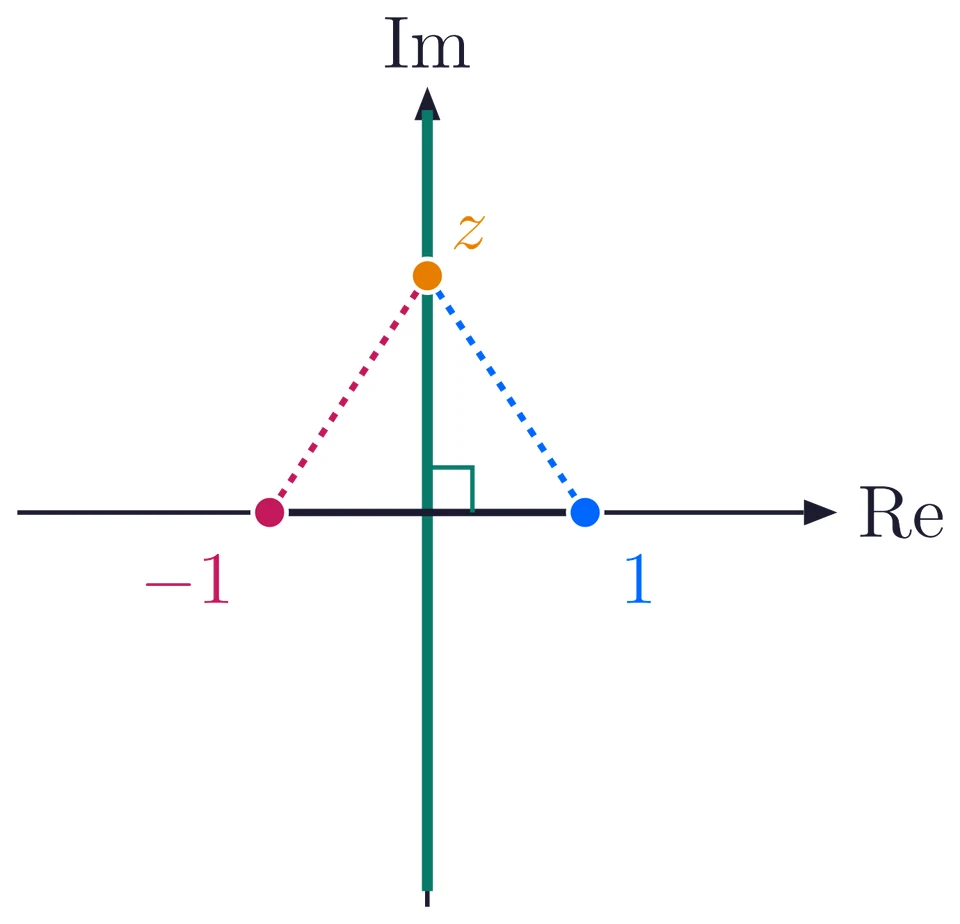
\(|z - 1| = |z + 1|\). Read \(|z + 1|\) as \(|z - (-1)|\), the distance from \(-1\). So \(z\) is as far from \(1\) as from \(-1\). Let the point move with these two distances equal, and it can only go up and down: the locus is the imaginary axis, the line \(x = 0\).
It is the perpendicular bisector of the segment from \(-1\) to \(1\): it passes through the midpoint \(0\) at a right angle. In \(x\) and \(y\): \((x - 1)^2 + y^2 = (x + 1)^2 + y^2\) gives \(-4x = 0\), so \(x = 0\).
Two equal distances
\(|z - a| = |z - b|\) (\(a \ne b\)) is the perpendicular bisector of the segment from \(a\) to \(b\).
A less obvious line
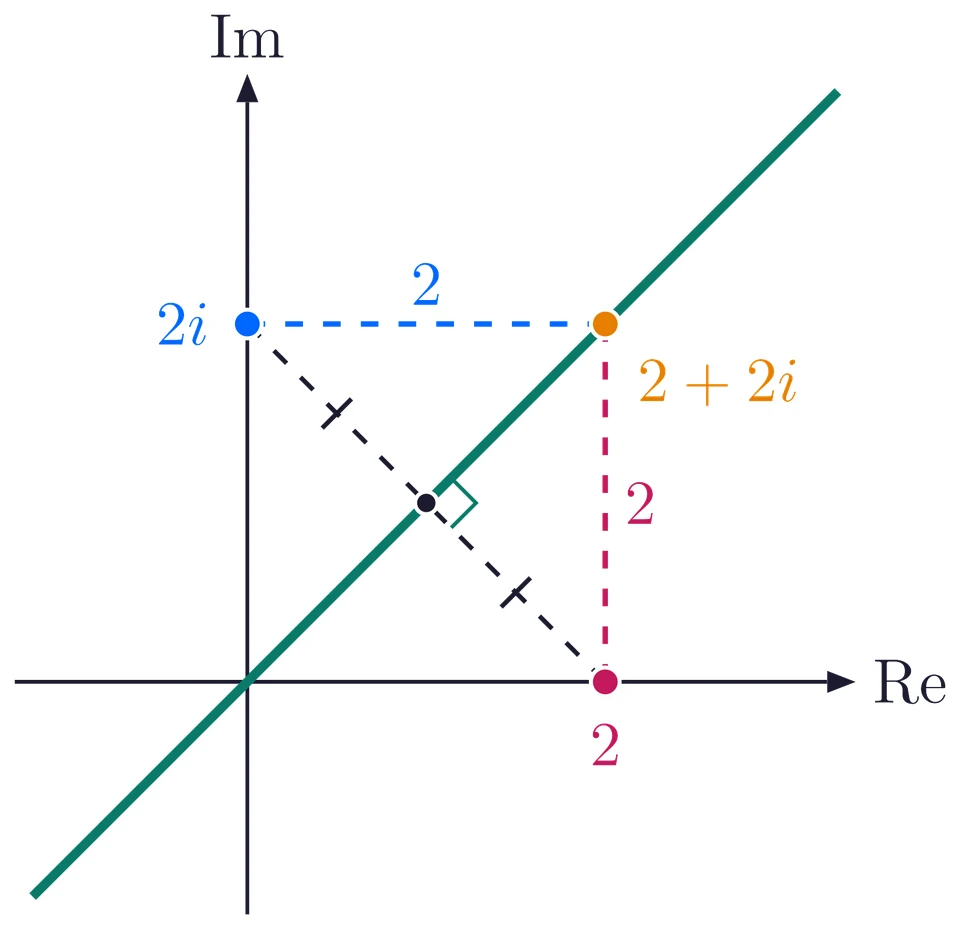
\(|z - 2i| = |z - 2|\): \(z\) is as far from \(2i\) as from \(2\). The locus is the perpendicular bisector of the segment from \(2i\) to \(2\). It passes through the midpoint \(1 + i\) and is at right angles to the segment: the line \(y = x\).
Check with \(z = x + iy\): \(x^2 + (y - 2)^2 = (x - 2)^2 + y^2\) gives \(4x - 4y = 0\), so \(y = x\). And the point \(2 + 2i\) is \(2\) from both: \(|2 + 2i - 2i| = 2\) and \(|2 + 2i - 2| = 2\).
One distance twice the other: a circle again
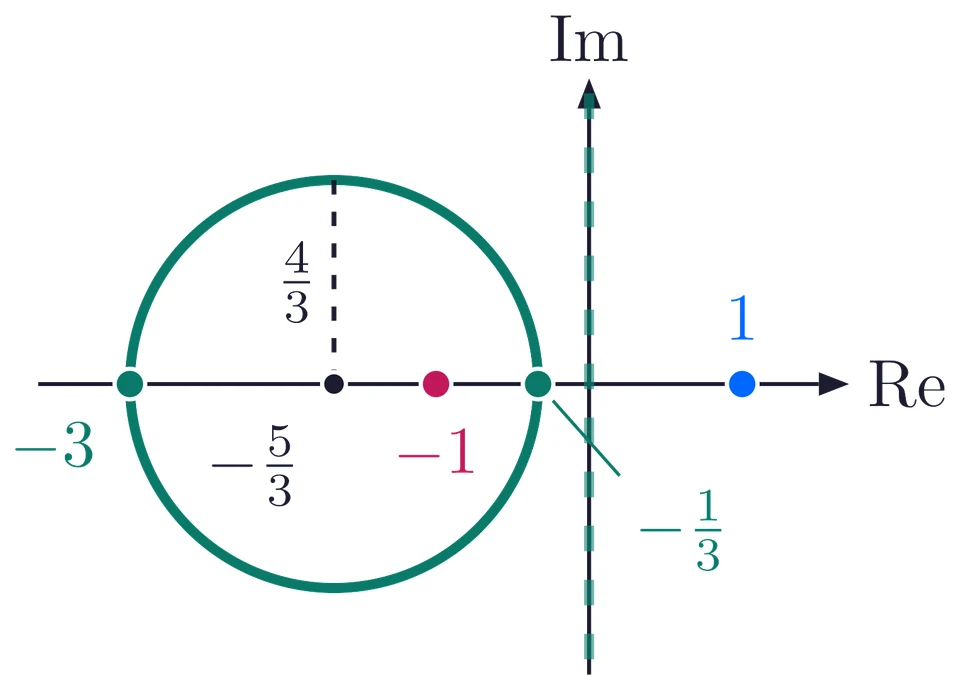
Put a \(2\) in front: \(|z - 1| = 2|z + 1|\). Now \(z\) must be twice as far from \(1\) as from \(-1\). The path is no longer a line: it closes into a circle round \(-1\).
On the real axis it passes through \(-\dfrac{1}{3}\) (distances \(\dfrac{4}{3}\) and \(\dfrac{2}{3}\)) and \(-3\) (distances \(4\) and \(2\)). The centre is halfway between them, \(-\dfrac{5}{3}\), and the radius is half the gap, \(\dfrac{4}{3}\). This is the circle of Apollonius.
Why a circle: the algebra
Put \(z = x + iy\) and square both sides:
\[ (x - 1)^2 + y^2 = 4\left[(x + 1)^2 + y^2\right] \;\Longrightarrow\; 3x^2 + 3y^2 + 10x + 3 = 0 \;\Longrightarrow\; \left(x + \tfrac{5}{3}\right)^2 + y^2 = \left(\tfrac{4}{3}\right)^2 . \]
The quick way: two points on the line through \(a\) and \(b\)
For \(|z - a| = k|z - b|\) (\(k > 0\), \(k \ne 1\)) the circle crosses the line through \(a\) and \(b\) at
\[ P = \frac{a + kb}{1 + k} \ \text{(between } a \text{ and } b\text{)}, \qquad Q = \frac{kb - a}{k - 1} \ \text{(outside)} . \]
\(PQ\) is a diameter: the centre is halfway between \(P\) and \(Q\), and the radius is half of \(|P - Q|\). Here \(P = -\dfrac{1}{3}\) and \(Q = -3\).
Careful: read \(k\) before you draw
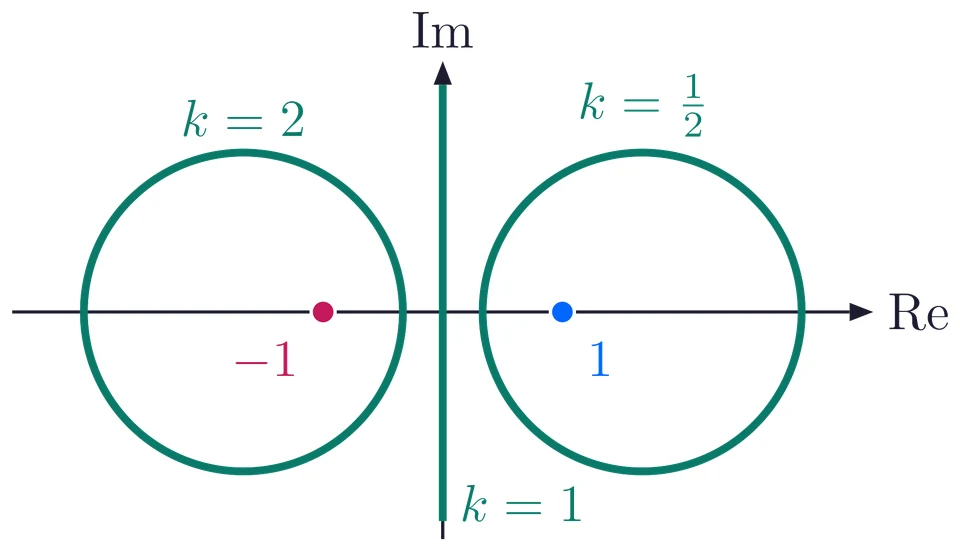
For \(|z - 1| = k|z + 1|\), squaring gives
\[ (1 - k^2)(x^2 + y^2) - 2(1 + k^2)x + (1 - k^2) = 0 . \]
The \(x^2 + y^2\) terms carry \(1 - k^2\), so they disappear only when \(k = 1\), and then the locus is the line \(x = 0\). For any other positive \(k\) it is a circle. Look for a hidden \(k\): \(|z - 1| = |2z + 2|\) is \(|z - 1| = 2|z + 1|\), a circle, not a line.
Solved example
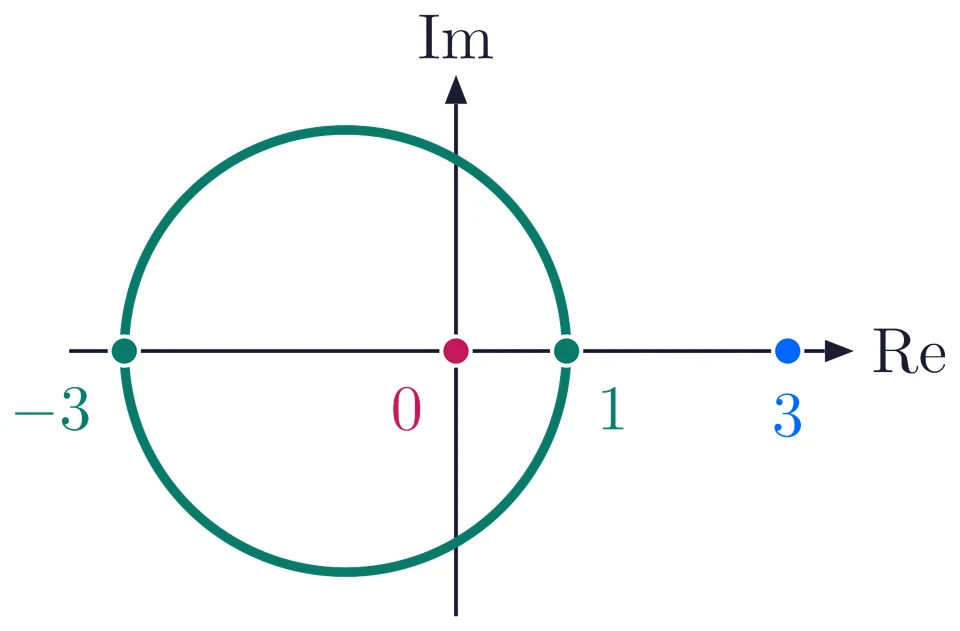
Find the locus of \(z\) if \(|z - 3| = 2|z|\).
Square. With \(z = x + iy\): \((x - 3)^2 + y^2 = 4(x^2 + y^2)\), so \(3x^2 + 3y^2 + 6x - 9 = 0\), that is \(x^2 + y^2 + 2x - 3 = 0\).
Complete the square. \((x + 1)^2 + y^2 = 2^2\).
Check. The circle meets the real axis at \(1\) and \(-3\): \(|1 - 3| = 2 = 2\,|1|\) and \(|-3 - 3| = 6 = 2\,|-3|\).
A circle with centre \(-1\) and radius \(2\).
Practice set
Easy to hard. Read every modulus as a distance first, and mark the points: the picture tells you whether to expect a circle or a line. Try each one before you open its answer.
Find the centre and the radius of \(|z - 3 + 2i| = 4\).
Show answer
Centre \(3 - 2i\), radius \(4\). Write \(z\) minus a number: \(z - 3 + 2i = z - (3 - 2i)\). So the distance from \(3 - 2i\) is always \(4\).
Find the centre of \(|z + 1 - i| = 2\). Is \(0\) inside it?
Show answer
Centre \(-1 + i\); yes, \(0\) is inside. \(z + 1 - i = z - (-1 + i)\). The distance of \(0\) from the centre is \(|0 - (-1 + i)| = \sqrt{2}\), less than the radius \(2\).
Which of \(3 + i\), \(1 + 4i\) and \(2 + 2i\) satisfy \(|z - (1 + i)| < 2\)?
Show answer
Only \(2 + 2i\). Distances from \(1 + i\): \(3 + i\) is \(2\) away (on the circle, not inside), \(1 + 4i\) is \(3\) away (outside), \(2 + 2i\) is \(\sqrt{2}\) away (inside).
Find the locus of \(z\) if \(|z - 2 - 3i| = |z + 2 + 3i|\).
Show answer
The line \(2x + 3y = 0\), the perpendicular bisector of \(2 + 3i\) and \(-2 - 3i\). Squaring: \(-4x - 6y = 4x + 6y\), so \(2x + 3y = 0\), through the midpoint \(0\).
Find the locus of \(z\) if \(|z - 4| = |z - 2i|\).
Show answer
The line \(y = 2x - 3\), the perpendicular bisector of \(4\) and \(2i\). Squaring: \(-8x + 16 = -4y + 4\). Check: it passes through the midpoint \(2 + i\).
Find the locus of \(z\) if \(|z + 2| = 2|z - 1|\).
Show answer
A circle with centre \(2\) and radius \(2\). Squaring: \(x^2 + y^2 - 4x = 0\). Quick way with \(a = -2\), \(b = 1\), \(k = 2\): \(P = 0\) and \(Q = 4\), so the centre is \(2\) and the radius \(2\).
Find the locus of \(z\) if \(|z - i| = 3|z + i|\).
Show answer
A circle with centre \(-\dfrac{5}{4}i\) and radius \(\dfrac{3}{4}\). Squaring: \(8x^2 + 8y^2 + 20y + 8 = 0\). Quick way on the imaginary axis: \(P = -\dfrac{1}{2}i\) and \(Q = -2i\).
A student says \(|z - 1| = |2z + 2|\) is a line, because it looks like \(|z - a| = |z - b|\). Find the mistake and the correct locus.
Show answer
A circle with centre \(-\dfrac{5}{3}\) and radius \(\dfrac{4}{3}\). \(|2z + 2| = 2\,|z + 1|\), so this is \(|z - 1| = 2|z + 1|\) with \(k = 2\), not \(1\): the circle of Apollonius from the lesson.