
Two words: the foci and the ellipse
\(|z - a|\) is the distance between the points \(z\) and \(a\). Two fixed points \(a\) and \(b\) are called the foci; each one is a focus. Read each focus with its sign: \(|z + 3| = |z - (-3)|\), so the focus is \(-3\).
Pin the two ends of a string at the foci, keep it tight with a pencil and take the pencil all the way round. The curve it draws is an ellipse. Every point of it has the same sum of distances from the foci: the length of the string.
A fixed sum of distances: the ellipse
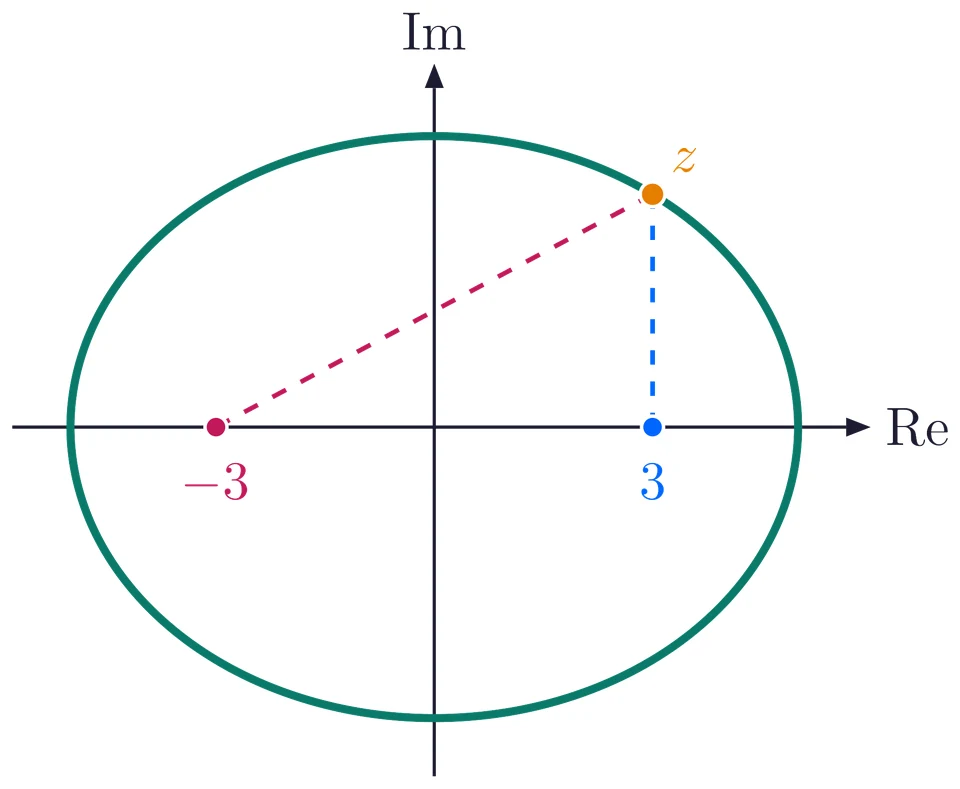
Take \(|z - 3| + |z + 3| = 10\). The foci are \(3\) and \(-3\), and the distances from \(z\) to them add up to \(10\).
At \(z = 3 + 3.2i\) they are \(3.2\) and \(6.8\); at \(z = 4i\) both are \(5\); at \(z = 5\) they are \(2\) and \(8\). Each time the sum is \(10\).
The locus is an ellipse
The distances are the two pieces of a string of length \(10\) pinned at \(3\) and \(-3\). As \(z\) goes round, it draws an ellipse with foci \(3\) and \(-3\).
How wide and how tall?
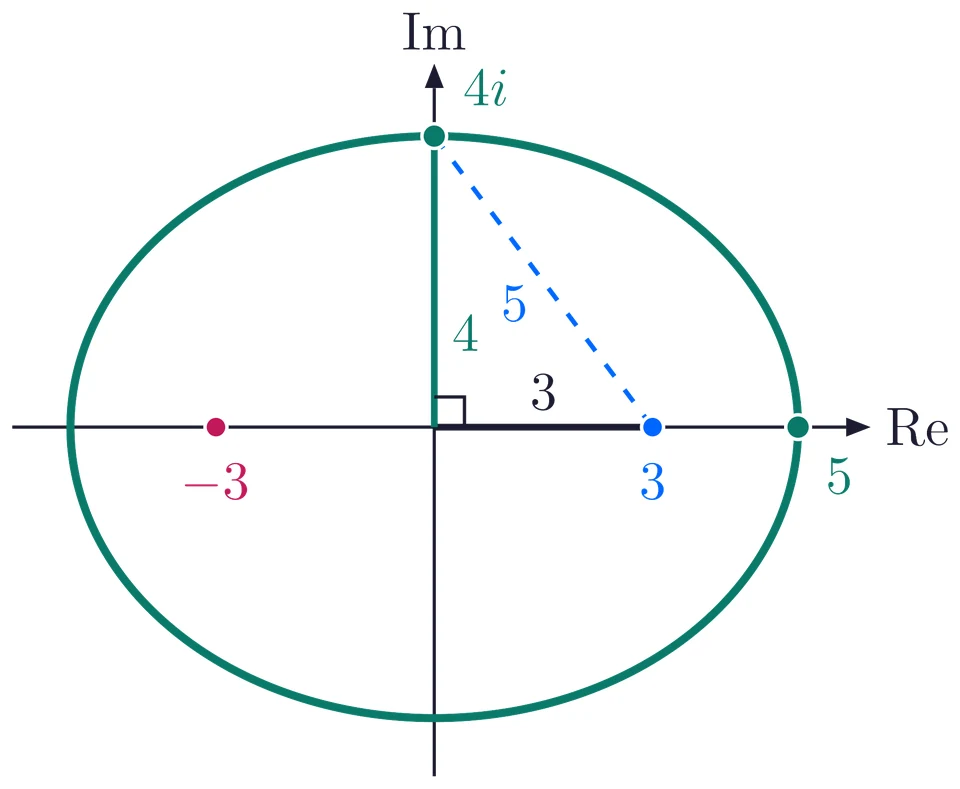
Width. On the real axis to the right of \(3\), \(z = x\) and the distances are \(x - 3\) and \(x + 3\). They add up to \(2x = 10\), so \(x = 5\): half the length of the string. By symmetry the ellipse also meets the real axis at \(-5\).
Height. At the top point both distances are equal, so each is \(5\). The right triangle with base \(3\) (half the gap) and slanted side \(5\) has height \(\sqrt{5^2 - 3^2} = 4\). The ellipse reaches \(4i\) and \(-4i\).
In conic sections it is \(\dfrac{x^2}{25} + \dfrac{y^2}{16} = 1\); the distances gave its size without it.
Any ellipse \(|z - a| + |z - b| = k\) with \(k > |a - b|\)
Centre \(\dfrac{a + b}{2}\). Half-width \(\dfrac{k}{2}\) along the line through the foci. Half-height \(\dfrac{1}{2}\sqrt{k^2 - |a - b|^2}\) across it, from the right triangle.
The string as long as the gap: a line segment
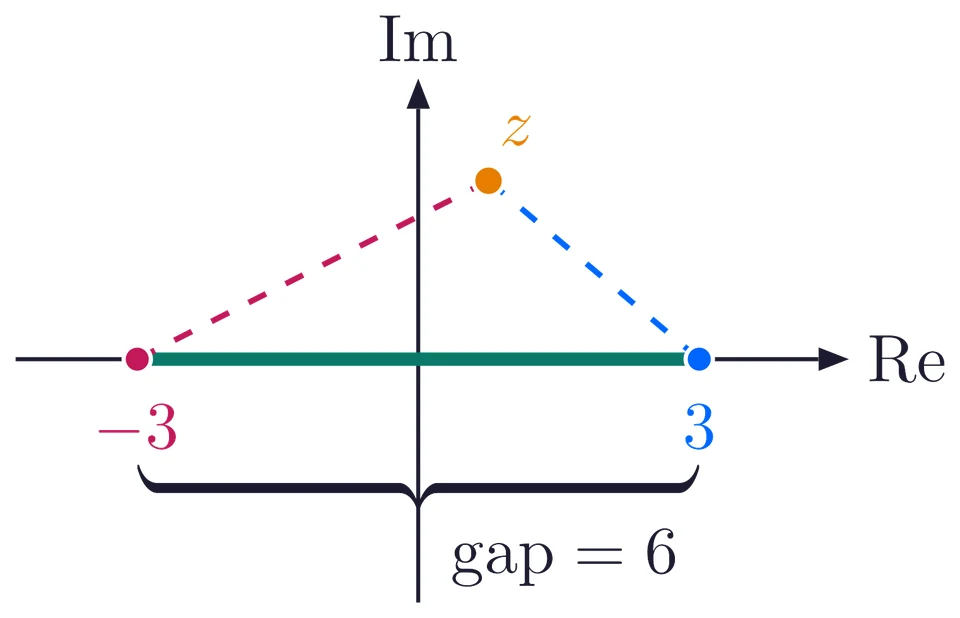
Shorten the string. At \(k = 6\) it is exactly as long as the gap between \(3\) and \(-3\), so it lies flat between the foci, and the ellipse becomes the line segment from \(-3\) to \(3\).
Why. Join any \(z\) to \(3\) and \(-3\). In a triangle two sides together are longer than the third, so off the segment the sum is more than \(6\). On the segment the triangle is flat and the sum is exactly \(6\).
So \(|z - 3| + |z + 3|\) is never less than \(6\), and \(|z - 3| + |z + 3| = 4\) has no point at all.
A fixed difference: the hyperbola
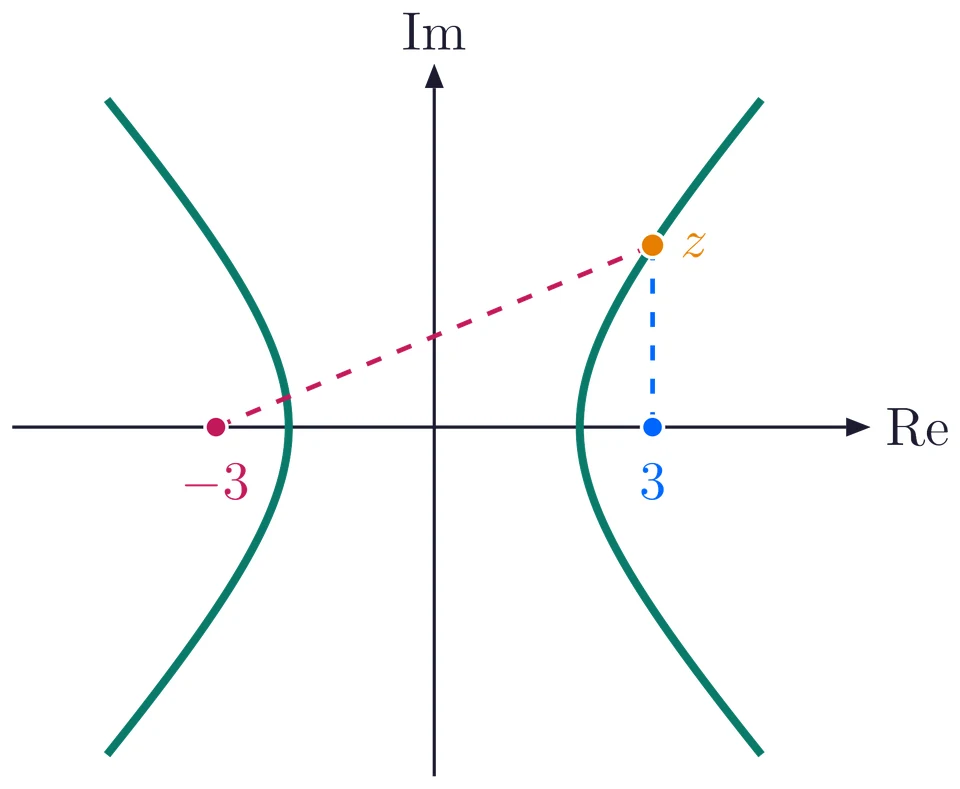
Take \(\big||z - 3| - |z + 3|\big| = 4\). The outer modulus means: the larger distance minus the smaller one is \(4\).
At \(z = 3 + 2.5i\) the distances are \(2.5\) and \(6.5\); at \(z = 2\) they are \(1\) and \(5\). These points make a curve near \(3\). The difference can also be \(4\) the other way round, with \(z\) nearer \(-3\) (at \(z = -2\): \(5\) and \(1\)), which gives a second curve near \(-3\).
The locus is a hyperbola
The two curves together are a hyperbola with foci \(3\) and \(-3\): \(\dfrac{x^2}{4} - \dfrac{y^2}{5} = 1\) in conic sections.
The difference as large as the gap: two rays
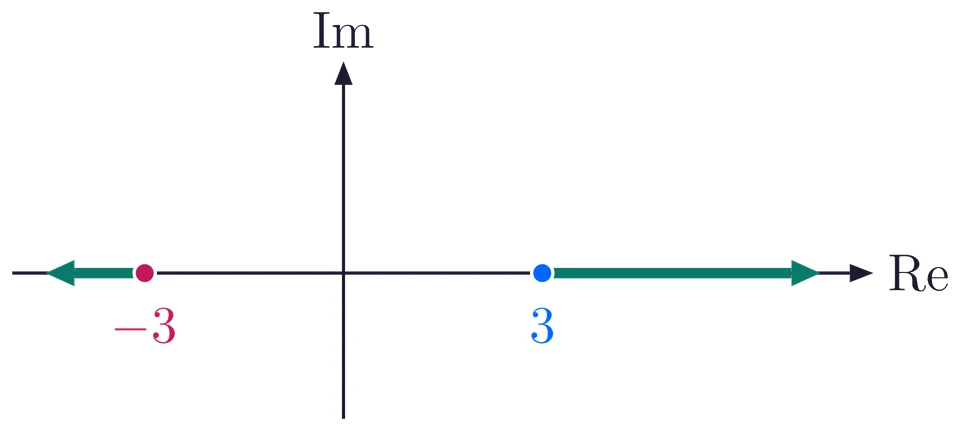
In a triangle the difference of two sides is less than the third side, so the difference of the distances is never more than \(6\). It is exactly \(6\) only on the real axis where \(x \ge 3\) or \(x \le -3\): at \(z = 4\) the distances are \(1\) and \(7\), at \(z = 6\) they are \(3\) and \(9\).
So \(\big||z - 3| - |z + 3|\big| = 6\) is the two rays \(x \ge 3\) and \(x \le -3\) of the real axis, and a difference of \(8\) gives no point.
Careful: \(|z - 3| + |z + 3| = 6\) is not an ellipse
The gap between the foci is also \(6\): the string only reaches from one focus to the other, so the locus is the line segment from \(-3\) to \(3\). Many students call it an ellipse. And when the sum is less than the gap, as in \(|z - 3| + |z + 3| = 4\), there is no point at all.
Before you name the curve, compare \(k\) with the gap \(|a - b|\).
Compare \(k\) with the gap \(|a - b|\)
- \(k\) more than the gap: the sum gives an ellipse, the difference gives no point.
- \(k\) equal to the gap: the sum gives the segment from \(a\) to \(b\), the difference gives two rays, from \(a\) and from \(b\), outward.
- \(k\) less than the gap: the sum gives no point, the difference gives a hyperbola (for \(k > 0\)).
A difference of \(0\) means \(|z - a| = |z - b|\): the perpendicular bisector of the segment joining the foci.
From the video
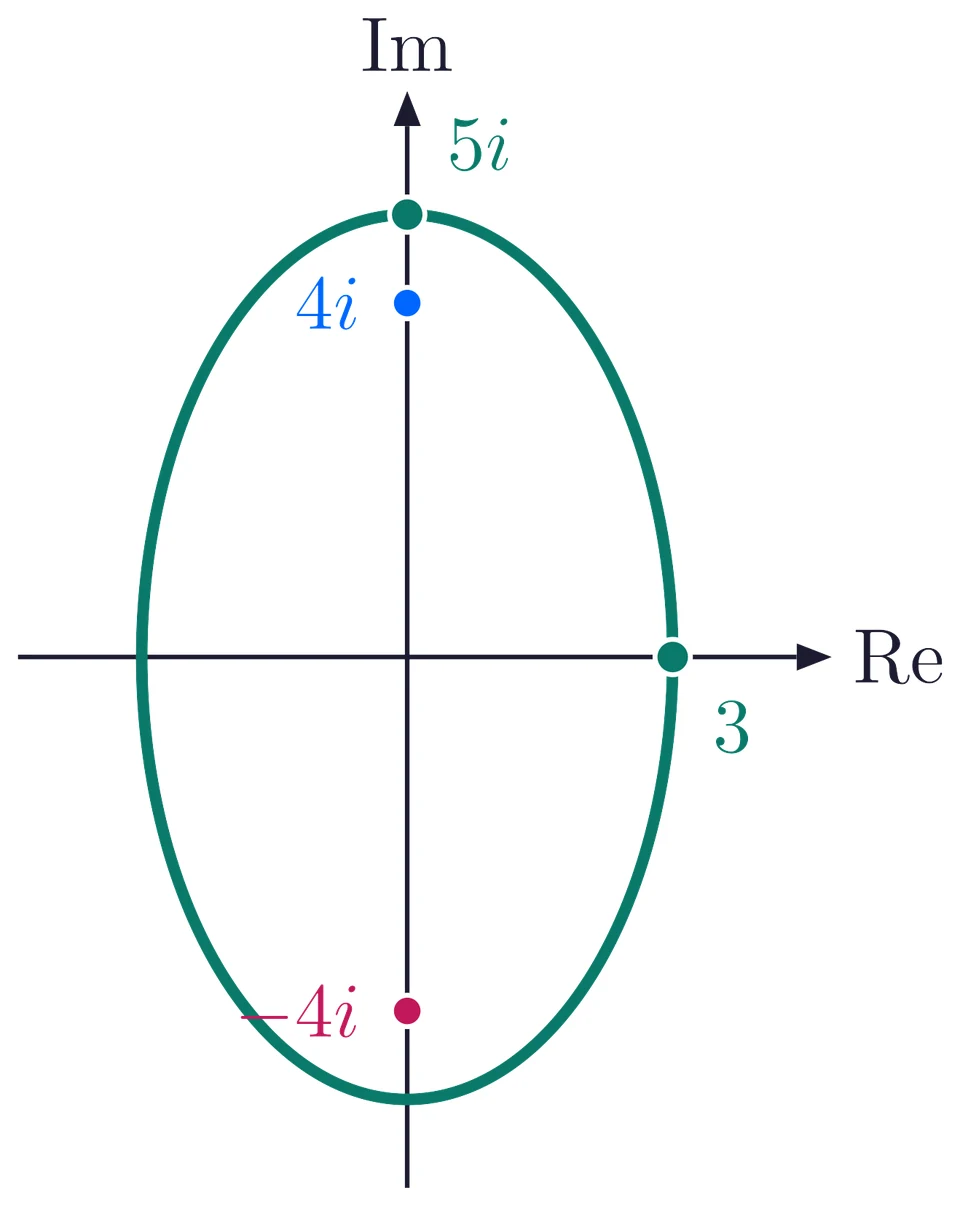
Find the locus of \(z\) if \(|z - 4i| + |z + 4i| = 10\).
Compare. The foci are \(4i\) and \(-4i\); the gap is \(8\), and the sum \(10\) is more than \(8\): an ellipse. It stands upright, because the foci are on the imaginary axis.
Check two points. At \(5i\) the distances are \(1\) and \(9\). At \(3\) both are \(5\) (the \(3\), \(4\), \(5\) right triangle). Each pair adds up to \(10\).
An ellipse with foci \(\pm 4i\), through \(\pm 5i\) and \(\pm 3\): \(\dfrac{x^2}{9} + \dfrac{y^2}{25} = 1\).
One more, with the difference
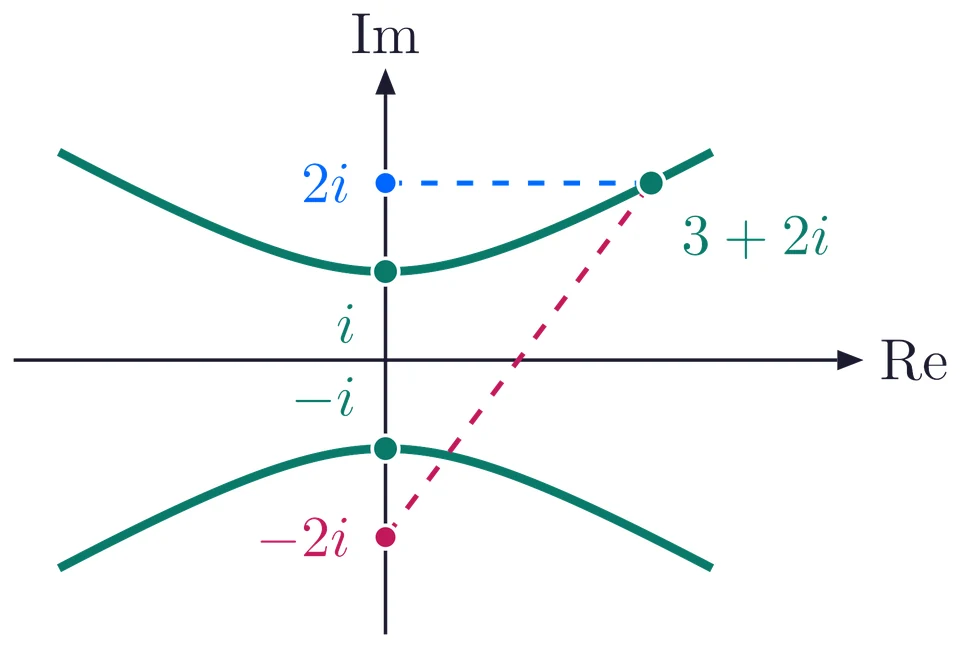
Find the locus of \(z\) if \(\big||z - 2i| - |z + 2i|\big| = 2\).
Compare. The foci are \(2i\) and \(-2i\); the gap is \(4\), and the difference \(2\) is more than \(0\) and less than \(4\): a hyperbola. Its two curves open up and down.
Check two points. At \(i\) the distances are \(1\) and \(3\); at \(3 + 2i\) they are \(3\) and \(5\). Each difference is \(2\).
A hyperbola with foci \(\pm 2i\), through \(\pm i\): \(y^2 - \dfrac{x^2}{3} = 1\).
Key formulas
- Distance from \(z\) to \(a\): \(|z - a|\). Gap between the foci: \(|a - b|\).
- Sum, \(k > |a - b|\): an ellipse, half-width \(\dfrac{k}{2}\), half-height \(\dfrac{1}{2}\sqrt{k^2 - |a - b|^2}\).
- Sum, \(k = |a - b|\): the segment from \(a\) to \(b\).
- Difference, \(0 < k < |a - b|\): a hyperbola. Difference, \(k = |a - b|\): two rays.
- A sum less than the gap, or a difference more than the gap: no point.
Practice set
Easy to hard. For each, find the foci and the gap first, compare \(k\) with the gap, then name the locus. Questions 1, 2, 4 and 5 are the quizzes at the end of the video and its Shorts. Try each one before you open its answer.
Which point lies on \(|z - 4| + |z + 4| = 10\)? (A) \(3i\) (B) \(4i\) (C) \(6i\)
Show answer
(A) \(3i\). The foci are \(4\) and \(-4\). From \(3i\) each is \(\sqrt{4^2 + 3^2} = 5\) away: \(5 + 5 = 10\). At \(4i\) the sum is \(2\sqrt{32} \approx 11.3\), at \(6i\) it is \(2\sqrt{52} \approx 14.4\).
What is the locus of \(|z - 3| + |z + 3| = 5\)? (A) an ellipse (B) a line segment (C) no point at all
Show answer
(C) no point at all. The gap between \(3\) and \(-3\) is \(6\). In the triangle \(z\), \(3\), \(-3\) the sum is at least \(6\), so it can never be \(5\).
Find the locus of \(z\) if \(|z - 2| + |z + 2| = 6\), and how far it reaches along each axis.
Show answer
An ellipse, \(\dfrac{x^2}{9} + \dfrac{y^2}{5} = 1\). Gap \(4\), less than \(6\). Half-width \(3\), half-height \(\frac{1}{2}\sqrt{36 - 16} = \sqrt{5}\): it reaches \(\pm 3\) and \(\pm\sqrt{5}\,i\).
How many parts does the locus of \(\big||z - 1| - |z + 1|\big| = 1\) have? (A) one (B) two (C) none
Show answer
(B) two. Gap \(2\), and \(0 < 1 < 2\): a hyperbola, through \(\frac{1}{2}\) and \(-\frac{1}{2}\). The imaginary axis, where the difference is \(0\), lies between its two parts.
What is the locus of \(z\) if \(\big||z - i| - |z + i|\big| = 2\)? (A) a hyperbola (B) two rays (C) no point at all
Show answer
(B) two rays. The gap \(|i - (-i)| = 2\) is equal to the difference: the imaginary axis from \(i\) upwards and from \(-i\) downwards. At \(3i\): \(4 - 2 = 2\).
Find the locus of \(z\) if \(\big||z - 5| - |z + 5|\big| = 6\), and where it crosses the real axis.
Show answer
A hyperbola, \(\dfrac{x^2}{9} - \dfrac{y^2}{16} = 1\). Gap \(10\), more than \(6\). Half the difference is \(3\), so it crosses the real axis at \(\pm 3\) (at \(3\): \(8 - 2 = 6\)); \(25 - 9 = 16\).
For which values of \(k\) is the locus of \(|z - 3i| + |z + 3i| = k\) an ellipse?
Show answer
\(k > 6\). The gap between \(3i\) and \(-3i\) is \(6\). At \(k = 6\) the locus is the segment between the foci, and for \(k\) less than \(6\) there is no point.
A student says that \(|z - 3| - |z + 3| = 4\) (no outer modulus) is a whole hyperbola. Find the mistake, and the correct locus.
Show answer
Only the branch nearer \(-3\). Without the outer modulus, \(z\) must be \(4\) farther from \(3\) than from \(-3\): the curve through \(-2\) (\(5 - 1 = 4\)). At \(2\) the difference is \(1 - 5 = -4\).