
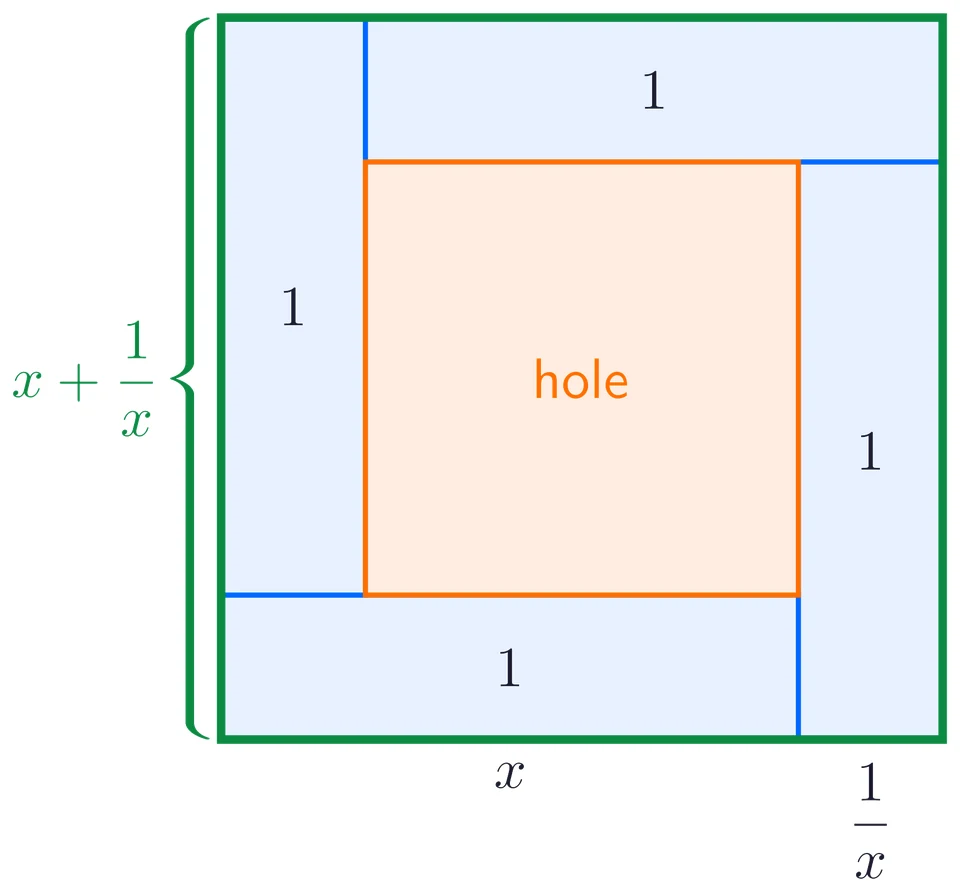
For every positive \(x\), \(x + \dfrac{1}{x} \ge 2\), and it is equal to \(2\) only at \(x = 1\). The reason is one picture: four rectangles of area \(1\) round a square of side \(x + \dfrac{1}{x}\) leave a square hole in the middle, so the big square's area is at least \(4\).
Fixed product
\(x\) and \(\dfrac{1}{x}\) multiply to \(1\) whatever \(x\) is: a rectangle with these sides always has area \(1\).
\(x \times \dfrac{1}{x} = 1\)
Least value
The smallest value the expression takes. Here it is \(2\), reached at \(x = 1\) only.
\(\min\left(x + \dfrac{1}{x}\right) = 2\)
The picture
Take \(x = 2\). A rectangle with sides \(x = 2\) and \(\dfrac{1}{x} = \dfrac{1}{2}\) has area \(1\).
Four such rectangles, each turned a quarter turn from the last, fit round a square of side \(x + \dfrac{1}{x} = 2.5\). In the middle they leave a square hole of side \(x - \dfrac{1}{x} = 1.5\).
So the big square's area is \(4 \times 1\) plus the hole: \(\left(x + \dfrac{1}{x}\right)^2 = 4 + \left(x - \dfrac{1}{x}\right)^2 \ge 4\). The side is positive, so \(x + \dfrac{1}{x} \ge 2\).
When is it exactly 2?
The sum is \(2\) only when the hole has no size, that is, when \(x = \dfrac{1}{x}\). For positive \(x\) this means \(x = 1\).
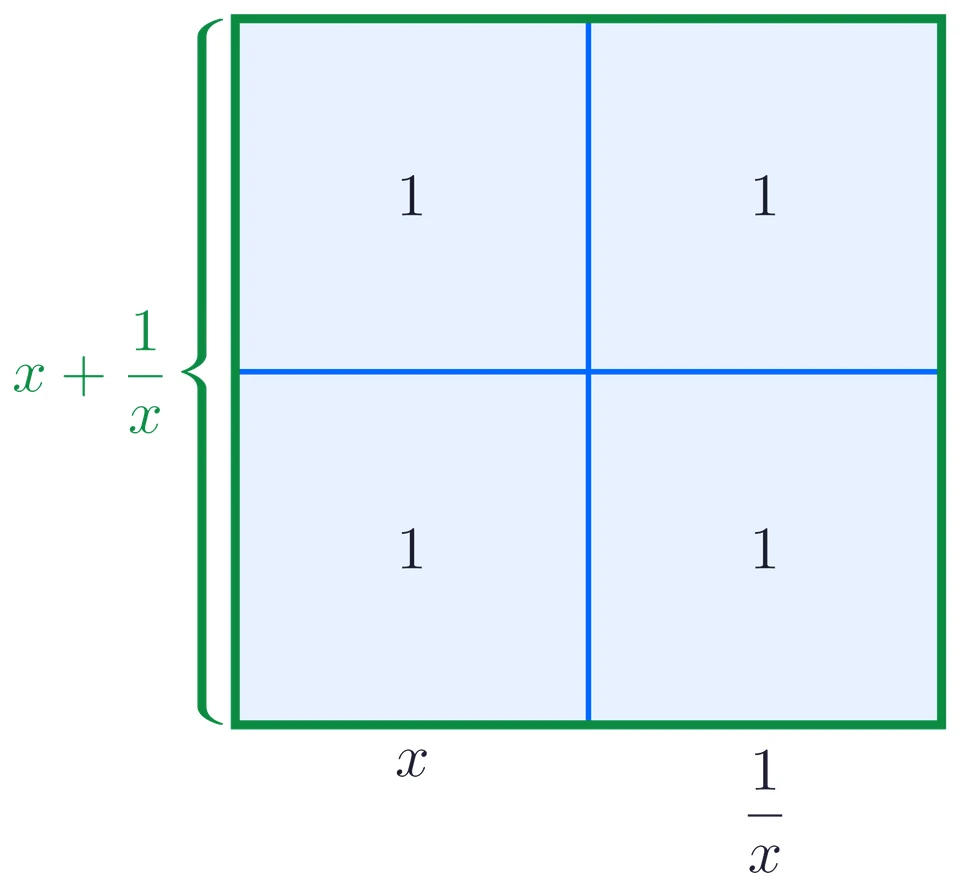
Then the four rectangles are unit squares, and they fill a square of side exactly \(2\).
For any other positive \(x\) there is a hole, and the sum is more than \(2\).
Careful
\(x\) must be positive. For negative \(x\) the sum is negative: \(x + \dfrac{1}{x} \le -2\), equal to \(-2\) at \(x = -1\). So \(x + \dfrac{1}{x}\) has no least value over all \(x \ne 0\).
The least value must be reached. The same idea gives \(t + \dfrac{1}{t} \ge 2\) for any positive \(t\), but \(2\) is the least value only if \(t = 1\) is allowed.
Solved example
Find the least value of \(x + \dfrac{4}{x}\) for \(x > 0\).
Product. \(x \times \dfrac{4}{x} = 4\): four rectangles of area \(4\) round a square of side \(x + \dfrac{4}{x}\), so \(\left(x + \dfrac{4}{x}\right)^2 \ge 16\) and \(x + \dfrac{4}{x} \ge 4\).
When. No hole when \(x = \dfrac{4}{x}\), that is, at \(x = 2\): \(2 + 2 = 4\).
4, at \(x = 2\)
Key formulas
\[ \begin{aligned}\left(x + \frac{1}{x}\right)^2 &= 4 + \left(x - \frac{1}{x}\right)^2\\[3pt] x + \frac{1}{x} &\ge 2 \quad \text{for } x > 0, \text{ equal only at } x = 1\\[3pt] a + b &\ge 2\sqrt{ab} \quad \text{for } a, b > 0, \text{ equal only when } a = b\end{aligned} \]
Practice set
Easy to hard. Try each one before you open its answer.
Quiz from the Short. What is the least value of \(\tan\theta + \cot\theta\), for \(0 < \theta < \dfrac{\pi}{2}\)? (A) \(1\) (B) \(2\) (C) \(4\).
Show answer
(B) \(2\). On \(\left(0, \dfrac{\pi}{2}\right)\), \(\tan\theta > 0\) and \(\cot\theta = \dfrac{1}{\tan\theta}\), so the sum is \(t + \dfrac{1}{t} \ge 2\), equal at \(\tan\theta = 1\), \(\theta = \dfrac{\pi}{4}\). \(1\) is the product; \(4\) is the square of the sum.
Find the least value of \(4^x + 4^{-x}\), for real \(x\).
Show answer
\(2\). \(t = 4^x > 0\) and \(4^{-x} = \dfrac{1}{t}\): \(t + \dfrac{1}{t} \ge 2\), equal at \(t = 1\), \(x = 0\).
Find the least value of \(x + \dfrac{9}{x}\) for \(x > 0\), and the \(x\) where it is reached.
Show answer
\(6\), at \(x = 3\). The product is \(9\): \(x + \dfrac{9}{x} \ge 2\sqrt{9} = 6\), equal when \(x = \dfrac{9}{x}\), \(x = 3\).
For \(x < 0\), find the greatest value of \(x + \dfrac{1}{x}\).
Show answer
\(-2\). Put \(x = -t\) with \(t > 0\): \(x + \dfrac{1}{x} = -\left(t + \dfrac{1}{t}\right) \le -2\), equal at \(t = 1\), \(x = -1\).
Find the least value of \(\sin^2\theta + \operatorname{cosec}^2\theta\).
Show answer
\(2\). \(t = \sin^2\theta\) is in \((0, 1]\) and \(\operatorname{cosec}^2\theta = \dfrac{1}{t}\): \(t + \dfrac{1}{t} \ge 2\), equal at \(t = 1\) (allowed: \(\theta = \dfrac{\pi}{2}\)).
Find the least value of \(\dfrac{x^2 + 2}{\sqrt{x^2 + 1}}\), for real \(x\).
Show answer
\(2\). \(\dfrac{x^2 + 2}{\sqrt{x^2 + 1}} = \sqrt{x^2 + 1} + \dfrac{1}{\sqrt{x^2 + 1}} \ge 2\), equal when \(\sqrt{x^2 + 1} = 1\), at \(x = 0\).