
When a wire is stretched, its copper is not lost: its volume stays the same. So if the length becomes \(n\) times, the cross-section area becomes \(\dfrac{1}{n}\) times, and the resistance \(R = \dfrac{\rho l}{A}\) becomes \(n \times n = n^2\) times. Twice the length gives four times the resistance, not twice.
Resistivity, \(\rho\)
A property of the material (and its temperature), not of the wire's shape. Stretching a copper wire does not change \(\rho\).
\(R = \dfrac{\rho l}{A}\)
Same volume
Stretching only reshapes the copper: \(A \times l\) stays the same. Longer means thinner.
\(A_2 l_2 = A_1 l_1\)
Why four times: the picture
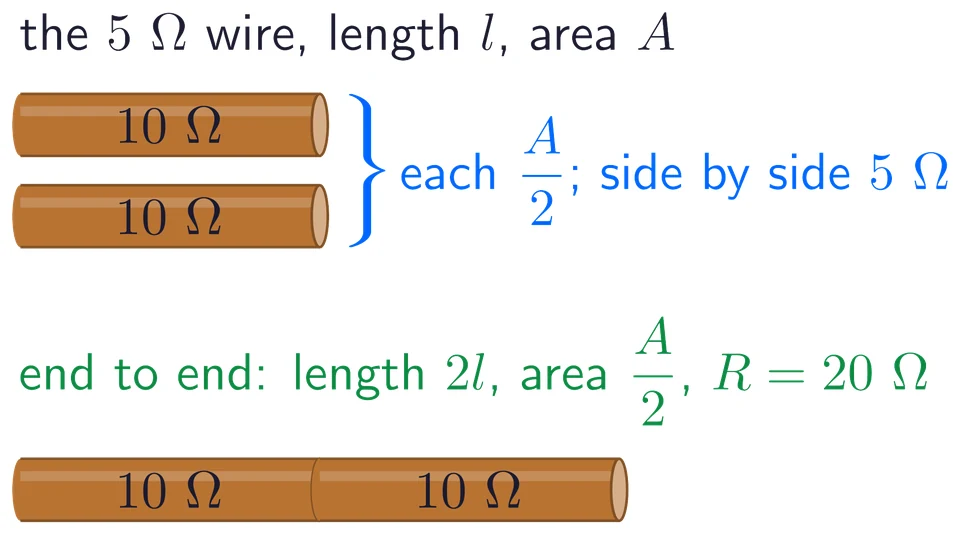
Take a \(5\ \Omega\) wire of length \(l\) and area \(A\). Think of it as two thin wires side by side, each of area \(\dfrac{A}{2}\).
Two equal wires side by side (in parallel) have half the resistance of one. Together they give \(5\ \Omega\), so each thin wire is \(10\ \Omega\).
Stretching to length \(2l\) gives a wire of area \(\dfrac{A}{2}\): exactly the two thin wires put end to end (in series). So the stretched wire is \(10 + 10 = 20\ \Omega\), which is \(2^2 \times 5\ \Omega\).
Three times the length
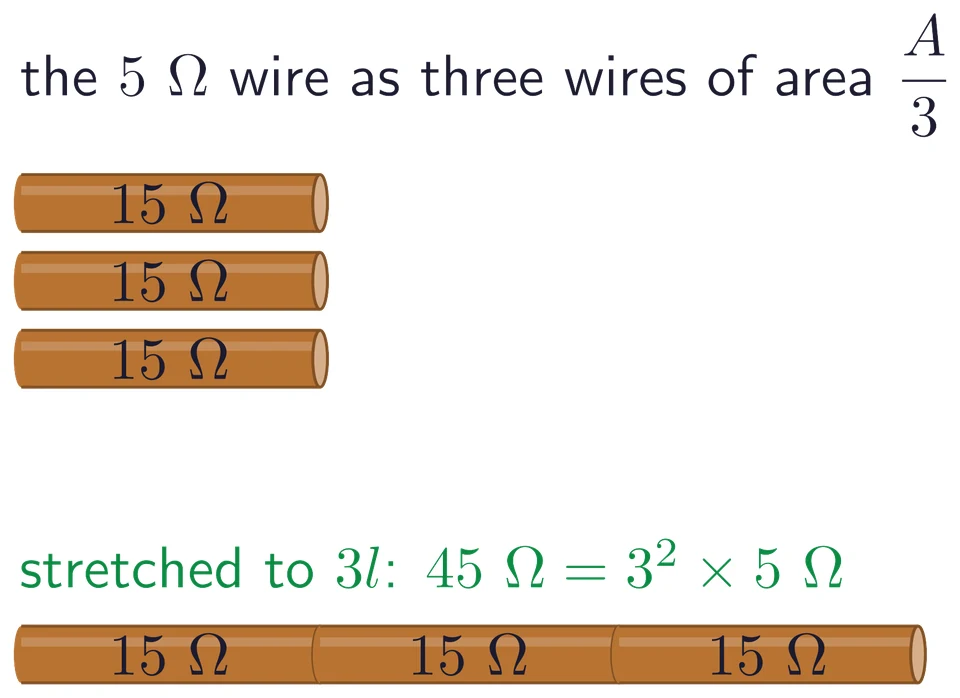
The same picture works for any whole number \(n\). For \(n = 3\): the \(5\ \Omega\) wire is three thin wires of area \(\dfrac{A}{3}\), each \(15\ \Omega\) (three of them side by side give \(5\ \Omega\)).
Stretched to \(3l\), they are end to end: \(15 + 15 + 15 = 45\ \Omega\), which is \(3^2 \times 5\ \Omega\).
By the formula, for any \(n\): \(R_{\text{new}} = \dfrac{\rho\,(n l)}{\frac{A}{n}} = n^2\,\dfrac{\rho l}{A} = n^2 R\).
Careful
Twice the length doubles \(R\) only when the thickness stays the same, as when you cut a longer piece from the same wire. Stretching makes the wire thinner too.
The radius counts twice. If stretching halves the radius, the area becomes \(\dfrac{1}{4}\) and (same volume) the length becomes 4 times: \(R\) becomes \(4 \times 4 = 16\) times.
Solved example
A \(6\ \Omega\) wire is stretched to twice its length. Find its new resistance.
Length and area. The length becomes \(2l\) and, with the same volume, the area becomes \(\dfrac{A}{2}\).
Resistance. \(R_{\text{new}} = 2 \times 2 \times 6 = 24\ \Omega\). Check by the picture: two thin wires of \(12\ \Omega\) (side by side they give \(6\ \Omega\)), end to end \(12 + 12 = 24\ \Omega\).
\(24\ \Omega\)
Key formulas
\[ \begin{aligned}R &= \frac{\rho l}{A}\\[3pt] \text{same volume:}\quad A l &= \text{constant}\\[3pt] \text{stretched to } n \text{ times the length:}\quad R_{\text{new}} &= n^2 R\\[3pt] \text{in terms of the radius } r:\quad R &\propto \frac{1}{r^4}\end{aligned} \]
Practice set
Easy to hard. In each, the wire is stretched uniformly and its volume and resistivity do not change. Try each one before you open its answer.
Quiz from the Short. A wire is stretched to be \(10\%\) longer. By what percent does its resistance increase? (A) \(10\%\) (B) \(21\%\) (C) \(20\%\).
Show answer
(B) \(21\%\). The length becomes \(1.1\) times, so \(R\) becomes \(1.1^2 = 1.21\) times: up by \(21\%\). \(10\%\) treats the area as fixed; \(20\%\) is \(2 \times 10\%\).
A \(4\ \Omega\) wire is stretched to three times its length. Find its new resistance.
Show answer
\(36\ \Omega\). \(n = 3\): \(R_{\text{new}} = 3^2 \times 4 = 36\ \Omega\).
A wire is stretched until its radius is half of what it was. How many times its old resistance does it have now?
Show answer
16 times. Half the radius gives \(\dfrac{1}{4}\) of the area, so the length becomes 4 times. \(R\) becomes \(4 \times 4 = 16\) times.
A wire is stretched to be \(20\%\) longer. By what percent does its resistance increase?
Show answer
\(44\%\). \(1.2^2 = 1.44\), so \(R\) goes up by \(44\%\).
After stretching, a wire's resistance is 4 times what it was. What fraction of its old cross-section area does it have now?
Show answer
\(\dfrac{1}{2}\). \(n^2 = 4\) gives \(n = 2\): twice the length, so half the area.
A \(9\ \Omega\) wire is stretched to three times its length. It is then cut into three equal parts, and the three parts are joined side by side (in parallel). Find the resistance of the combination.
Show answer
\(9\ \Omega\). Stretched: \(3^2 \times 9 = 81\ \Omega\). Each third is \(27\ \Omega\), and three of them side by side give \(\dfrac{27}{3} = 9\ \Omega\).