
\(A\) and \(B\) are on the same side of a line, and \(P\) moves on the line. Mirror \(B\) in the line to get \(B'\). Then the least value of \(PA + PB\) is \(AB'\), and it happens where \(AB'\) meets the line.
Mirror image
The image of a point in a line: on the other side, at the same distance, with the line as the perpendicular bisector of the join.
In the \(x\)-axis, \((x, y)\) goes to \((x, -y)\).
Same side
Two points are on the same side of \(ax + by + c = 0\) when \(ax + by + c\) has the same sign at both.
\(A(1, 2)\) and \(B(9, 4)\): both above the \(x\)-axis.
Why the mirror works
\(P\) is on the \(x\)-axis, \(A(1, 2)\), \(B(9, 4)\). The mirror image of \(B\) in the \(x\)-axis is \(B'(9, -4)\).
Every point \(P\) on the axis is the same distance from \(B\) and from \(B'\), so \(PB = PB'\) (the two equal marks). That turns the question into: when is \({PA} + {PB'}\) least?
The path \(A \to P \to B'\) crosses the axis, and the shortest such path is the straight line: \(AB' = \sqrt{8^2 + 6^2} = 10\), at \(P\left(\frac{11}{3}, 0\right)\).
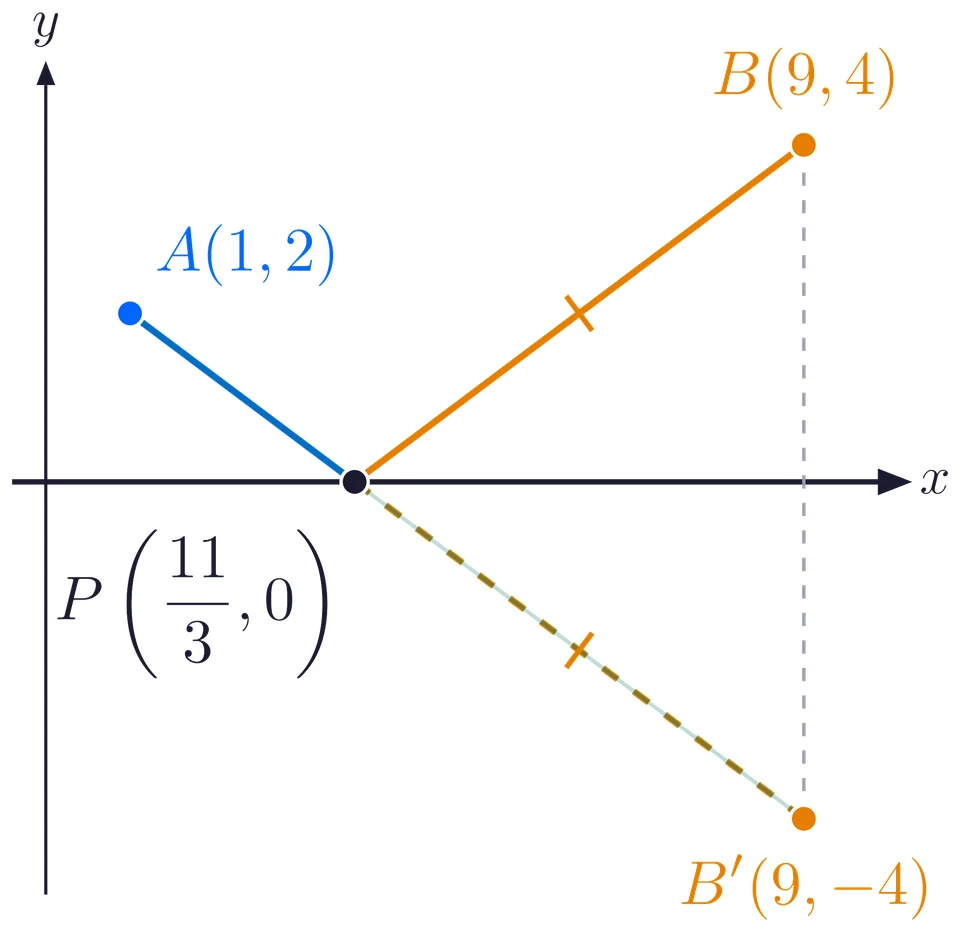
Finding \(P\). Drop perpendiculars from \(A\) and from \(B'\) to the \(x\)-axis. The two right triangles that meet at \(P\) have equal angles at \(P\), so they are similar. Their heights are \(2\) (\(A\) above the axis) and \(4\) (\(B'\) below it), so their bases are in the ratio \(1 : 2\) as well. The bases add up to \(9 - 1 = 8\), so they are \(\frac{8}{3}\) and \(\frac{16}{3}\), and \(x = 1 + \frac{8}{3} = \frac{11}{3}\). The same comes from the section formula: \(P\) divides \(AB'\) in the ratio \(2 : 4\), so \(x = \frac{4 \times 1 + 2 \times 9}{2 + 4} = \frac{22}{6} = \frac{11}{3}\).
Why the straight line is the least
For any \(P\) on the axis, the triangle inequality in triangle \(APB'\) gives \(PA + PB' \ge AB'\), with equality only when \(P\) lies on the segment \(AB'\). Since \(PB = PB'\),
\[ PA + PB \;\ge\; AB' = 10 \quad \text{for every } P, \qquad \text{equal only at } P = \left(\tfrac{11}{3}, 0\right). \]
When \(A\) and \(B\) are on opposite sides
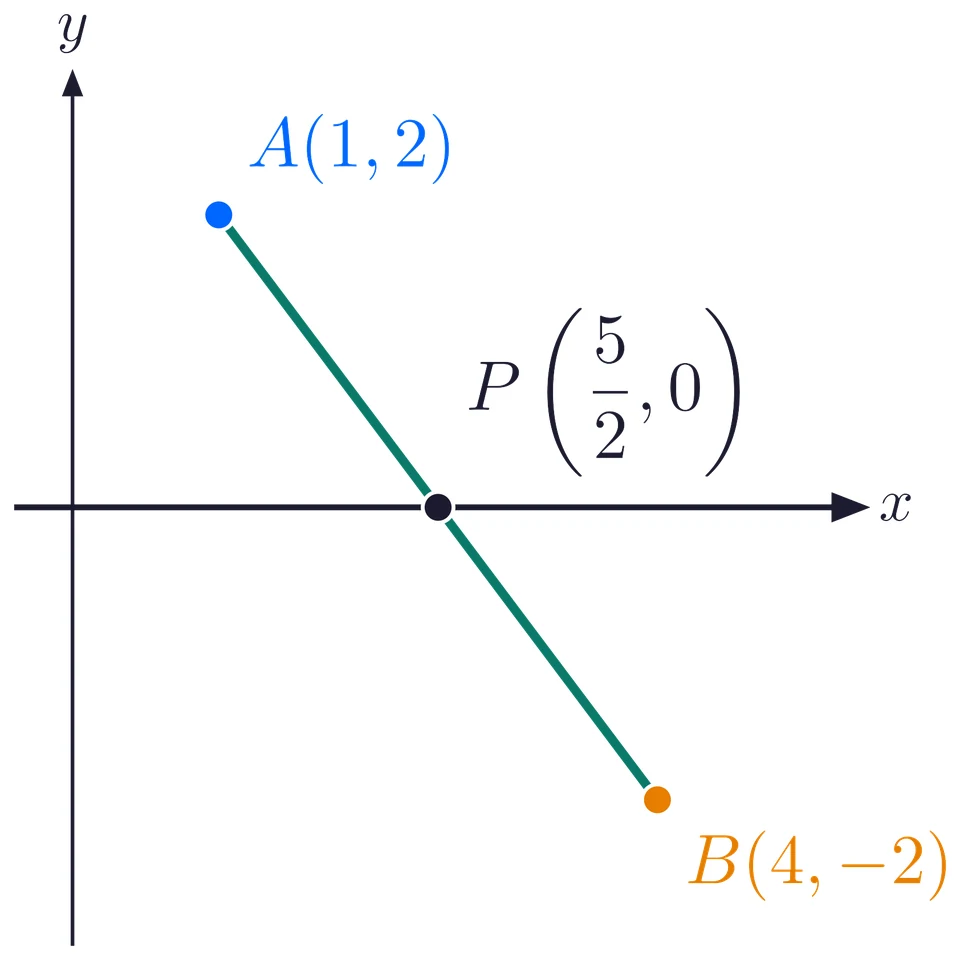
No mirror is needed. For \(A(1, 2)\) and \(B(4, -2)\) the straight segment \(AB\) already crosses the \(x\)-axis, at \(P\left(\frac{5}{2}, 0\right)\). So the least \(PA + PB\) is \(AB = 5\).
Check the side first: put both points into the line's expression. Same sign, mirror one of them; opposite signs, join them directly.
Careful
Not the straight \(AB\) when both are on one side. \(AB = \sqrt{68} \approx 8.25\) is shorter than 10, but that segment never touches the axis, so no \(P\) on the axis gives it.
Not the midpoint. \(P\) under the middle of \(A\) and \(B\), at \((5, 0)\), gives \(PA + PB \approx 10.13\). The least is at \(x = \frac{11}{3}\), nearer the point closer to the line.
Mirror in the right line. For \(P\) on the \(y\)-axis, \((x, y)\) goes to \((-x, y)\); for \(P\) on \(y = x\), \((x, y)\) goes to \((y, x)\).
Solved example
\(P\) moves on the \(y\)-axis. Find the least value of \(PA + PB\) for \(A(3, 1)\) and \(B(5, 7)\).
Same side. Both \(x\)-coordinates are positive, so mirror \(A\) in the \(y\)-axis: \(A'(-3, 1)\).
Least value. \(A'B = \sqrt{(5 + 3)^2 + (7 - 1)^2} = \sqrt{64 + 36} = 10\).
Where. The line \(A'B\) has slope \(\frac{6}{8} = \frac{3}{4}\), so at \(x = 0\), \(y = 1 + \frac{3}{4} \times 3 = \frac{13}{4}\). Check: \(PA = \frac{15}{4}\), \(PB = \frac{25}{4}\), and \(\frac{15}{4} + \frac{25}{4} = 10\).
10, at \(P\left(0, \frac{13}{4}\right)\)
Key formulas
\[ \begin{aligned}\text{least } PA + PB \text{ (same side)} &= AB', \quad B' = \text{image of } B \text{ in the line}\\[3pt] \text{image of } (x, y) \text{ in the } x\text{-axis:} &\quad (x, -y)\\[2pt] \text{in the } y\text{-axis:} &\quad (-x, y)\\[2pt] \text{in the line } y = x\text{:} &\quad (y, x)\\[3pt] \text{image of } (x_1, y_1) \text{ in } ax + by + c = 0: \quad \frac{x - x_1}{a} = \frac{y - y_1}{b} &= -\frac{2(ax_1 + by_1 + c)}{a^2 + b^2}\end{aligned} \]
Practice set
Easy to hard. \(P\) moves on the line named in each question. Try each one before you open its answer.
Quiz from the Short. \(A(0, 1)\), \(B(4, 2)\), \(P\) on the \(x\)-axis. The least value of \(PA + PB\) is: (A) \(\sqrt{17}\) (B) 5 (C) 7.
Show answer
(B) 5. Both points are above the axis, so mirror \(B\): \(B'(4, -2)\). The least value is \(AB' = \sqrt{4^2 + 3^2} = 5\), at \(P\left(\frac{4}{3}, 0\right)\). \(\sqrt{17}\) is \(AB\), which never touches the axis; 7 is the length of a path that does touch it (down to the axis, along it, up to \(B\)), but not the shortest one.
\(A(1, 1)\), \(B(4, 3)\), \(P\) on the \(x\)-axis. Find the least value of \(PA + PB\) and the point \(P\).
Show answer
5, at \(P\left(\frac{7}{4}, 0\right)\). \(B'(4, -3)\): \(AB' = \sqrt{3^2 + 4^2}\); \(AB'\) meets \(y = 0\) at \(x = 1 + \frac{3}{4}\).
\(A(1, 2)\), \(B(4, -2)\), \(P\) on the \(x\)-axis. Find the least value of \(PA + PB\) and the point \(P\).
Show answer
5, at \(P\left(\frac{5}{2}, 0\right)\). Opposite sides: no mirror. \(AB = \sqrt{3^2 + 4^2}\), and \(AB\) crosses the axis at \(x = \frac{5}{2}\).
\(A(1, 2)\), \(B(2, 6)\), \(P\) on the \(y\)-axis. Find the least value of \(PA + PB\) and the point \(P\).
Show answer
5, at \(P\left(0, \frac{10}{3}\right)\). Mirror \(A\) in the \(y\)-axis: \(A'(-1, 2)\), \(A'B = \sqrt{3^2 + 4^2}\); at \(x = 0\), \(y = 2 + \frac{4}{3}\).
Find the mirror image of \((3, 4)\) in the line \(y = x\), and in the line \(x + y = 1\).
Show answer
\((4, 3)\) and \((-3, -2)\). In \(y = x\) swap the coordinates. In \(x + y - 1 = 0\): \(-\frac{2(3 + 4 - 1)}{2} = -6\), so \((3 - 6, 4 - 6)\). Check: the midpoint \((0, 1)\) is on the line.
\(A(4, 1)\), \(B(5, 2)\), \(P\) on the line \(y = x\). Find the least value of \(PA + PB\) and the point \(P\).
Show answer
\(2\sqrt{5}\), at \(P(3, 3)\). \(y - x\) is \(-3\) at both points (same side). \(B'(2, 5)\), \(AB' = \sqrt{2^2 + 4^2} = 2\sqrt{5}\); \(AB'\) meets \(y = x\) at \((3, 3)\).