
The doubt
Take \(x = 2\). Then \(\sin 2 \approx 0.909\), but \(\sin^{-1}(0.909) \approx 1.14\), not \(2\). Many angles have the same sine, and \(\sin^{-1}\) gives only one of them: the angle from \(-\dfrac{\pi}{2}\) to \(\dfrac{\pi}{2}\). So \(\sin^{-1}(\sin x) = x\) only when \(x\) is already in that range. For any other \(x\), find the angle in that range with the same sine.
Here \(x\) is an angle in radians. A half turn is \(\pi\), about \(3.14\), so \(2\) radians is about \(115^\circ\). The principal value \(\sin^{-1} y\) is the one angle \(\theta\) with \(-\dfrac{\pi}{2} \le \theta \le \dfrac{\pi}{2}\) and \(\sin\theta = y\); it is defined for \(-1 \le y \le 1\).
Many angles, one sine
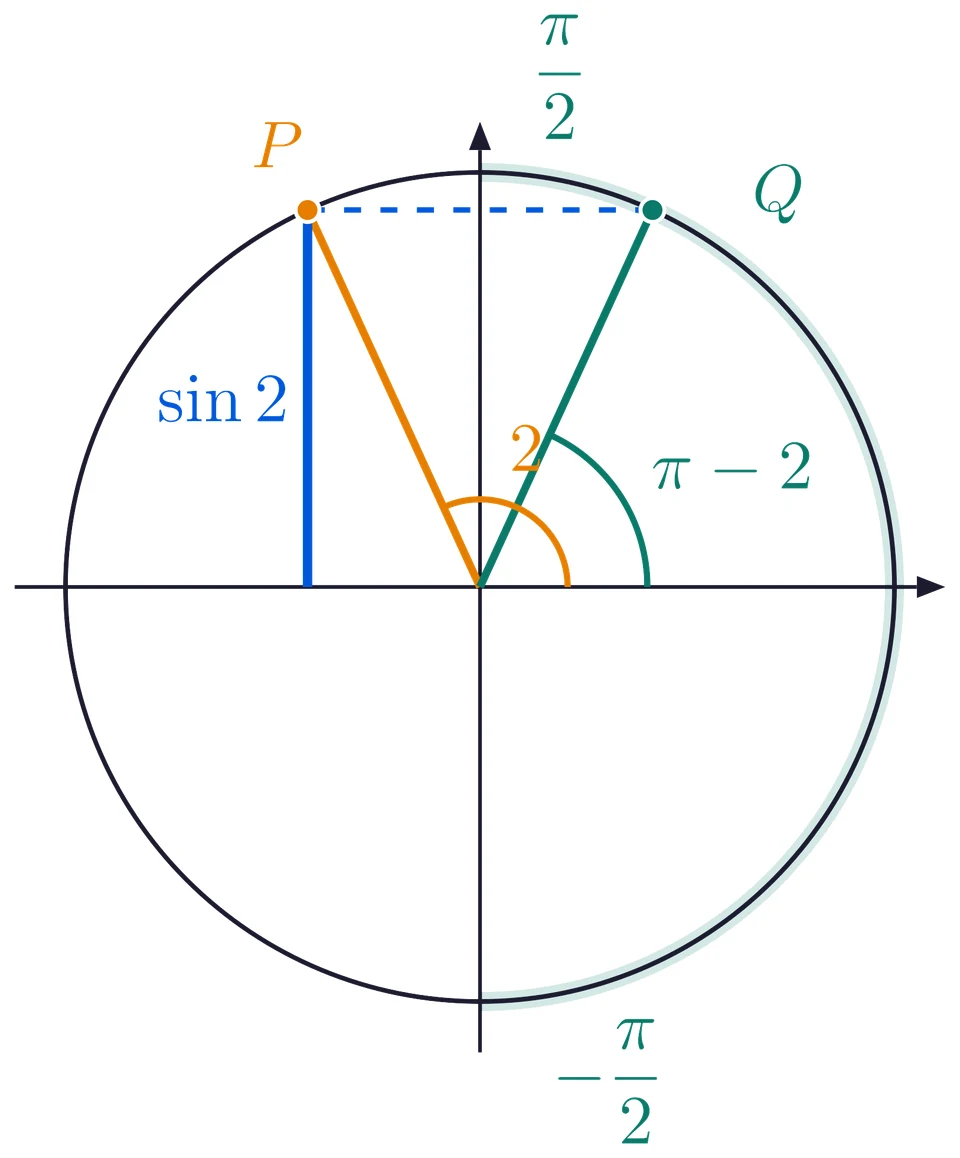
On a circle of radius \(1\), the point \(P\) at angle \(2\) has height \(\sin 2 \approx 0.909\).
Mirror \(P\) in the vertical axis. It lands on \(Q\), at angle \(\pi - 2\), at the same height. So \(\sin(\pi - 2) = \sin 2\). One full turn more also ends at \(P\): \(\sin(2 + 2\pi) = \sin 2\). Many angles have this same sine.
\(\sin^{-1}\) answers on the right half
On the right half of the circle, from \(-\dfrac{\pi}{2}\) to \(\dfrac{\pi}{2}\), every height from \(-1\) to \(1\) comes exactly once. \(Q\) is there, so \(\sin^{-1}(\sin 2) = \pi - 2 \approx 1.14\).
The zigzag graph
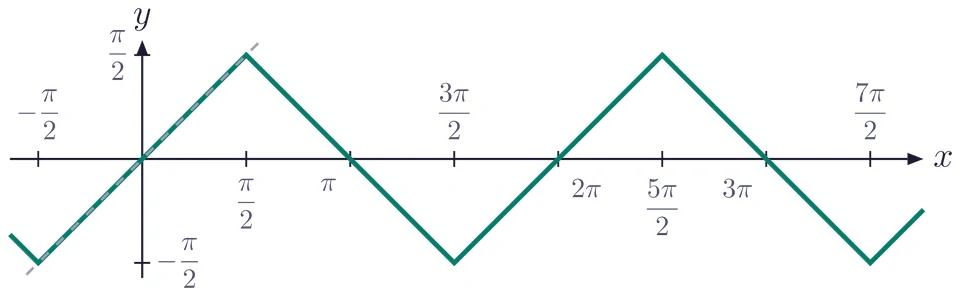
Now let \(x\) move. From \(-\dfrac{\pi}{2}\) to \(\dfrac{\pi}{2}\) the answer is \(x\) itself. From \(\dfrac{\pi}{2}\) to \(\dfrac{3\pi}{2}\) the point \(P\) is on the left half, the answer is \(\pi - x\), and it falls. Then it rises again as \(x - 2\pi\), and so on. The graph of \(y = \sin^{-1}(\sin x)\) is a zigzag. It never goes above \(\dfrac{\pi}{2}\) or below \(-\dfrac{\pi}{2}\), and it meets the dashed line \(y = x\) only from \(-\dfrac{\pi}{2}\) to \(\dfrac{\pi}{2}\).
Reading the zigzag
Every piece crosses the \(x\)-axis at a multiple of \(\pi\) and has slope \(1\) or \(-1\). The corners are at odd multiples of \(\dfrac{\pi}{2}\).
- \(x\) from \(-\dfrac{\pi}{2}\) to \(\dfrac{\pi}{2}\): \(y = x\)
- \(x\) from \(\dfrac{\pi}{2}\) to \(\dfrac{3\pi}{2}\): \(y = \pi - x\)
- \(x\) from \(\dfrac{3\pi}{2}\) to \(\dfrac{5\pi}{2}\): \(y = x - 2\pi\)
- \(x\) from \(\dfrac{5\pi}{2}\) to \(\dfrac{7\pi}{2}\): \(y = 3\pi - x\)
From the video
Find \(\sin^{-1}(\sin 10)\).
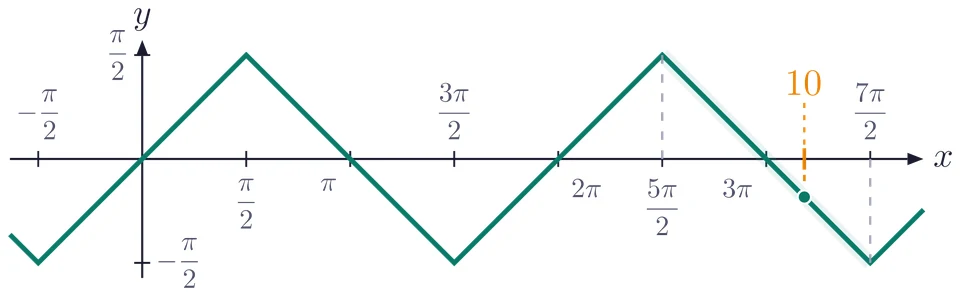
Where is \(10\)? \(\dfrac{5\pi}{2} \approx 7.85\) and \(\dfrac{7\pi}{2} \approx 11.0\), so \(10\) lies between them.
The piece. It crosses the \(x\)-axis at \(3\pi\) and falls: \(y = 3\pi - x\).
Check. \(3\pi - 10 \approx -0.58\), which lies from \(-\dfrac{\pi}{2}\) to \(\dfrac{\pi}{2}\).
\(\sin^{-1}(\sin 10) = 3\pi - 10 \approx -0.58\)
Careful
\(\sin^{-1}(\sin 10)\) is not \(10\). The answer of \(\sin^{-1}\) always lies from \(-\dfrac{\pi}{2}\) to \(\dfrac{\pi}{2}\), and \(10\) does not. Cancelling \(\sin^{-1}\) with \(\sin\) works only when \(x\) is already in that range.
Find the piece of the zigzag that holds \(x\), then use its line.
Key formulas
- Range of \(\sin^{-1}\): from \(-\dfrac{\pi}{2}\) to \(\dfrac{\pi}{2}\).
- Same sine: \(\sin(\pi - x) = \sin x\) and \(\sin(x + 2\pi) = \sin x\).
- \(\sin^{-1}(\sin x) = x\) only for \(-\dfrac{\pi}{2} \le x \le \dfrac{\pi}{2}\).
- Corners of the zigzag: at odd multiples of \(\dfrac{\pi}{2}\).
- Rising piece through \(n\pi\), \(n\) even: \(y = x - n\pi\). Falling piece through \(n\pi\), \(n\) odd: \(y = n\pi - x\).
Practice set
Easy to hard. For each, find the piece of the zigzag that holds \(x\) and use its line. Question 1 is the quiz at the end of the video. Take \(\pi \approx 3.1416\). Try each one before you open its answer.
What is \(\sin^{-1}(\sin 4)\)? (A) \(4\) (B) \(\pi - 4\) (C) \(4 - \pi\)
Show answer
(B) \(\pi - 4\). \(4\) lies from \(\dfrac{\pi}{2} \approx 1.57\) to \(\dfrac{3\pi}{2} \approx 4.71\): the piece \(y = \pi - x\). So the answer is \(\pi - 4 \approx -0.86\). (A): \(4\) is not from \(-\dfrac{\pi}{2}\) to \(\dfrac{\pi}{2}\). (C): \(\sin(4 - \pi) = -\sin 4\), the wrong sign.
Find \(\sin^{-1}\left(\sin \dfrac{2\pi}{3}\right)\).
Show answer
\(\dfrac{\pi}{3}\). \(\dfrac{2\pi}{3}\) is more than \(\dfrac{\pi}{2}\), so it is not the answer. It lies on the piece \(y = \pi - x\): \(\pi - \dfrac{2\pi}{3} = \dfrac{\pi}{3}\).
Find \(\sin^{-1}(\sin 3)\).
Show answer
\(\pi - 3 \approx 0.14\). \(3\) lies from \(\dfrac{\pi}{2}\) to \(\dfrac{3\pi}{2}\), on the piece \(y = \pi - x\).
Find \(\sin^{-1}(\sin 6)\).
Show answer
\(6 - 2\pi \approx -0.28\). \(6\) lies from \(\dfrac{3\pi}{2} \approx 4.71\) to \(\dfrac{5\pi}{2} \approx 7.85\). That piece crosses the \(x\)-axis at \(2\pi\) and rises: \(y = x - 2\pi\).
Find \(\sin^{-1}(\sin(-2))\).
Show answer
\(2 - \pi \approx -1.14\). \(-2\) lies from \(-\dfrac{3\pi}{2}\) to \(-\dfrac{\pi}{2}\). That piece crosses at \(-\pi\) and falls: \(y = -\pi - x\), and \(-\pi - (-2) = 2 - \pi\).
Find \(\sin^{-1}(\sin 12)\).
Show answer
\(12 - 4\pi \approx -0.57\). \(\dfrac{7\pi}{2} \approx 11.00\) and \(\dfrac{9\pi}{2} \approx 14.14\). That piece crosses at \(4\pi\) and rises: \(y = x - 4\pi\).
For which \(x\) from \(0\) to \(2\pi\) is \(\sin^{-1}(\sin x) = \pi - x\)?
Show answer
\(\dfrac{\pi}{2} \le x \le \dfrac{3\pi}{2}\). That is the falling piece through \(\pi\). On the rest of \(0\) to \(2\pi\) the zigzag follows another line.
For which real \(x\) is \(\sin^{-1}(\sin x) = x\)?
Show answer
\(-\dfrac{\pi}{2} \le x \le \dfrac{\pi}{2}\). Only there does the zigzag lie on the line \(y = x\). Outside it, \(x\) is beyond the range of \(\sin^{-1}\).