
The doubt
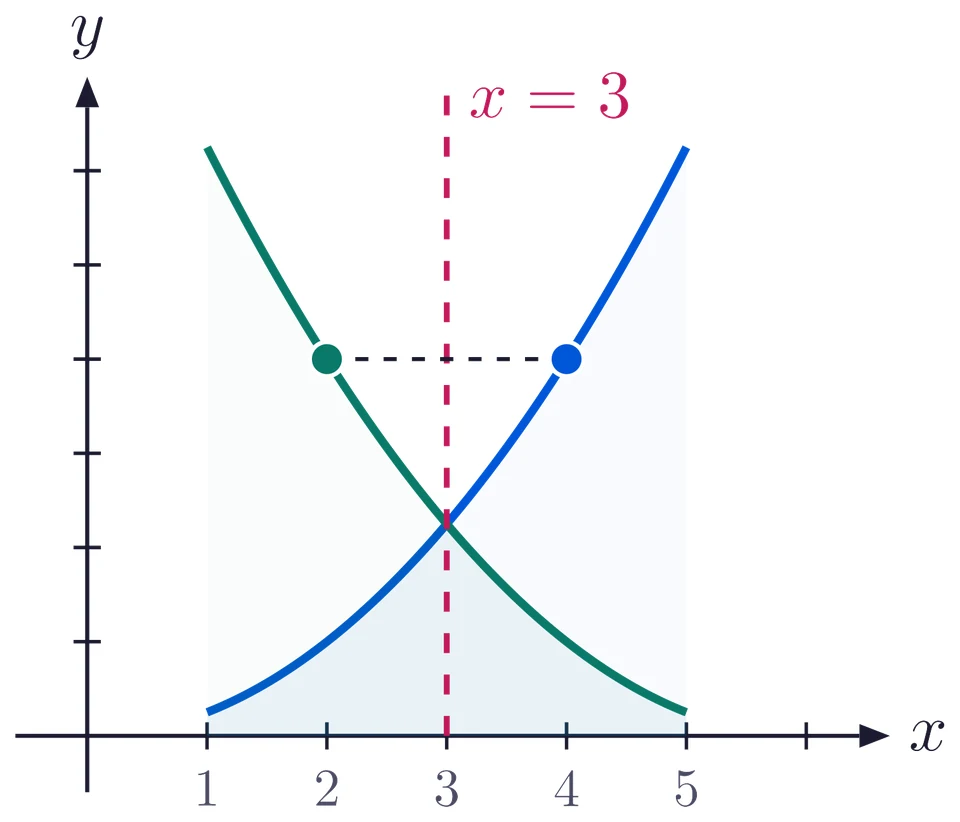
The graphs of \(f(x)\) and \(f(a + b - x)\) are different, but from \(a\) to \(b\) their areas are equal. The reason: \(x\) and \(a + b - x\) are always the same distance from the middle, \(\dfrac{a + b}{2}\). So the graph of \(f(a + b - x)\) is the mirror image of the graph of \(f\) in the line \(x = \dfrac{a + b}{2}\). The region turns over that line like a page, and its area does not change. This result is often called the King's property.
For \(f(x) \ge 0\), the integral of \(f(x)\) from \(a\) to \(b\) is the area under the graph of \(f\) from \(x = a\) to \(x = b\). The middle line \(x = \dfrac{a + b}{2}\) is the line halfway between \(a\) and \(b\); the average of \(x\) and \(a + b - x\) is always \(\dfrac{a + b}{2}\).
The mirror picture
Take \(f(x) = \dfrac{x^2}{4}\) with \(a = 1\) and \(b = 5\). Here \(a + b - x = 6 - x\), so the new function is \(f(6 - x)\).
At \(x = 2\), \(6 - x = 4\), so the new function is \(f(4) = 4\). The new graph takes the height of \(f\) at \(4\) and carries it across to \(2\). Both \(2\) and \(4\) are \(1\) unit from \(3\), the middle of \(1\) and \(5\).
The graph of \(f(a + b - x)\) is a mirror image
It is the mirror image of the graph of \(f\) in the line \(x = \dfrac{a + b}{2}\). The ends swap: the height at \(a\) moves to \(b\), and the height at \(b\) moves to \(a\). A region that is turned over keeps its area, so both integrals are \(\dfrac{31}{3}\) here.
The same result by algebra
Substitution \(t = a + b - x\)
Then \(dt = -dx\). When \(x = a\), \(t = b\); when \(x = b\), \(t = a\). So
\[ \int_a^b f(a + b - x)\,dx = \int_b^a f(t)\,(-dt) = \int_a^b f(t)\,dt = \int_a^b f(x)\,dx . \]The minus sign swaps the limits back, and the letter inside a definite integral does not change its value. This holds for every \(f\) that is continuous on \([a, b]\).
From the video
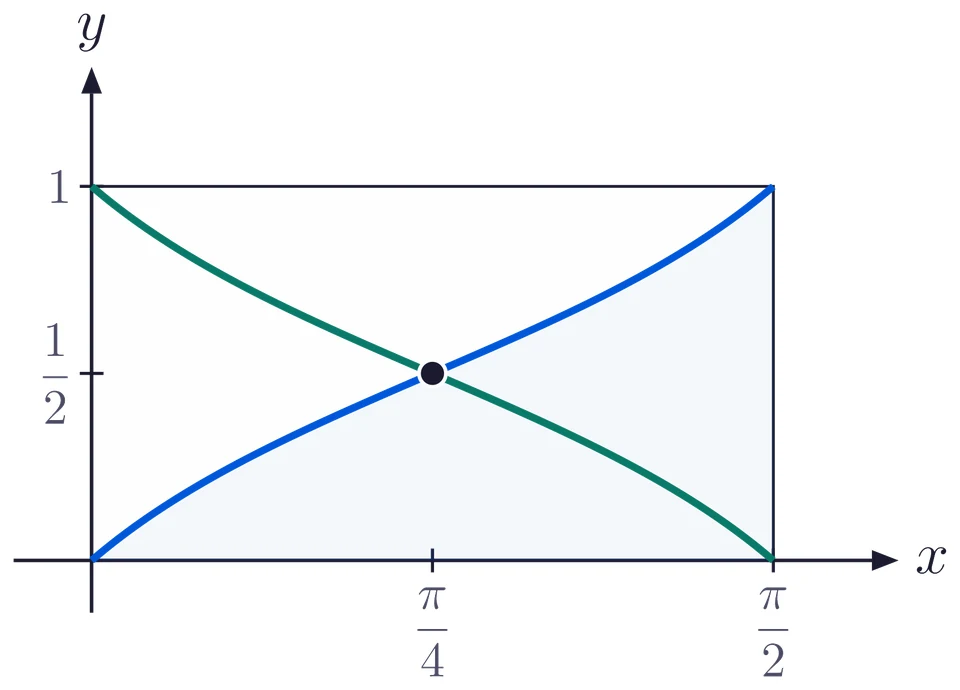
Evaluate \(I = \displaystyle\int_0^{\pi/2} \frac{\sin x}{\sin x + \cos x}\,dx\).
Mirror it. Here \(a + b = \dfrac{\pi}{2}\). Replace \(x\) by \(\dfrac{\pi}{2} - x\): \(\sin x\) becomes \(\cos x\) and \(\cos x\) becomes \(\sin x\). So, as well,
\[ I = \int_0^{\pi/2} \frac{\cos x}{\cos x + \sin x}\,dx . \]Add the two forms. At every \(x\) the two heights add up to \(\dfrac{\sin x + \cos x}{\sin x + \cos x} = 1\). So \(2I\) is the area of a rectangle of height \(1\) and width \(\dfrac{\pi}{2}\): \(2I = \dfrac{\pi}{2}\).
\(I = \dfrac{\pi}{4}\)
Careful
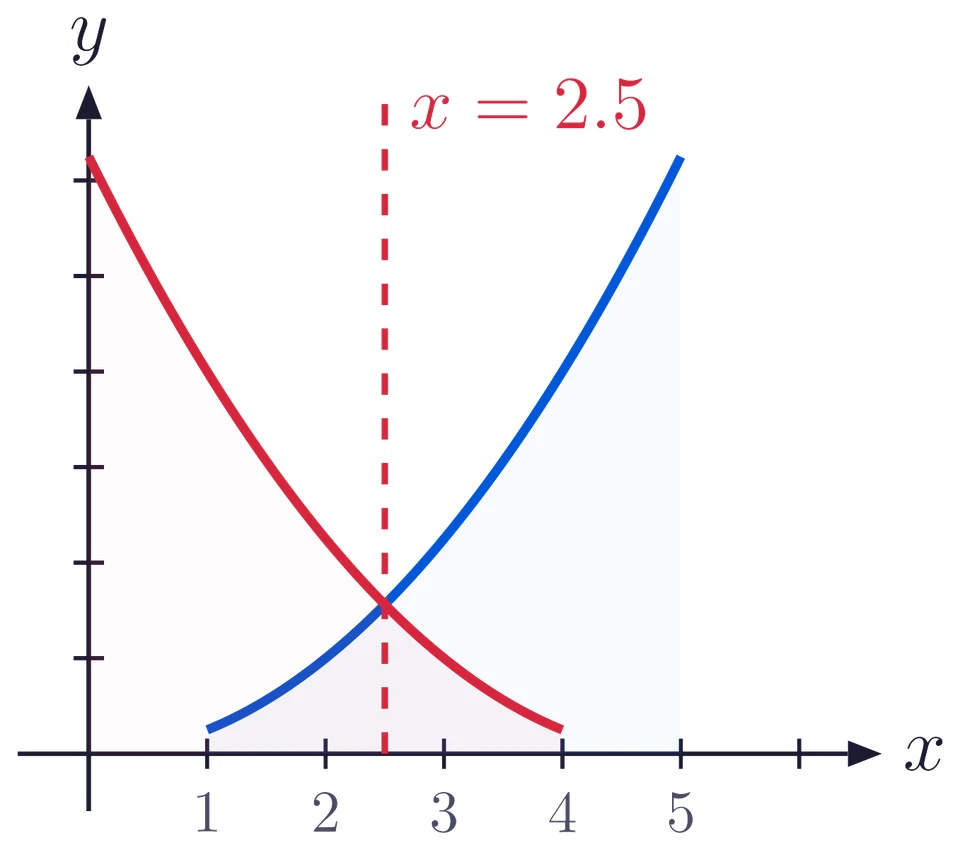
Replace \(x\) by \(a + b - x\), not by \(b - x\). For the limits \(1\) and \(5\), the function \(f(5 - x)\) turns the region over \(x = 2.5\), not over the middle line \(x = 3\). The region moves to \(0\) to \(4\), off the limits, and the area changes: \(\dfrac{16}{3}\) instead of \(\dfrac{31}{3}\). \(b - x\) is right only when \(a = 0\).
Lower limit plus upper limit, minus \(x\).
Key formulas
- King's property: \(\displaystyle\int_a^b f(x)\,dx = \int_a^b f(a + b - x)\,dx\).
- When \(a = 0\): \(\displaystyle\int_0^c f(x)\,dx = \int_0^c f(c - x)\,dx\).
- Add the two forms: \(2I = \displaystyle\int_a^b \big[f(x) + f(a + b - x)\big]\,dx\).
- If \(f(x) + f(a + b - x) = 1\), then \(I = \dfrac{b - a}{2}\).
Practice set
Easy to hard. In each, replace \(x\) by \(a + b - x\), then add the two forms of \(I\). Question 1 is the quiz at the end of the video. Try each one before you open its answer.
What is \(\displaystyle\int_2^4 \frac{\sqrt{x}}{\sqrt{x} + \sqrt{6 - x}}\,dx\)? (A) \(2\) (B) \(1\) (C) \(3\)
Show answer
(B) \(1\). \(a + b = 6\): the mirror is \(\dfrac{\sqrt{6 - x}}{\sqrt{6 - x} + \sqrt{x}}\), and the two add to \(1\). So \(2I = 4 - 2 = 2\) and \(I = 1\). (A) is \(2I\), not halved.
Evaluate \(\displaystyle\int_0^{\pi/2} \frac{\cos x}{\sin x + \cos x}\,dx\).
Show answer
\(\dfrac{\pi}{4}\). It is the mirror form of the example, so it has the same value: \(2I = \dfrac{\pi}{2}\).
Evaluate \(\displaystyle\int_0^{\pi/2} \frac{\sqrt{\sin x}}{\sqrt{\sin x} + \sqrt{\cos x}}\,dx\).
Show answer
\(\dfrac{\pi}{4}\). Replace \(x\) by \(\dfrac{\pi}{2} - x\): \(\sin\) and \(\cos\) swap. The two forms add to \(1\), so \(2I = \dfrac{\pi}{2}\).
Evaluate \(\displaystyle\int_1^3 \frac{x^2}{x^2 + (4 - x)^2}\,dx\).
Show answer
\(1\). \(a + b = 4\): the mirror is \(\dfrac{(4 - x)^2}{(4 - x)^2 + x^2}\). The two add to \(1\), so \(2I = 3 - 1 = 2\).
Evaluate \(\displaystyle\int_0^{\pi} x \sin x\,dx\) using the property.
Show answer
\(\pi\). The mirror is \((\pi - x)\sin(\pi - x) = (\pi - x)\sin x\). Adding, \(2I = \pi\displaystyle\int_0^{\pi} \sin x\,dx = 2\pi\).
Evaluate \(\displaystyle\int_0^{\pi/2} \sin^2 x\,dx\) using the property.
Show answer
\(\dfrac{\pi}{4}\). The mirror of \(\sin^2 x\) is \(\cos^2 x\), and \(\sin^2 x + \cos^2 x = 1\). So \(2I = \dfrac{\pi}{2}\).
With \(f(x) = \dfrac{x^2}{4}\), which one is equal to \(\displaystyle\int_1^5 f(x)\,dx\)? (A) \(\displaystyle\int_1^5 f(5 - x)\,dx\) (B) \(\displaystyle\int_1^5 f(6 - x)\,dx\) (C) \(\displaystyle\int_1^5 f(4 - x)\,dx\)
Show answer
(B). \(a + b = 1 + 5 = 6\). (A) gives \(\dfrac{16}{3}\) and (C) gives \(\dfrac{7}{3}\); only (B) gives \(\dfrac{31}{3}\).
Evaluate \(\displaystyle\int_0^{\pi/4} \ln(1 + \tan x)\,dx\).
Show answer
\(\dfrac{\pi}{8}\ln 2 \approx 0.272\). \(1 + \tan\left(\dfrac{\pi}{4} - x\right) = \dfrac{2}{1 + \tan x}\), so the two forms add to \(\ln 2\). \(2I = \dfrac{\pi}{4}\ln 2\).