
Every battery has a small resistance \(r\) inside it. When the battery drives a current \(I\), a voltage \(Ir\) is used up across \(r\), so the voltage across its ends is \(V = E - Ir\), less than its emf \(E\). The two are equal only when no current flows.
Emf, \(E\)
The voltage a battery gives when no current flows: what an ideal voltmeter reads across it on its own. The 12 V marked on a battery is its emf.
It does not change with the current.
Terminal voltage, \(V\)
The voltage across the battery's two ends while it drives a current \(I\): \(V = E - Ir\).
It falls as the current grows.
Where the 2 V goes: one circuit
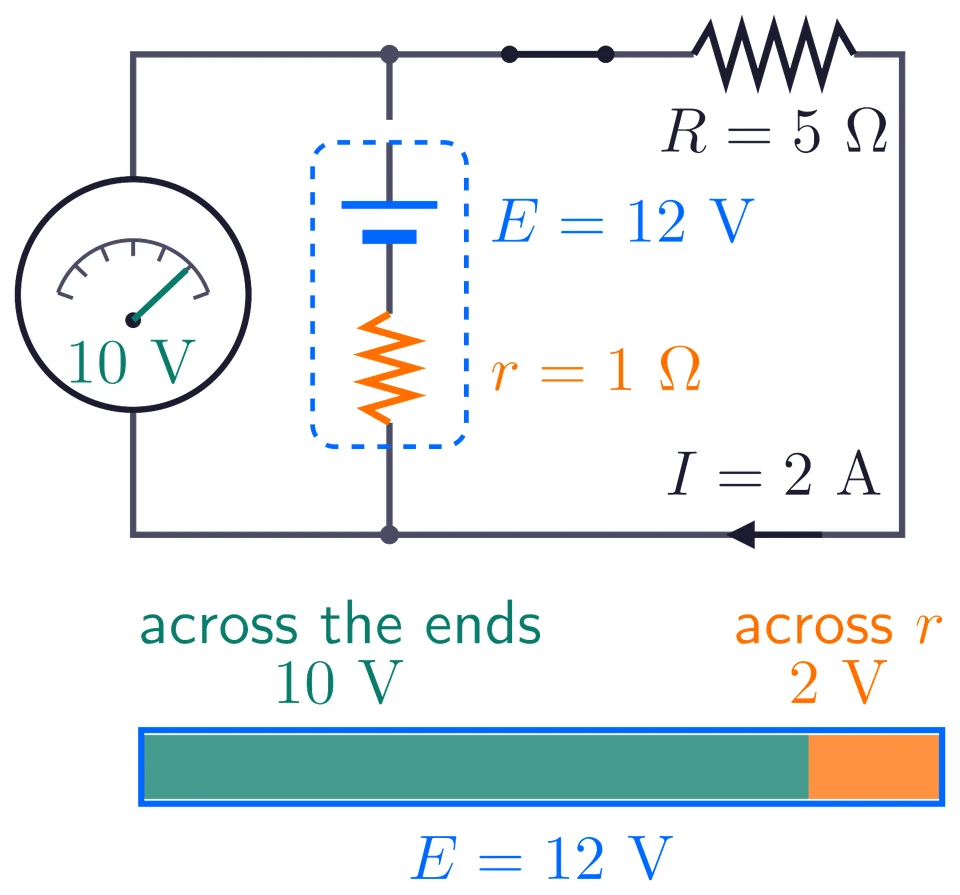
A battery of emf \(E = 12\) V with internal resistance \(r = 1\ \Omega\) drives a current through \(R = 5\ \Omega\).
The same current flows through \(R\) and \(r\), which are in series: \(I = \dfrac{E}{R + r} = \dfrac{12}{5 + 1} = 2\) A.
Across \(r\), inside the battery: \(Ir = 2 \times 1 = 2\) V, used up as heat in the battery.
Left across the ends: \(V = 12 - 2 = 10\) V. This is also \(IR = 2 \times 5\), the voltage across \(R\), and it is what the voltmeter reads.
Open the switch
With the switch open, \(I = 0\), so \(Ir = 0\) and the voltmeter reads \(V = E = 12\) V. This is why the emf is the reading with no current.
The voltage against the current
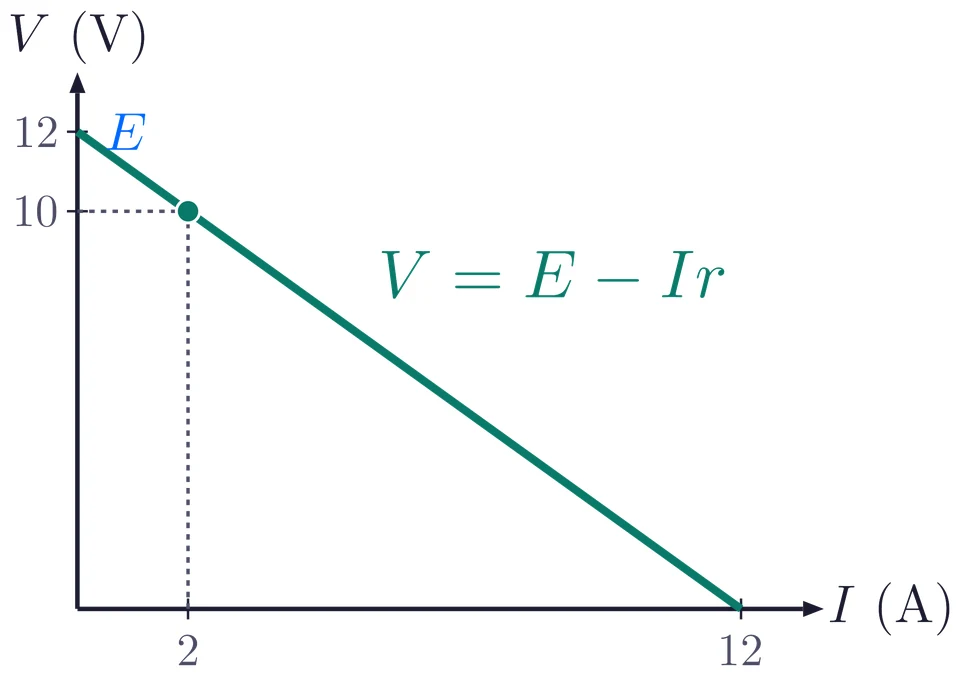
\(V = E - Ir\) is a straight line on a graph of \(V\) against \(I\).
It meets the \(V\)-axis at \(E\) (no current) and falls by \(r\) for every ampere: its slope is \(-r\). At \(I = 2\) A it gives 10 V.
It reaches \(V = 0\) at \(I = \dfrac{E}{r} = 12\) A, the largest current the battery can drive: its ends joined by a thick wire (a short circuit).
Careful
The label is not the voltage you get. A battery marked 12 V gives 12 V across its ends only when no current flows. The more current it drives, the less it gives.
\(V = E - Ir\) is for a battery driving the current. When another source pushes current into it (charging), the current goes the other way through \(r\) and \(V = E + Ir\).
Solved example
A cell of emf 3 V and internal resistance \(1\ \Omega\) is joined to a \(5\ \Omega\) resistor. Find the current and the voltage across the cell's ends.
Current. \(I = \dfrac{E}{R + r} = \dfrac{3}{5 + 1} = 0.5\) A.
Ends. \(V = E - Ir = 3 - 0.5 \times 1 = 2.5\) V. Check: \(IR = 0.5 \times 5 = 2.5\) V.
0.5 A; 2.5 V
Key formulas
\[ \begin{aligned}\text{current in the circuit} &= \frac{E}{R + r}\\[3pt] \text{voltage across the ends (driving the current)} &= E - Ir = IR\\[3pt] \text{voltage across the ends (being charged)} &= E + Ir\\[3pt] \text{short-circuit current} &= \frac{E}{r}\end{aligned} \]
Practice set
Easy to hard. The voltmeter is ideal (it draws no current). Try each one before you open its answer.
Quiz from the Short. A battery has \(E = 6\) V and \(r = 0.5\ \Omega\), and the current is 2 A. What does a voltmeter across its ends read? (A) 6 V (B) 5 V (C) 1 V.
Show answer
(B) 5 V. The voltage used up inside is \(Ir = 2 \times 0.5 = 1\) V, so \(V = E - Ir = 6 - 1 = 5\) V. 6 V forgets \(r\); 1 V is \(Ir\) alone.
A cell of emf 1.5 V and internal resistance \(0.5\ \Omega\) is joined to a \(2.5\ \Omega\) resistor. Find the current and the voltage across the cell's ends.
Show answer
0.5 A; 1.25 V. \(I = \dfrac{1.5}{2.5 + 0.5} = 0.5\) A; \(V = 1.5 - 0.5 \times 0.5 = 1.25\) V \(= 0.5 \times 2.5\).
A voltmeter reads 9 V across a battery on its own and 8 V when the battery drives a current of 0.5 A. Find the emf and the internal resistance.
Show answer
\(E = 9\) V; \(r = 2\ \Omega\). With no current the voltmeter reads \(E\). Then \(8 = 9 - 0.5\,r\), so \(r = 2\ \Omega\).
A battery has \(E = 12\) V and \(r = 2\ \Omega\). What resistance must be joined to it so that the voltage across its ends is 9 V?
Show answer
\(6\ \Omega\). \(Ir = 12 - 9 = 3\) V, so \(I = \dfrac{3}{2} = 1.5\) A and \(R = \dfrac{9}{1.5} = 6\ \Omega\).
A battery of emf 12 V and internal resistance \(0.5\ \Omega\) has its ends joined by a thick wire of negligible resistance. Find the current and the voltage across its ends.
Show answer
24 A; 0 V. \(I = \dfrac{E}{r} = \dfrac{12}{0.5} = 24\) A. All 12 V is used up inside: \(Ir = 12\) V, so \(V = 0\).
A battery of emf 12 V and internal resistance \(1\ \Omega\) is being charged by a current of 2 A. Find the voltage across its ends.
Show answer
14 V. While being charged, the current enters at the \(+\) end, so \(V = E + Ir = 12 + 2 \times 1 = 14\) V.